

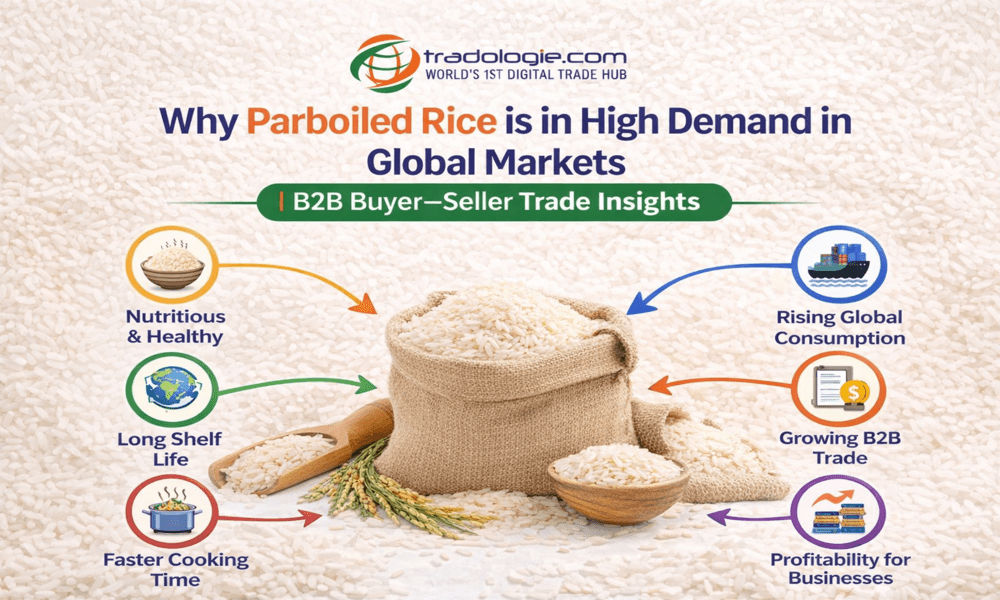
The world market for parboiled rice is in a stage of rapid evolution. The peculiar nature of its physical properties and increased concerns of consumers about health issues have enabled it to emerge as a crop not only with utility value but also with a firm position in world trade. To players in this world of business-to-business marketing, high demand is positioned at a crossroads of premiumisation of generic foods and food security trends.
1. Global Demand Drivers
The rise in demand is fuelled by three main factors: nutritional superiority, logistical resilience, and culinary versatility.
- Change in “The Healthy Staple”: Refined white rice consumption is gradually declining among today’s consumers. By forcing the vitamins from the husk into the rice, the parboiling process raises the concentration of iron, magnesium, and vitamin B. Additionally, it is a popular choice for the growing number of people in the Middle East and the West who are aware of diabetes due to its lower Glycaemic Index.
- Operational Efficiency for HORECA: In the hotel, restaurant, and catering (HORECA) industry, parboiled rice is considered the benchmark. The steaming stage initiates gelatinisation of starch. This ensures that the rice is firm, fluffy, and not sticky even when stored for a long period in the steam table.
- Extended Shelf Life: Being resistant to weevils and spoilage, parboiled rice is the best and ideal choice to exchange over large distances via sea routes compared to brown rice, which spoils because of its bran, and to white rice, which is more likely to store insects.
2. Regional Demand Analysis: A Tale of Two Markets
To navigate this trade, one must recognise that demand is split between high-volume commodity buying and high-margin speciality sourcing.
|
Region |
Primary Grade Demand |
Market Driver |
|
West Africa (Nigeria, Benin, Togo) |
IR-64 Parboiled (5% to 25% Broken) |
Food security, affordability, and a cultural preference for the firm texture of parboiled grains. |
|
GCC & Middle East (Saudi Arabia, UAE, Iraq) |
High-end culinary applications (Biryani/Mandi) where grain length and aesthetic “golden” hue are paramount. |
|
|
European Union |
PR-11, Organic Parboiled |
Health trends and stringent MRL (Maximum Residue Level) compliance are used largely in ready-to-eat meals. |
|
North America |
Long Grain Parboiled / Converted Rice |
Driven by the growing ethnic food sector and the demand for “fail-safe” rice that doesn’t overcook. |
3. Market Confidence for Buyers: Sourcing with Certainty
In a market characterised by fluctuating export duties—particularly out of India—buyers must focus on Contractual Specifications to ensure value:
- The Sortex Advantage: In 2026, “field quality” is no longer the standard. Parboiled Rice Buyers should insist on 100% Sortex-cleaned rice to ensure the absence of black grains and stones, which is critical for retail-ready packaging.
- Moisture Stabilisation: Contracts should strictly mandate a maximum 14% moisture content. Anything higher poses a significant risk of fungal growth during the 30–45 day transit times typical of deep-sea routes.
4. Opportunities for Sellers: The Digital Pivot
For suppliers, the “old-school” method of relying on local brokers is being replaced by Agri-B2B Digital Platforms. These platforms act as a catalyst for export growth by providing:
- Verified Lead Generation: Here, Rice Sellers do not have to waste time responding to every lead and instead bid straight on verified and pre-approved international importers’ RFQs.
- Credential Transparency: Modern platforms enable exporters to display their ISO 22000, HACCP, and APEDA certifications, thereby establishing the trust required to win large sales.
- Logistical Integration: Today’s digital trade hubs frequently combine freight and inspection services, allowing smaller mills to compete on a global scale using a CNF/CIF model.
5. Conclusion
The requirement for parboiled rice represents a paradigm shift in global rice consumption patterns, rather than a seasonal increase. Buyers can reduce their purchase costs by understanding the differences between the best Sella varieties and standard IR-64 Rice. On the other hand, suppliers will be in the best position to capitalise on the increasing market share in Africa and the Middle East if they embrace transparency and quality grading.
