

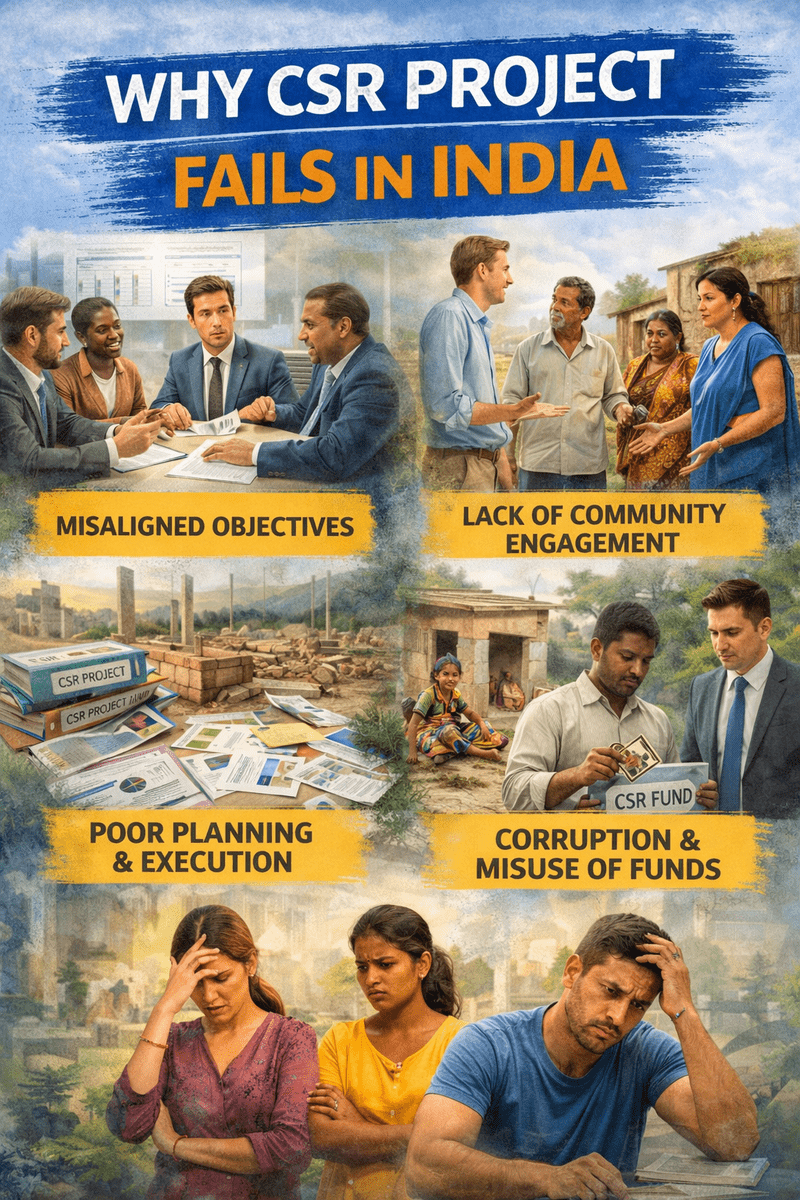
Corporate Social Responsibility (CSR) has become a mandatory and strategic priority for businesses in India. Every year , thousands of crores are allocated toward social development projects across healthcare, education, environment, and livelihoods. Yet, despite increasing CSR expenditure, many projects fail to deliver real and sustainable impact. According to Dr. Soumitro Chakraborty, CEO of Fiinovation , the problem often lies not in intent or budget, but in planning, execution, and impact measurement.
Lack of Clear Problem Identification
One of the primary reasons CSR projects underperform is poor problem identification. Many initiatives are designed without conducting proper needs assessments or baseline studies. When projects are planned without understanding local challenges, they often address symptoms rather than root causes. As a result, interventions fail to create lasting change and communities remain dependent instead of empowered.
Compliance-Driven Approach to CSR
Another major issue is treating CSR as a compliance obligation rather than a strategic responsibility. When the focus is only on meeting statutory spending requirements, projects are rushed, short-term, and poorly aligned with community needs. Dr. Chakraborty emphasizes that CSR should be viewed as a long-term investment in social development, not merely a financial checkbox under the Companies Act.
Weak NGO Due Diligence
CSR success depends heavily on the strength of implementing partners. Many CSR projects fail because of inadequate NGO due diligence. Without evaluating an NGO’s governance, financial transparency, field capacity, and past performance, corporates risk partnering with organizations that are unable to deliver outcomes effectively. Weak implementation structures often lead to delays, misuse of funds, or incomplete projects.
Absence of Impact Measurement
A common mistake in CSR planning is focusing on activities instead of outcomes. Reporting numbers such as beneficiaries reached or funds spent does not reflect real impact. Effective CSR requires measuring changes in behavior, access, quality of life, or sustainability. Without impact measurement frameworks, companies are unable to assess whether their CSR initiatives are making a meaningful difference.
Short-Term Project Cycles
Many CSR projects are designed for short durations, often limited to one financial year. Social change, however, requires time. Short-term funding restricts continuity and prevents initiatives from achieving scale or sustainability. According to Dr. Chakraborty, long-term project planning with phased implementation leads to stronger outcomes and better community ownership.
Poor Monitoring and Governance
Lack of regular monitoring and weak governance structures also contribute to CSR failure. Without ongoing tracking, issues at the ground level remain unnoticed until it is too late. Strong monitoring mechanisms, periodic evaluations, and transparent reporting are essential to ensure projects stay aligned with objectives and budgets.
Misalignment With Core Expertise
CSR projects that are disconnected from a company’s core values or expertise often struggle. When businesses leverage their industry knowledge, technology, or resources, CSR initiatives become more innovative and impactful. Strategic alignment helps create shared value for both the company and society.
Role of Professional CSR Consultants
Dr. Soumitro Chakraborty highlights the importance of professional CSR advisory support to avoid these pitfalls. Expert consultants help in needs assessment, partner evaluation, project design, compliance management, and impact assessment. Structured CSR planning ensures that investments translate into measurable and sustainable social outcomes.
The Way Forward
For CSR to deliver real impact, companies must shift from spend-focused strategies to outcome-driven approaches. This includes investing in planning, selecting credible partners, adopting data-driven monitoring, and committing to long-term engagement. Transparency, accountability, and community participation should remain central to every CSR initiative.
Conclusion
Many CSR projects fail not due to lack of funds, but due to gaps in strategy, execution, and evaluation. Insights from Dr. Soumitro Chakraborty underline the need for a more thoughtful and professional approach to CSR. When projects are designed with clarity, implemented responsibly, and measured effectively, CSR can become a powerful force for sustainable development and social transformation in India.
