

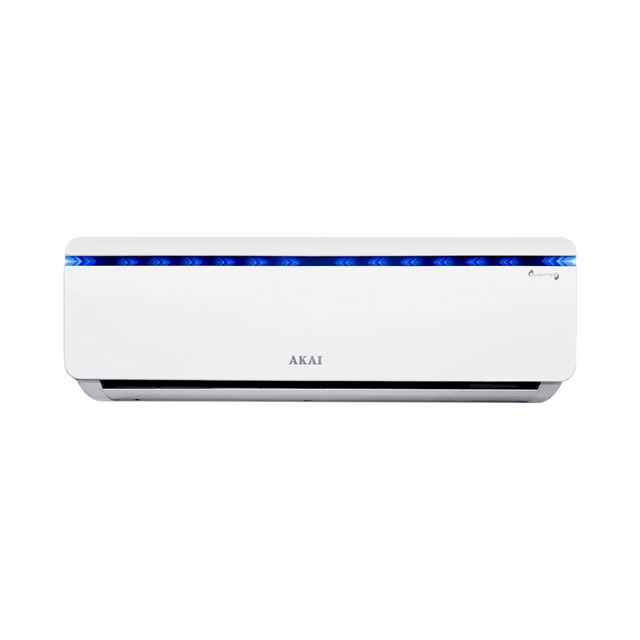
Walk into a room cooled by a fixed-speed AC long enough and you will notice something familiar — a cycle of too cold, then slightly warm, then too cold again. This subtle temperature swing is not your imagination. It is a fundamental limitation of how fixed-speed air conditioners work. An inverter AC, by contrast, is engineered to eliminate exactly this problem. The result is a room that stays consistently comfortable rather than oscillating between extremes.
Understanding why inverter technology delivers superior temperature stability requires a closer look at how both systems operate — and where the critical difference lies.
How a Fixed-Speed AC Works
A fixed-speed or non-inverter AC operates on a simple on/off principle. Its compressor — the heart of the cooling system — runs at only one speed: full power. When the room temperature rises above the set point, the compressor switches on at 100% capacity and cools the room rapidly. Once the thermostat detects that the target temperature has been reached, the compressor switches off completely.
This sounds logical, but it creates a problem. The moment the compressor stops, the room begins to warm again. When the temperature drifts above the set point by a few degrees, the compressor kicks back in — again at full power. This stop-start cycle repeats throughout the day, causing the room temperature to fluctuate by 2 to 4 degrees Celsius above and below the desired setting. For light sleepers, allergy sufferers, or anyone sensitive to temperature shifts, this inconsistency is both uncomfortable and disruptive.
How a 1 Ton Inverter AC Works Differently
A 1 ton inverter AC uses a variable-speed compressor that does not simply switch on and off. Instead, it continuously adjusts its operating speed based on real-time cooling demand. When the room is far from the set temperature, the compressor runs at higher speed to cool it quickly. As the room approaches the target temperature, the compressor slows down rather than switching off — maintaining just enough cooling output to hold the temperature precisely at the set point.
Think of it like driving a car. A fixed-speed AC is like driving with only two settings — full throttle and complete braking. An inverter AC is like cruise control — making constant small adjustments to maintain a steady, comfortable speed. The room temperature stays within a much tighter band, typically within 0.5 to 1 degree Celsius of the set point, rather than the wider swings of a fixed-speed system.
Why Temperature Stability Matters More Than You Think
Consistent temperature control is not just about comfort — it has real, practical consequences:
- Better sleep quality: The human body is highly sensitive to temperature during sleep. Repeated fluctuations trigger micro-awakenings, reducing sleep depth and leaving you feeling unrested even after a full night.
- Reduced humidity swings: Fixed-speed ACs that overcool and then switch off allow humidity to creep back up between cycles. Inverter ACs maintain steadier humidity levels by continuously running at low capacity, keeping the air drier and more comfortable.
- Healthier indoor environment: Humidity spikes between cooling cycles can encourage mould growth and dust mite activity. Stable cooling reduces this risk significantly.
- Consistent comfort during work and study: Temperature fluctuations affect concentration and productivity. A stable environment supports focus far better than one that alternates between cold blasts and warm lulls.
The Energy Efficiency Bonus
Beyond comfort, the variable-speed operation of a 1 ton inverter AC delivers a significant energy efficiency advantage. The most power-hungry moment in any AC’s operation is startup — the surge of electricity required to bring a stationary compressor to full speed. Fixed-speed ACs experience this surge repeatedly throughout the day with every on-off cycle.
Since an inverter AC’s compressor rarely switches off completely, it avoids these repeated startup surges. It also spends most of its time running at lower, more efficient speeds once the target temperature is reached. Studies and real-world usage data consistently show that inverter ACs consume 30 to 50 percent less electricity than equivalent fixed-speed models under similar conditions — making the 1 ton inverter AC not just more comfortable but considerably cheaper to run over time.
Why 1 Ton Is the Right Capacity for Most Rooms
A 1 ton inverter AC is ideally suited for rooms between 100 and 150 square feet — covering most standard bedrooms, home offices, and small living spaces in Indian homes. Matching the right capacity to the room size is itself a factor in temperature stability. An undersized AC struggles to hold the set temperature during peak heat, while an oversized unit cools too quickly, triggering frequent cycling that undermines the very stability inverter technology is designed to deliver.
A properly sized 1 ton inverter AC operating in the right room finds its ideal working range — running efficiently at moderate speeds for extended periods and maintaining a rock-steady temperature with minimal effort.
The Bottom Line
The difference between a fixed-speed AC and a 1 ton inverter AC is not just technical — it is something you feel every day. One delivers bursts of cold air interrupted by warm spells. The other quietly holds your room at exactly the temperature you set, hour after hour, without the cycling, without the noise spikes, and without the energy waste. For anyone who values genuine comfort alongside lower electricity bills, the inverter AC is not simply the better option — it is the smarter long-term investment.
