

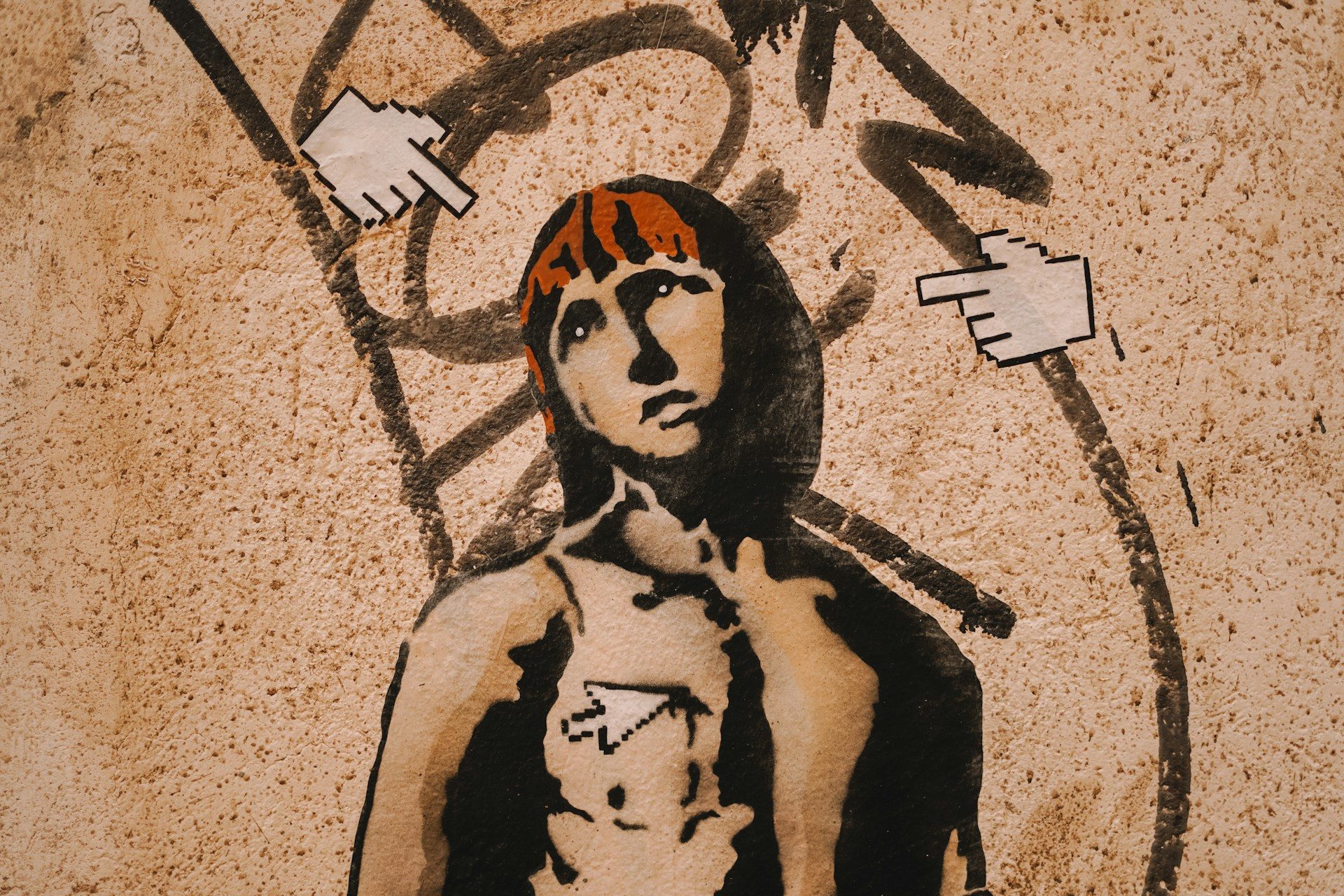
Feminist artwork refers to art that is informed by feminist theory, politics, and lived experience, and that seeks to challenge, critique, or transform the social, cultural, and historical conditions that have marginalized women and other gendered identities. Emerging most visibly in the late 1960s and 1970s alongside second-wave feminism, feminist art is not a single style or medium but a broad, evolving practice that spans painting, sculpture, performance, photography, film, installation, digital media, and socially engaged art. Its central concern is the interrogation of power—particularly how power operates through gender, sexuality, race, class, and representation—and how art can become a tool for resistance, visibility, and social change. Feminist artwork asks who has been allowed to create art, whose stories have been told, how bodies are represented, and how artistic institutions have historically excluded or devalued women’s contributions.
Historically, Western art history was written through a patriarchal lens that elevated male artists as geniuses while relegating women to the margins or erasing them altogether. For centuries, women were denied access to formal artistic training, life-drawing classes, professional guilds, and patronage networks. Even when women produced significant work, it was often dismissed as “craft,” “decorative,” or secondary to so-called “high art.” Feminist artwork arose in direct response to this imbalance. It sought not only to add women into existing art histories but also to question the very structures, hierarchies, and values upon which those histories were built. Thus, feminist art is as much a critical methodology as it is a creative practice.
The development of feminist art is closely linked to the broader feminist movement, particularly the political activism of the 1960s and 1970s. As women organized for equal rights, reproductive freedom, and workplace equality, artists began to explore how personal experiences of sexism, domestic labor, motherhood, sexuality, and bodily autonomy could be expressed visually. The feminist slogan “the personal is political” became a guiding principle for many artists, who used their own lives and bodies as subject matter to expose structural inequalities. In this context, art was no longer seen as a neutral or purely aesthetic endeavor; it became a site of political engagement and social critique.
One of the foundational goals of feminist artwork was to reclaim women’s experiences as valid and meaningful artistic subjects. Traditional art history often idealized women as passive muses, nude bodies, or symbols of beauty, morality, or temptation, created for the male gaze. Feminist artists challenged these representations by depicting women as active agents, complex individuals, and thinking subjects. They explored themes such as menstruation, childbirth, aging, desire, and trauma—topics long considered inappropriate or unworthy of serious art. By doing so, feminist artwork expanded the range of what could be represented and valued within the art world.
Feminist art also questioned the distinction between fine art and craft, a hierarchy that has historically been gendered. Practices such as embroidery, quilting, ceramics, weaving, and textile work were traditionally associated with women and domestic labor and were therefore excluded from the canon of fine art. Feminist artists deliberately incorporated these materials and techniques into their work, asserting their aesthetic and conceptual value. This strategy not only elevated undervalued forms of labor but also critiqued the ways capitalism and patriarchy devalue work associated with women and the home.
The feminist art movement of the 1970s produced both individual artists and collective initiatives that sought to transform artistic institutions. Artists such as Judy Chicago played a crucial role in articulating feminist art practices. Chicago’s landmark installation The Dinner Party (1974–79) celebrated women’s history by commemorating notable women through symbolic place settings, combining craft, collaboration, and historical research. The work challenged the absence of women from historical narratives and demonstrated how art could function as a form of visual historiography. While the piece was controversial, it became a defining example of how feminist artwork could reclaim suppressed histories and provoke public debate.
Another important figure, Miriam Schapiro, developed the concept of “femmage,” a blend of collage and traditionally feminine materials. Schapiro’s work highlighted how women’s creativity had been confined to decorative or domestic spaces and recontextualized those practices within contemporary art. Alongside Chicago, she co-founded the Feminist Art Program, which emphasized collaboration, consciousness-raising, and alternative pedagogical models. These initiatives demonstrated that feminist artwork was not only about producing objects but also about reshaping how art is taught, exhibited, and discussed.
Performance and body art became especially significant within feminist practice because they allowed artists to confront issues of bodily autonomy, objectification, and visibility directly. Artists used their own bodies to challenge the commodification of female flesh and to expose the vulnerability and strength embedded in embodied experience. Through performance, feminist artists could disrupt the passive consumption of images and instead create encounters that were confrontational, intimate, or unsettling. This emphasis on the body underscored the political dimensions of physical presence and lived experience.
In the 1980s and 1990s, feminist artwork evolved in response to critiques that earlier feminist art had often centered the experiences of white, middle-class, Western women. Scholars and artists began to emphasize intersectionality—a framework that recognizes how gender intersects with race, class, sexuality, nationality, and ability to produce different forms of oppression and privilege. Feminist artists of color, queer artists, and artists from the Global South expanded feminist discourse by addressing colonialism, racism, migration, and cultural identity. Their work demonstrated that feminism is not a singular or universal experience but a multiplicity of perspectives shaped by historical and social contexts.
The emergence of collective activism in art further amplified feminist critiques of power. The anonymous collective Guerrilla Girls used humor, statistics, and graphic design to expose sexism and racism in museums, galleries, and the art market. By wearing gorilla masks and adopting pseudonyms, they shifted attention away from individual authorship and toward systemic critique. Their posters and interventions questioned why so few women and artists of color were represented in major institutions, making visible the structural inequalities that feminist artwork seeks to dismantle. Their approach demonstrated how art could function as activism and public education.
The significance of feminist artwork lies partly in its challenge to traditional notions of artistic genius and authorship. Western art history has often celebrated the lone (male) genius, obscuring the collaborative, social, and material conditions of artistic production. Feminist art questioned this model by emphasizing collaboration, collective processes, and community engagement. Many feminist projects involved groups of artists working together, sharing skills, and valuing process over product. This shift redefined creativity as relational rather than individualistic and aligned artistic practice with feminist ethics of care, solidarity, and mutual support.
Feminist artwork has also been crucial in transforming how art institutions operate. Through protests, alternative exhibition spaces, and critical writing, feminist artists and scholars pressured museums and galleries to reconsider their collections, curatorial practices, and interpretive frameworks. Over time, this activism contributed to greater visibility for women artists and a more critical awareness of bias within cultural institutions. While inequalities persist, feminist interventions have reshaped conversations about representation, inclusion, and accountability in the art world.
Another key significance of feminist art is its role in redefining aesthetics. Rather than adhering to formalist criteria such as beauty, harmony, or technical mastery alone, feminist artwork often prioritizes meaning, context, and impact. It embraces messiness, ambiguity, and emotional intensity as legitimate aesthetic strategies. By valuing storytelling, personal narrative, and affect, feminist art expanded the language of art criticism and challenged the idea that art should be detached from social realities. This redefinition of aesthetics opened space for new forms of expression and broadened the scope of what art can do.
Feminist artwork has also contributed significantly to academic discourse, influencing fields such as art history, visual culture studies, and cultural theory. Feminist scholars questioned the supposed objectivity of traditional art history and exposed how its methodologies reflected patriarchal values. They developed new approaches that foregrounded gender analysis, social context, and marginalized voices. This intellectual work reinforced the importance of feminist art as both practice and theory, demonstrating that art is inseparable from the power structures within which it is produced and interpreted.
In contemporary contexts, feminist artwork continues to evolve, responding to new technologies, global politics, and social movements. Digital media, social networks, and virtual platforms have enabled artists to reach wider audiences and to address issues such as online harassment, surveillance, and digital identity. Feminist artists today often engage with topics such as transgender rights, climate justice, reproductive politics, and migration, reflecting the expanding scope of feminist concerns. This adaptability underscores the ongoing relevance of feminist art as a mode of critical inquiry and social engagement.
The global dimension of feminist artwork is especially significant in the twenty-first century. Artists from diverse cultural backgrounds draw on local histories, traditions, and struggles to articulate feminist perspectives that resist Western-centric narratives. By situating gender within specific social, political, and economic contexts, these artists challenge the assumption that feminism has a single origin or trajectory. Their work highlights how feminist art can function as a form of cultural translation, building solidarities across borders while respecting difference.
Despite its achievements, feminist artwork has not been without controversy or critique. Some have argued that feminist art risks becoming institutionalized or commodified, losing its radical edge as it is absorbed into mainstream markets and museums. Others have questioned whether the label “feminist art” limits artistic interpretation or reinforces gender-based categorization. These debates are themselves part of the significance of feminist artwork, as they reflect ongoing tensions between activism and assimilation, critique and celebration, difference and inclusion.
Ultimately, the significance of feminist artwork lies in its transformative potential. By challenging exclusionary histories, redefining artistic value, and foregrounding marginalized experiences, feminist art has reshaped both the content and the structures of the art world. It has demonstrated that art is not merely a reflection of society but an active participant in shaping social consciousness. Feminist artwork invites viewers to question assumptions, confront injustices, and imagine more equitable futures.
In conclusion, feminist artwork is a dynamic and multifaceted field that has played a crucial role in expanding the boundaries of art and redefining its social function. Rooted in political struggle and theoretical critique, it addresses issues of gender, power, and representation while engaging with broader questions of identity and justice. Its significance extends beyond the visibility of women artists; it lies in its capacity to challenge dominant narratives, transform institutions, and inspire critical reflection. As long as inequalities persist, feminist artwork will remain an essential and vital force within contemporary art and culture.
