

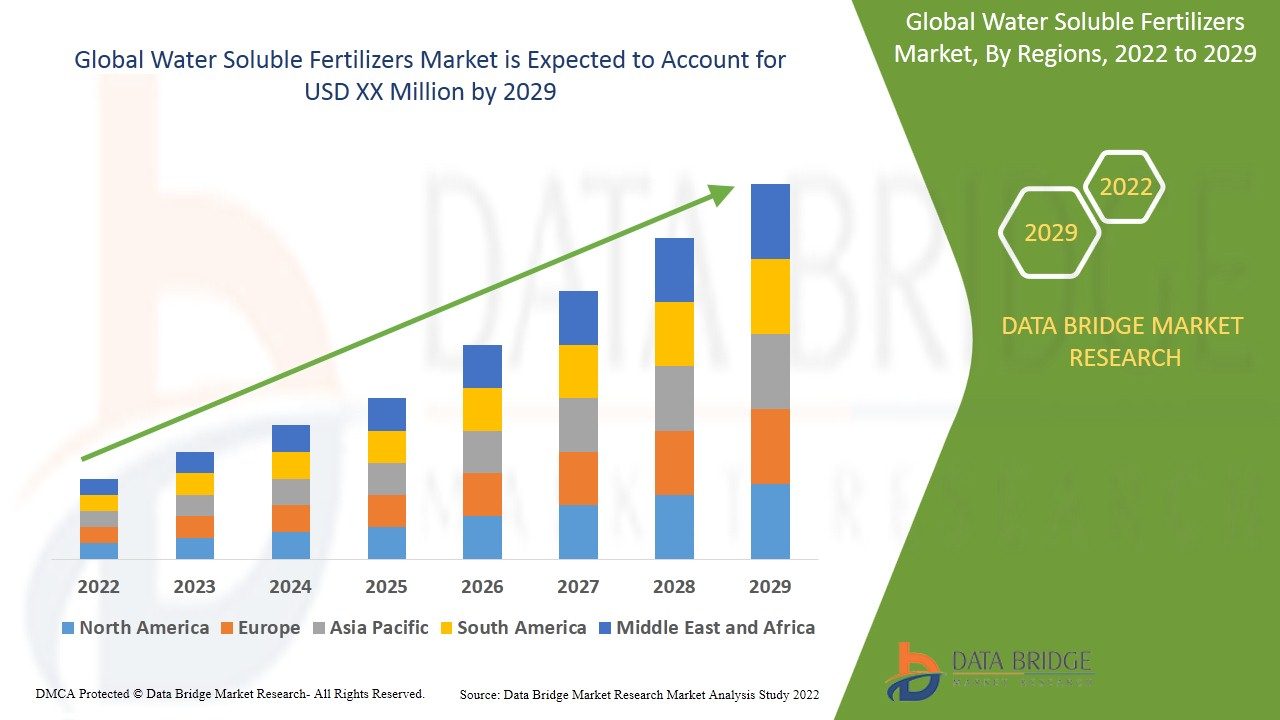
The Water Soluble Fertilizers Market, valued at USD 18.6 billion in 2024, is witnessing strong global growth driven by the rising adoption of precision farming, fertigation systems, and high-value crop cultivation. The market is projected to reach USD 33.4 billion by 2032, expanding at a 7.6% CAGR.
Water soluble fertilizers—comprising nitrogen, phosphorus, potassium, and micronutrient formulations—dissolve completely in water and deliver nutrients directly to plant roots or foliage. These fertilizers enhance nutrient uptake efficiency, reduce losses, and support sustainable agricultural productivity, making them increasingly essential in modern farming systems.
Get More Details : https://www.databridgemarketresearch.com/reports/global-water-soluble-fertilizers-market
Market Dynamics
Key Market Drivers
Rising Adoption of Precision Agriculture and Fertigation Systems
Precision agriculture practices are rapidly expanding due to the need for higher yields, efficient resource utilization, and climate-resilient farming.
Key factors include:
-
Increasing use of drip and sprinkler irrigation
-
Demand for precise nutrient dosing
-
Reduced fertilizer runoff and soil degradation
-
Growing awareness of nutrient use efficiency
Fertigation-based nutrient application improves fertilizer efficiency by 25–40%, significantly boosting demand for water soluble fertilizers.
Growing Demand for High-Value Crops and Protected Cultivation
The expansion of horticulture, floriculture, fruits, vegetables, and greenhouse farming is accelerating market growth.
Trends driving demand include:
-
Growth of greenhouse and polyhouse farming
-
Rising export-oriented crop production
-
Increased focus on crop quality and uniformity
-
Adoption of controlled-environment agriculture
Water soluble fertilizers are widely used in protected cultivation due to their fast absorption and compatibility with automated irrigation systems.
Need for Sustainable and High-Efficiency Fertilization
Global pressure to reduce environmental impact is pushing farmers toward fertilizers that offer higher nutrient efficiency and lower leaching losses.
Benefits driving adoption:
-
Reduced groundwater contamination
-
Lower nutrient wastage
-
Improved soil health
-
Compliance with environmental regulations
These factors are positioning water soluble fertilizers as a core component of sustainable agriculture.
Market Challenges
High Cost Compared to Conventional Fertilizers
Water soluble fertilizers are typically priced higher than traditional granular fertilizers.
Key cost-related challenges include:
-
Expensive raw materials
-
Advanced manufacturing processes
-
Higher distribution costs
Small and marginal farmers in developing regions often hesitate to adopt these fertilizers due to cost sensitivity.
Limited Awareness and Technical Knowledge
Effective use of water soluble fertilizers requires proper understanding of:
-
Crop nutrient requirements
-
Correct dosage and timing
-
Compatibility with irrigation systems
Lack of training and extension services in rural areas limits adoption rates.
Market Restraints
Dependence on Irrigation Infrastructure
Water soluble fertilizers are most effective when applied through irrigation systems.
Constraints include:
-
Limited access to drip or sprinkler irrigation
-
Uneven irrigation penetration in developing regions
-
High initial cost of irrigation system installation
These factors restrain market growth in rain-fed agricultural zones.
Volatility in Raw Material Prices
Prices of key inputs such as phosphates, potash, and nitrogen compounds fluctuate due to:
-
Energy price volatility
-
Supply chain disruptions
-
Geopolitical factors
This impacts product pricing and profit margins for manufacturers.
Market Opportunities
Expansion of Micronutrient and Specialty Fertilizers
Deficiencies of micronutrients such as zinc, iron, boron, and manganese are increasingly recognized as yield-limiting factors.
Opportunities include:
-
Customized crop-specific formulations
-
Chelated micronutrient products
-
High-margin specialty blends
Micronutrient water soluble fertilizers are witnessing double-digit growth globally.
Growth in Precision Farming Technologies
Integration of digital agriculture tools such as:
-
Soil testing
-
Remote sensing
-
AI-based nutrient management
…is creating strong demand for precision-compatible fertilizers, positioning water soluble products for long-term growth.
Increasing Focus on Climate-Resilient Agriculture
Erratic weather patterns and soil degradation are driving adoption of efficient nutrient solutions that support crop resilience and productivity under stress conditions.
Segment Analysis
By Type
-
Nitrogenous
-
Phosphatic
-
Potassic
-
Micronutrients
-
Compound Fertilizers
By Application
-
Fertigation
-
Foliar Application
-
Soil Application
By Crop Type
-
Fruits and Vegetables
-
Cereals and Grains
-
Oilseeds and Pulses
-
Plantation Crops
-
Turf and Ornamentals
By End User
-
Commercial Farms
-
Greenhouse Growers
-
Horticulture Producers
-
Plantation Operators
Regional Insights
Asia-Pacific dominates the market due to extensive agricultural activity, increasing adoption of drip irrigation, and government support for modern farming practices. Europe shows strong growth driven by sustainability regulations and precision agriculture adoption. North America continues to expand steadily due to advanced farming infrastructure and high-value crop cultivation.
Competitive Landscape
The global water soluble fertilizers market is moderately fragmented, with key players focusing on product innovation, customized formulations, and geographic expansion.
Major Companies Profiled
-
Yara International
-
Nutrien Ltd.
-
ICL Group
-
EuroChem Group
-
Haifa Group
-
Mosaic Company
-
SQM
-
Coromandel International
-
Israel Chemicals Ltd.
These companies emphasize:
-
High-purity fertilizer formulations
-
Crop-specific nutrient solutions
-
Sustainable and low-impact products
-
Strong distribution and agronomic support networks
Recent Developments & Trending Updates: Water Soluble Fertilizers Market
Rising Adoption of Drip Irrigation and Fertigation
Government subsidies and water conservation initiatives are accelerating drip irrigation adoption, directly supporting water soluble fertilizer demand.
Shift Toward Customized Crop Nutrition
Farmers increasingly prefer crop-stage-specific fertilizer programs to maximize yield and quality, boosting demand for customized water soluble blends.
Growth of Greenhouse and Vertical Farming
The rise of controlled-environment agriculture is increasing reliance on highly soluble, fast-acting nutrient solutions.
Focus on Sustainable and Low-Residue Fertilizers
Manufacturers are developing eco-friendly formulations with lower salt index and improved nutrient efficiency.
Digital Advisory Platforms Supporting Adoption
Agri-tech platforms providing real-time nutrient recommendations are improving farmer confidence and driving consistent usage.
Conclusion
The Water Soluble Fertilizers Market is set for sustained growth as agriculture shifts toward precision, efficiency, and sustainability. Despite challenges related to cost and infrastructure, rising adoption of fertigation systems, high-value crops, micronutrient solutions, and digital farming technologies continues to strengthen market demand. Companies investing in innovative formulations, agronomic support, and precision-compatible products will be well positioned to capitalize on the evolving global agricultural landscape.
Get More Reports :
https://www.databridgemarketresearch.com/reports/global-artificial-intelligence-in-healthcare-market
https://www.databridgemarketresearch.com/reports/global-premium-wine-market
https://www.databridgemarketresearch.com/reports/global-onion-powder-market
https://www.databridgemarketresearch.com/reports/latin-america-aesthetic-injectables-market
https://www.databridgemarketresearch.com/reports/global-glass-substrate-market
