

Tool Steel Market Overview 2034
The global Tool Steel Market is experiencing steady growth, driven by increasing industrialization, expanding automotive and manufacturing sectors, rising demand for precision tooling solutions, and growing investments in advanced metalworking technologies. Tool steel plays a critical role in industrial production processes due to its exceptional hardness, wear resistance, toughness, and ability to withstand high temperatures.
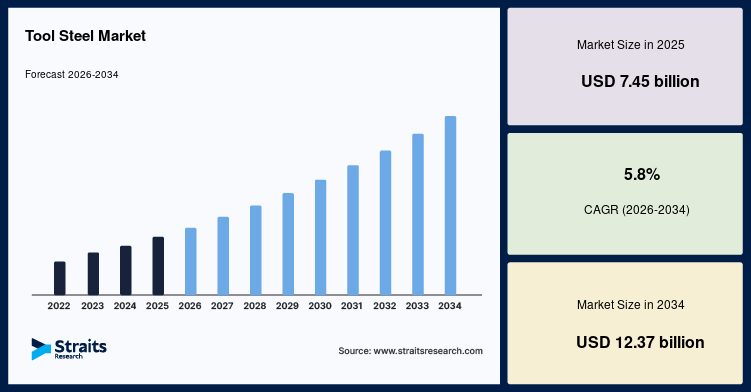
The global tool steel market size was valued at USD 7.45 billion in 2025 and is projected to grow from USD 7.88 billion in 2026 to USD 12.37 billion by 2034 at a CAGR of 5.8% during the forecast period 2026-2034.
Tool steel is a specialized category of carbon and alloy steel designed for the manufacture of cutting tools, dies, molds, machine components, and industrial tooling equipment. Its superior mechanical properties make it indispensable in industries such as automotive, aerospace, machinery, construction, and metal fabrication. The growing demand for durable and high-performance tooling materials is expected to support market expansion throughout the forecast period.
Market Drivers
Growth of the Automotive Industry
The increasing production of automobiles and automotive components is driving demand for high-performance tool steels used in stamping, forging, cutting, and molding operations.
Expansion of Manufacturing Activities
Rapid industrialization and increasing manufacturing output across emerging economies are creating significant demand for tool steel products used in industrial machinery and production equipment.
Rising Demand for Precision Engineering
Industries are increasingly adopting precision manufacturing processes that require durable and high-quality tooling materials capable of maintaining dimensional accuracy and performance.
Advancements in Metalworking Technologies
The development of advanced machining, forming, and manufacturing techniques is supporting the demand for specialized tool steels with enhanced mechanical properties.
Growing Aerospace and Defense Applications
Tool steel is extensively used in aerospace component manufacturing due to its strength, wear resistance, and ability to withstand extreme operating conditions.
Market Challenges
Fluctuating Raw Material Prices
Variations in the prices of alloying elements such as chromium, molybdenum, tungsten, and vanadium can impact production costs and profitability.
High Manufacturing Costs
Producing premium-grade tool steels often involves complex heat treatment processes and specialized alloy compositions, increasing manufacturing expenses.
Competition from Alternative Materials
Advanced ceramics, carbide materials, and composite tooling solutions may compete with traditional tool steel products in certain applications.
Environmental Regulations
Steel manufacturers face increasing pressure to reduce emissions and adopt sustainable production practices, which may require substantial investments.
Market Segmentation
The tool steel market is segmented based on product type, process, application, end-user industry, and region.
By Product Type
The market includes:
-
High-Speed Steel
-
Cold Work Tool Steel
-
Hot Work Tool Steel
-
Plastic Mold Tool Steel
-
Shock-Resistant Tool Steel
Cold work tool steel dominates the market due to its extensive use in cutting, punching, stamping, and forming operations across various industries.
By Process
The market is categorized into:
-
Forged Tool Steel
-
Rolled Tool Steel
-
Cast Tool Steel
Forged tool steel accounts for a significant market share owing to its superior strength, durability, and performance characteristics.
By Application
The market includes:
-
Cutting Tools
-
Dies and Molds
-
Machine Components
-
Industrial Equipment
-
Hand Tools
Dies and molds represent the largest application segment due to their widespread use in automotive, plastics, and metalworking industries.
By End-User Industry
The market is segmented into:
-
Automotive
-
Aerospace and Defense
-
Industrial Manufacturing
-
Construction
-
Energy
-
Consumer Goods
Automotive remains the dominant end-user segment due to extensive use of tool steel in vehicle component manufacturing and production tooling.
Regional Insights
Asia-Pacific
Asia-Pacific dominates the tool steel market due to rapid industrialization, expanding manufacturing industries, strong automotive production, and increasing infrastructure development activities. China, India, Japan, and South Korea are major contributors to regional growth.
North America
North America represents a significant market supported by advanced manufacturing capabilities, growing aerospace production, and increasing adoption of precision engineering technologies.
Europe
Europe holds a substantial market share due to its well-established automotive industry, strong industrial base, and increasing demand for high-performance tooling materials.
Latin America
Latin America is experiencing steady growth driven by industrial expansion, automotive manufacturing activities, and increasing investments in infrastructure development.
Middle East & Africa
The Middle East & Africa region is emerging as a promising market due to growing industrialization, construction activities, and investments in manufacturing infrastructure.
Key Trends and Growth Opportunities
Development of Advanced Tool Steel Grades
Manufacturers are investing in innovative alloy compositions and heat treatment technologies to enhance wear resistance, toughness, and performance.
Increasing Adoption of Additive Manufacturing
The integration of tool steel materials into additive manufacturing and 3D printing processes is creating new opportunities for customized tooling solutions.
Growth of Precision Manufacturing
Industries are increasingly requiring high-performance tool steels capable of supporting advanced machining and precision production operations.
Focus on Sustainable Steel Production
Steel producers are investing in energy-efficient manufacturing processes and environmentally responsible production technologies.
Key Players Analysis
The tool steel market is highly competitive, with major steel manufacturers focusing on product innovation, production efficiency, and strategic expansion initiatives.
Key companies operating in the market include:
-
Voestalpine AG
-
Daido Steel Co., Ltd.
-
Hitachi Metals, Ltd.
-
Schmolz + Bickenbach AG
-
Nachi-Fujikoshi Corp.
-
Hudson Tool Steel Corporation
-
Eramet S.A.
-
ArcelorMittal S.A.
-
Sandvik AB
-
Bohler-Uddeholm Corporation
These companies are investing in advanced metallurgy, customized tooling solutions, sustainable steel manufacturing, and global capacity expansion to strengthen their positions in the global tool steel market.
For Detailed Insights, Visit:
https://straitsresearch.com/report/tool-steel-market
About Us
Straits Research is a leading research and intelligence organization, specializing in research, analytics, and advisory services, along with providing business insights and research reports.
Contact Us
Email: sales@straitsresearch.com
Tel: +1 646 905 0080 (U.S.), +44 203 695 0070 (U.K.)
