

A lot of businesses moved to remote work faster than they planned to.
At first, most companies focused on communication tools. Slack channels were created. Zoom meetings increased. Managers started asking for daily updates.
For a while, that seemed enough.
Then the operational issues started showing up.
Projects that looked “on track” suddenly missed deadlines. Employees appeared active online all day, but actual output felt inconsistent. Managers spent more time asking for updates than solving problems.
That is usually the moment companies start looking into time tracking for remote teams.
Not because they suddenly want tighter control over employees.
Because they realize remote work needs better structure.
Why Remote Work Creates Visibility Problems
In a physical office, managers naturally see how work moves during the day.
You notice when:
- someone is overloaded,
- a project is stuck,
- a team member needs help,
- or work is slowing down.
Remote work removes most of those signals.
When everyone works from different locations, leadership depends heavily on:
- messages,
- meetings,
- task boards,
- and employee updates.
The problem is that updates do not always reflect actual workflow conditions.
A project can appear fine on paper while deadlines quietly slip underneath.
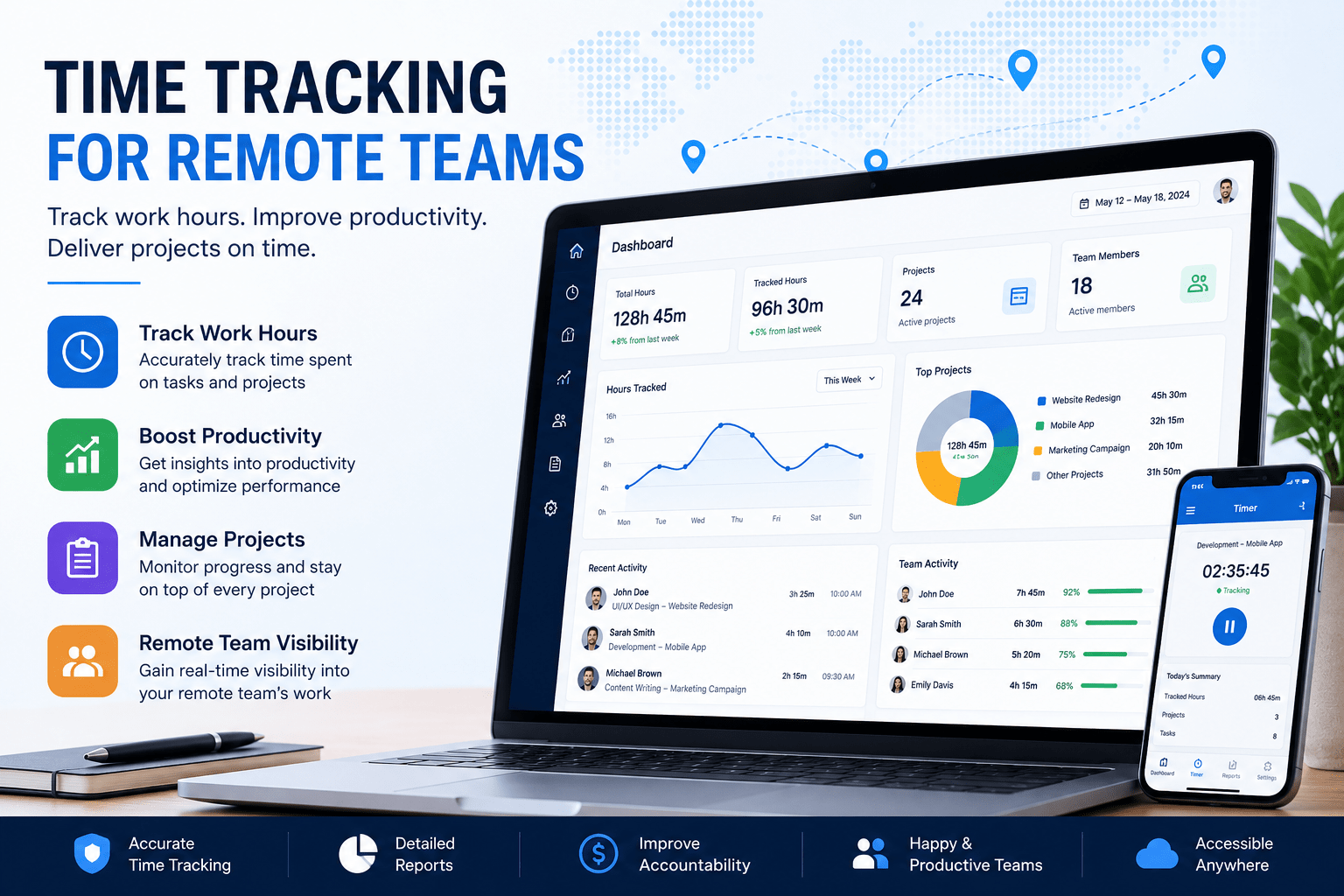
That is why businesses are increasingly using time tracking software for remote teams to get clearer operational visibility.
Most Companies Start Tracking Time After Something Goes Wrong
Very few business owners wake up one day excited about implementing tracking software.
Usually, the decision comes after repeated friction.
Maybe client projects are taking longer than expected.
Maybe payroll hours look high while productivity feels low.
Maybe managers are spending half the week trying to understand where time is going.
Or maybe remote employees are working hard, but nobody has enough visibility to measure workloads accurately.
Time tracking often becomes necessary when businesses realize they are operating with too many assumptions.
Time Tracking Helps Managers Understand Workflow, Not Just Hours
A common misconception is that tracking software only records employee attendance.
Modern systems do much more than that.
Good time tracking software for modern teams helps businesses understand:
- where work hours are spent,
- which projects consume the most time,
- where bottlenecks happen,
- and how workloads are distributed across teams.
That context matters.
For example, if deadlines keep getting delayed, the issue may not be employee performance at all.
Sometimes the real problem is:
- too many meetings,
- unclear project requirements,
- approval delays,
- context switching,
- or poor task distribution.
Without actual tracking data, managers often guess incorrectly.
Remote Teams Usually Need Fewer Meetings, Not More
One pattern shows up in many remote companies.
When managers lose visibility, they compensate by increasing communication.
More check-ins.
More status meetings.
More follow-up messages.
Eventually employees spend a large part of the day discussing work instead of doing work.
This becomes exhausting for everyone.
Using proper time tracking for remote teams reduces that pressure because managers already have operational visibility.
Instead of repeatedly asking:
“Where are we on this?”
they can review structured project and activity data directly.
That creates calmer workflows and fewer interruptions across teams.
Employees Often Prefer Clear Tracking Systems
Many managers worry that employees will dislike time tracking tools.
Some employees do resist poorly implemented systems.
But clear, transparent tracking is often better than unclear expectations.
Most people simply want:
- fair workload distribution,
- reasonable accountability,
- and accurate performance evaluation.
Without structured visibility, performance conversations become subjective.
Managers rely on perception instead of measurable data.
That creates problems for both high performers and struggling employees.
When expectations are visible and consistent, teams usually operate more smoothly.
Client Work Becomes Easier to Manage With Accurate Time Data
For agencies, software companies, consulting firms, and service providers, time tracking becomes even more important.
Clients increasingly expect detailed reporting.
Businesses often need to explain:
- how project hours were used,
- why timelines changed,
- and where resources were allocated.
Without proper systems, reporting becomes messy very quickly.
Many businesses also discover operational problems after reviewing time data carefully.
Some projects may be far less profitable than expected.
Certain clients may consume significantly more resources than originally estimated.
Tracking helps leadership make better business decisions instead of relying entirely on intuition.
The Best Tracking Software Feels Invisible During Work
One mistake companies make is choosing software that creates extra friction.
If employees constantly fight with the system, adoption drops quickly.
The best time tracking software for remote teams usually works quietly in the background.
Employees should not need complicated processes just to track normal work activity.
Managers also need reports that are simple enough to understand quickly.
If reporting becomes overly technical, most teams stop using the insights properly.
Good software should reduce operational confusion, not create more of it.
What Business Owners Usually Care About Most
After implementing tracking systems, most leadership teams focus on a few practical things:
- Are projects staying profitable?
- Are teams overloaded?
- Where is time being lost?
- Which workflows are slowing delivery?
- How can productivity improve without burning people out?
Those are operational questions, not surveillance questions.
That distinction matters.
The companies that benefit most from tracking software are usually the ones using it to improve systems rather than pressure employees unnecessarily.
Remote Work Is Now Normal Business Infrastructure
A few years ago, remote work felt temporary for many companies.
Now it is simply how modern businesses operate.
Teams are distributed across cities, countries, and time zones.
That changes how accountability, productivity, and project management work.
Businesses need systems that provide visibility without requiring constant supervision.
That is one reason adoption of time tracking software for modern teams continues growing across industries.
Not because managers want more control.
Because distributed operations need better structure to scale properly.
Final Thoughts
Managing remote teams becomes difficult when leadership lacks visibility into daily operations.
Without reliable systems, businesses often rely on assumptions, excessive meetings, and inconsistent reporting.
That approach rarely works well long term.
Proper time tracking for remote teams gives companies a clearer understanding of:
- productivity,
- project timelines,
- workload distribution,
- and operational efficiency.
When used correctly, tracking software helps businesses run more smoothly without creating unnecessary pressure on employees.
If your company is looking for a better way to manage distributed teams and improve operational visibility, take a look at Prime Teams Time Tracking Software.
