

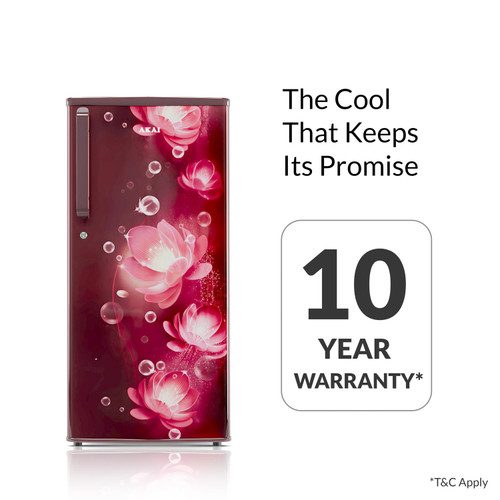
When you’re looking at your monthly power bill and wondering why the numbers are climbing, it’s natural to eye the appliances that never take a day off. Chief among them is the refrigerator. For a small family, a bachelor, or a couple, the 190-liter single-door refrigerator is the gold standard of efficiency and utility.
But exactly how many “units” (kilowatt-hours) is that sleek box pulling from your wall every day? Let’s break down the math, the tech, and the habits that dictate your fridge’s appetite for power.
Understanding the “Unit”
Before we dive into the numbers, we need to speak the same language as the utility company. In electrical terms, one unit equals 1 kilowatt-hour (kWh). This is the amount of energy consumed by a 1,000-watt appliance running for one hour.
The Average Daily Consumption
For a standard 190L refrigerator, the daily consumption typically ranges between 0.5 units and 1.2 units per day.
Wait—why such a big range? It’s because “190 liters” only tells us the size, not the efficiency. To get a clearer picture, we have to look at the Star Rating (issued by bodies like BEE in India or Energy Star in the US).
| Star Rating | Estimated Daily Consumption (Approx.) | Estimated Annual Consumption |
| 5 Star | 0.35 – 0.5 units | 130 – 170 units |
| 3 Star | 0.6 – 0.8 units | 210 – 260 units |
| 1 Star / Old Model | 1.0 – 1.5 units | 360+ units |
The Variables: What Changes the Math?
If we lived in a laboratory, your fridge would use the exact same amount of power every day. In the real world, several factors act as “energy vampires.”
1. Inverter vs. Non-Inverter Technology
This is the single biggest hardware factor.
-
Non-Inverter: The compressor works like a light switch—it’s either 100% on or 100% off. Every time it kicks back on to cool the fridge, it uses a massive surge of electricity.
-
Inverter: The compressor is more like an accelerator pedal. It stays on but slows down or speeds up based on the cooling demand. This can save you up to 30-40% in electricity compared to older models.
2. Ambient Temperature
Your fridge works by moving heat from the inside to the outside. If your kitchen is a sweltering 35°C (95°F) in the middle of July, the compressor has to work significantly harder to dump that heat. A 190L fridge will use more units in the summer than it will in the winter.
3. Usage Patterns (The “Door” Factor)
Every time you open the door to “just browse” for a snack, the cold air escapes and is replaced by warm, humid room air. The fridge then has to run a cooling cycle to stabilize the temperature. If you have a habit of leaving the door ajar, expect your daily units to spike.
4. Thermostat Settings
Setting your fridge to the “Colder” or “Deep Freeze” setting unnecessarily is a quick way to burn through units. For most households, a medium setting is sufficient to keep milk fresh and veggies crisp without overtaxing the motor.
How to Calculate Your Specific Consumption
If you want to be a sleuth, you can find the exact answer for your specific model. Look for the Energy Rating Label usually pasted on the front or side of the appliance.
- Find the Annual Energy Consumption (e.g., 200 kWh).
- Divide that number by 365 days.
- $200 / 365 = 0.54 text{ units per day}$.
Keep in mind that this lab-tested number assumes “ideal” conditions. To be safe, add about 10-15% to that number to account for real-world usage.
Tips to Lower Your Daily Units
If your 190L fridge is eating more than its fair share of the budget, you don’t necessarily need a new one. Try these “efficiency hacks”:
-
Check the Gasket: The rubber seal around the door is the only thing keeping the cold in. If it’s cracked or loose, your fridge is effectively trying to cool your entire kitchen.
-
Give it Space: Don’t push the fridge flush against the wall. The coils on the back need airflow to dissipate heat. Leave at least 6 inches of breathing room.
-
Don’t Put Hot Food Inside: Putting a steaming pot of soup directly into a 190L fridge forces the compressor into overdrive. Let food cool to room temperature first.
-
Defrost Regularly: If you have a manual defrost model (common in the 190L category), ice buildup on the freezer coils acts as an insulator, making the fridge work twice as hard to achieve the same cooling.
The Verdict
For a modern, 3-star or 5-star 190L refrigerator, you are likely looking at less than 1 unit per day. In many regions, that translates to a very small cost—roughly the price of a single candy bar per week to keep your food fresh.
However, if you are running a 15-year-old “hand-me-down” 190L model, you could be burning 1.5 to 2 units daily, which adds up to a hidden “tax” on your electricity bill every single month.
