

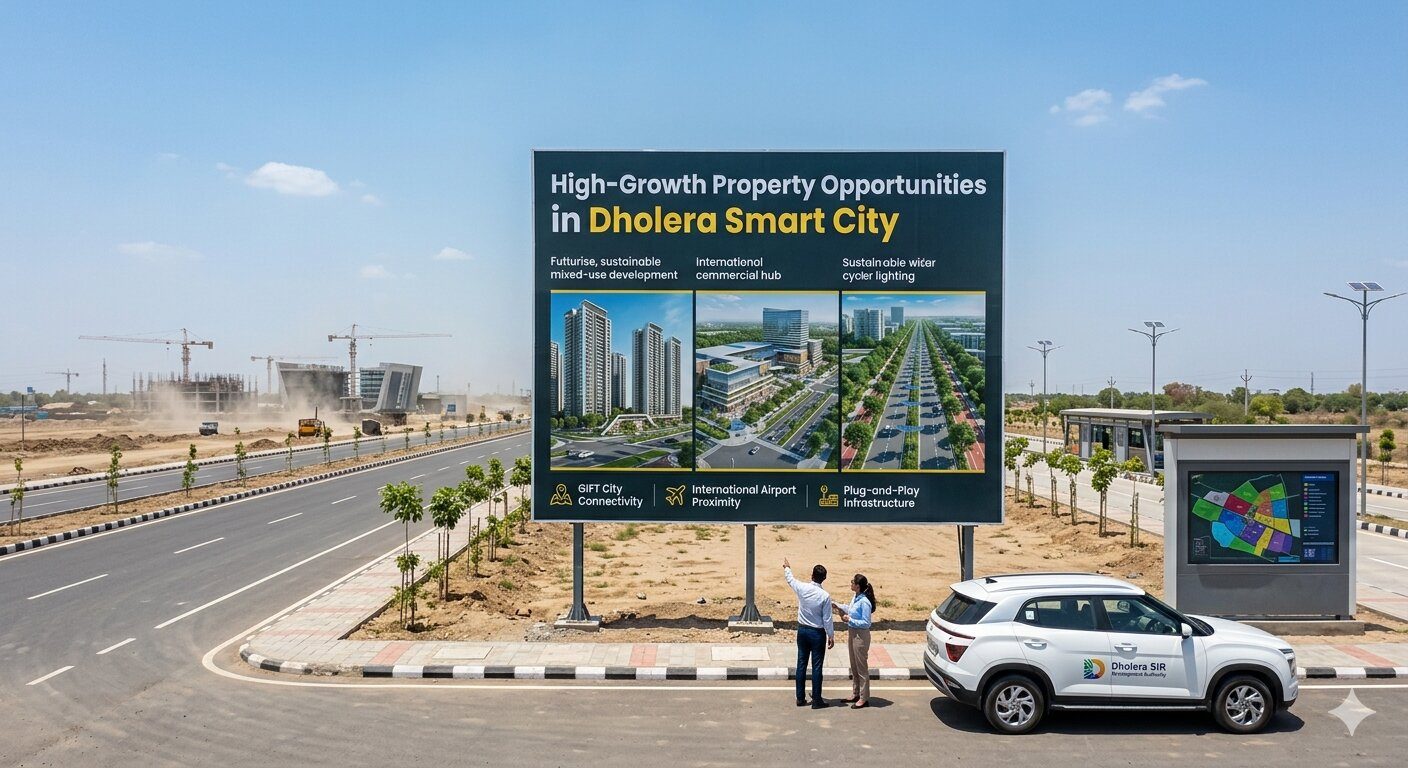
India’s real estate landscape is shifting — and Dholera Smart City sits right at the centre of that change. Whether you’re a first-time land buyer or a seasoned investor, buying a plot here in 2026 is one of the most talked-about moves in long-term property investment. But where do you actually start?
Here’s a no-fluff, step-by-step guide to help you go from curious to confident.
Step 1: Understand What Dholera SIR Actually Is
Before you spend a single rupee, know what you’re investing in.
Dholera Special Investment Region (DSIR) is India’s first planned greenfield smart city, developed under the Delhi–Mumbai Industrial Corridor (DMIC). It spans over 920 sq. km near Ahmedabad in Gujarat and is backed directly by the Government of India and the Government of Gujarat.
This isn’t a private township or a speculative land bank. It’s a government-notified urban development zone with dedicated zoning, smart utilities, and a master plan already in execution.
Step 2: Choose the Right Plot Type for Your Goal
Not all plots in Dholera Smart City serve the same purpose. You need to match the plot type with your intent:
- Residential plots — Best for long-term capital appreciation and future self-use
- Commercial plots — Suited for investors eyeing retail or office space demand as the population grows
- Industrial plots — Ideal for entrepreneurs or institutional investors linked to manufacturing or logistics
If you’re buying purely for investment, residential plots in the Activation Area offer the strongest near-term appreciation potential given current infrastructure development.
Step 3: Verify Legal Approvals Before Anything Else
This is the step most buyers skip — and it’s the costliest mistake.
Always confirm:
- Town Planning (TP) Scheme approval — Is the plot part of a finalised TP scheme?
- NA (Non-Agricultural) conversion — Has the land been legally converted for non-agricultural use?
- RERA registration — Is the developer registered under Gujarat RERA?
- Clear title deed — No disputes, encumbrances, or pending litigation
Ask for the RERA registration number and verify it independently at https://gujrera.gujarat.gov.in.
Step 4: Shortlist a RERA-Approved Developer
Dholera has attracted dozens of developers — some credible, some not. Stick to builders with a verifiable track record, registered projects, and physical site presence.
During your developer evaluation, ask:
- When was the project approved?
- What’s the possession timeline?
- Is the plot demarcated on ground or only on paper?
A site visit before booking is non-negotiable.
Step 5: Compare Pricing by Zone
Plot prices in Dholera vary significantly based on location:
| Zone | Approx. Price (per sq. meter) |
|---|---|
| Activation Area (Residential) | ₹9,000 – ₹13,500 |
| Developed TP Scheme Zones | ₹7,000 – ₹10,000 |
| Peripheral Residential Zones | ₹4,500 – ₹6,500 |
Plots closer to the Ahmedabad–Dholera Expressway or the upcoming Dholera International Airport command a premium — and for good reason.
Step 6: Finalise the Agreement and Register
Once you’ve chosen a plot, the legal process includes:
- Booking amount — Typically 10–20% of total value
- Sale Agreement — Review every clause; involve a property lawyer
- Stamp duty payment — Currently applicable as per Gujarat government rates
- Plot registration — Done at the local Sub-Registrar’s office in Gujarat
Ensure the registered document clearly mentions plot number, survey number, area in sq. meters, and boundaries.
Step 7: Plan Your Holding Period
Dholera is a long-term play — not a quick flip.
Experts consistently suggest a minimum 5–7 year holding period to ride out the infrastructure build-out phase. Once the airport becomes operational and Tata’s semiconductor plant drives employment, residential demand is expected to accelerate meaningfully.
Early buyers who enter before that inflection point tend to see the strongest returns.
Final Thought
Buying plots in Dholera Smart City isn’t complicated — but it does require due diligence, patience, and a clear investment goal. Follow these steps carefully, work only with verified developers, and treat it as a long-term wealth-building asset rather than a short-term trade.
