

Introduction
The stealth warfare market has become a critical component of modern defense strategies, driven by the growing need for advanced technologies that provide superior battlefield advantage. Stealth warfare involves the use of technologies and platforms designed to reduce visibility, radar cross-section, heat signatures, and other detection methods. By minimizing the ability of adversaries to detect and track military assets, stealth capabilities enhance operational effectiveness, survivability, and the element of surprise.
This market includes a wide range of systems such as stealth aircraft, naval vessels, unmanned aerial vehicles, and radar-evading weaponry. Governments and defense organizations across the globe are investing heavily in stealth technologies to counter evolving security threats, asymmetric warfare, and advancements in surveillance systems.
With global tensions, territorial disputes, and modernization of defense forces, the stealth warfare market is expected to witness strong growth over the coming years.
Market Overview
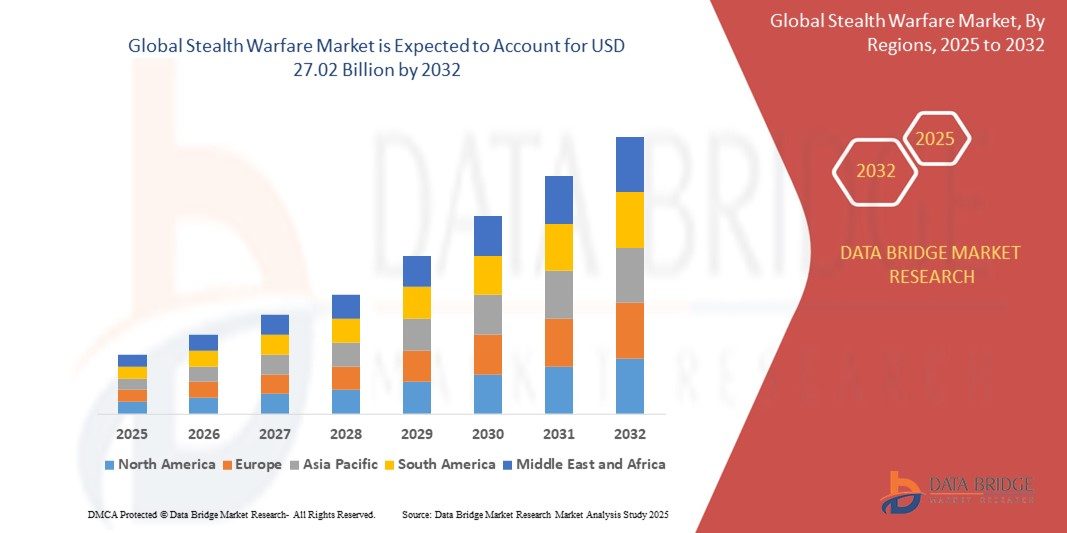
The stealth warfare market is witnessing rapid expansion due to the adoption of next-generation defense technologies by both developed and emerging nations. North America, led by the United States, dominates the market with its advanced stealth aircraft programs and naval technologies. Europe and Asia-Pacific are also experiencing significant growth due to increasing defense spending and modernization projects.
Stealth technologies are not confined to aerial platforms alone. They are increasingly integrated into submarines, naval destroyers, drones, and ground-based weapon systems. The global defense landscape is witnessing an arms race where stealth plays a central role in shaping future military operations.
Key Market Drivers
1. Rising Global Defense Expenditure
With geopolitical tensions and regional conflicts escalating, nations are allocating higher budgets toward defense modernization. A considerable portion of this spending is being directed toward stealth technologies to ensure battlefield superiority.
2. Advancements in Detection and Surveillance Technologies
As adversaries enhance their radar, sonar, and satellite-based surveillance systems, militaries are compelled to invest in stealth platforms that can evade detection and ensure mission success.
3. Demand for Next-Generation Aircraft and Naval Platforms
The replacement of aging fleets and the development of new-generation fighter jets, bombers, and submarines are boosting the demand for stealth solutions. Programs like the F-35 Lightning II and B-21 Raider in the United States exemplify this trend.
4. Growing Adoption of Unmanned Systems
Stealth unmanned aerial vehicles (UAVs) are gaining traction for surveillance, reconnaissance, and combat missions. Their low observability and ability to operate in hostile environments make them indispensable.
5. Emphasis on Asymmetric Warfare Capabilities
Modern warfare increasingly relies on strategies that exploit stealth to offset the conventional advantages of adversaries. Stealth warfare is vital in executing covert operations and achieving tactical superiority.
Market Segmentation
By Platform
-
Stealth Aircraft – Fighter jets, bombers, and UAVs equipped with radar-absorbing materials and designs.
-
Stealth Naval Vessels – Submarines, frigates, and destroyers designed with reduced acoustic and radar signatures.
-
Ground-Based Systems – Tanks, armored vehicles, and missile systems with stealth coatings and heat signature reduction technologies.
-
Weapons and Equipment – Precision-guided munitions, drones, and communication systems designed with low observability.
By Technology
-
Radar-Absorbing Materials (RAM)
-
Infrared Signature Reduction
-
Acoustic Signature Suppression
-
Electronic Countermeasures (ECM)
-
Camouflage and Concealment Systems
By End-User
-
Air Force
-
Navy
-
Army
-
Special Forces and Intelligence Agencies
By Region
-
North America – Leading the market with advanced defense programs and highest defense expenditure.
-
Europe – Increasing investments in stealth fighter programs and naval modernization.
-
Asia-Pacific – Fastest-growing region with rising budgets in China, India, Japan, and South Korea.
-
Middle East & Africa – Demand fueled by regional security concerns and procurement of advanced systems.
-
Latin America – Emerging demand due to modernization of defense forces.
Competitive Landscape
The stealth warfare market is dominated by major defense contractors and technology providers, including:
-
Lockheed Martin Corporation
-
Northrop Grumman Corporation
-
BAE Systems
-
Boeing Defense, Space & Security
-
Raytheon Technologies
-
Saab AB
-
Dassault Aviation
-
General Dynamics Corporation
-
Huntington Ingalls Industries
-
Thales Group
These companies are focusing on R&D to enhance stealth capabilities, investing in radar-absorbing materials, advanced coatings, and modular stealth designs. Strategic collaborations between governments and defense manufacturers are also shaping the competitive landscape.
Challenges in the Stealth Warfare Market
-
High Development and Maintenance Costs – Stealth platforms require significant investment, limiting accessibility for smaller nations.
-
Rapid Advancements in Detection Technologies – As radar and satellite surveillance improve, stealth systems must continuously evolve.
-
Complexity in Manufacturing – Advanced materials and specialized designs increase production challenges.
-
Geopolitical Constraints – Export restrictions and international defense agreements limit technology transfer between countries.
-
Limited Skilled Workforce – Specialized expertise is required for designing and maintaining stealth platforms.
Emerging Trends
-
Next-Generation Stealth Aircraft – Programs like the sixth-generation fighter jets and hypersonic stealth aircraft are being developed to dominate future air combat.
-
Integration of Artificial Intelligence – AI-enabled stealth drones and autonomous systems are enhancing decision-making and reducing human risks.
-
Hybrid Warfare Strategies – Combining stealth with cyber warfare and electronic warfare is becoming a cornerstone of modern military strategies.
-
Lightweight Radar-Absorbing Materials – Development of new composites and nanomaterials for better stealth performance is gaining momentum.
-
Expansion of Stealth Naval Fleets – Submarines and surface ships with enhanced stealth features are being deployed to secure maritime borders.
Future Outlook
The stealth warfare market is poised for robust growth in the coming decades as nations strive for technological superiority. The rising complexity of global security threats will push investments in advanced stealth platforms that can operate in highly contested environments.
With rapid advancements in artificial intelligence, unmanned stealth systems, and next-generation aircraft, the market will expand beyond traditional applications. Countries in Asia-Pacific, the Middle East, and Eastern Europe are expected to emerge as key markets due to rising defense budgets and procurement activities.
Manufacturers that prioritize cost efficiency, eco-friendly materials, and modular designs will be better positioned to cater to the growing demand. Collaborative defense programs and technology-sharing initiatives will also play a crucial role in shaping the future landscape of stealth warfare.
Source: https://www.databridgemarketresearch.com/reports/global-stealth-warfare-market
Conclusion
The stealth warfare market is at the forefront of modern defense innovation, reshaping how militaries approach combat and national security. From advanced aircraft and naval vessels to stealth drones and ground systems, the technology is revolutionizing battlefield strategies. Despite challenges such as high costs and evolving detection systems, stealth warfare remains indispensable for ensuring tactical superiority and strategic deterrence.
As global defense budgets rise and threats evolve, the stealth warfare market will continue to expand, driven by innovation, collaboration, and the need for unmatched military capabilities.
