

There is a very old saying in the engineering world — “It is always the smallest part that causes the biggest failure.”
You have seen this happen. A heavy machine running smoothly for months. Bolts tightened correctly. Assembly done perfectly. And then one day, out of nowhere, a joint starts loosening. Vibration increases. Performance drops. Engineers check everything — the motor, the bearings, the shaft — and in the end, the culprit is a tiny component that nobody paid much attention to.
A missing or wrong spring washer.
If you are a procurement engineer, a maintenance manager, a project manager, or someone involved in industrial manufacturing — you have most likely dealt with this situation at some point. And if you have not yet, you probably will.
This blog is about understanding the spring washer properly — what it does, why it matters, where it is used, what types are available, and most importantly, what to check when you are sourcing it in bulk for industrial applications.
Let us go step by step.
What Exactly Is a Spring Washer and Why Does It Exist
A spring washer is a type of washer that has axial flexibility — meaning it can compress and expand along the axis of the bolt. Unlike a flat washer that just sits between a bolt and a surface, a spring washer actively pushes back against the nut to maintain tension in the joint.
The main purpose of a spring washer is to prevent loosening of bolted joints due to vibration, thermal expansion, or dynamic loading. In simple words — it keeps the bolt tight even when the assembly is shaking, heating up, or under continuous stress.
In high-vibration environments like power plants, railways, wind turbines, heavy machinery, and automotive assemblies, a bolted joint without a spring washer is a joint waiting to fail. The constant vibration causes the nut to rotate backwards over time, a phenomenon called “self-loosening.” A properly selected spring washer counters this by maintaining a constant spring load on the fastener.
This is not just a theory. It is a well-documented engineering problem. The Junker Vibration Test — an internationally accepted test method — specifically measures how fasteners loosen under vibration, and spring washers are one of the most commonly tested solutions in this field.
How a Spring Washer Actually Works — The Simple Explanation
Many people think a spring washer works because its sharp edges dig into the nut and the surface below. This is partially true for some types. But the main working principle is different.
When you tighten a bolt and nut over a spring washer, the washer gets compressed. This compression creates a stored elastic force — like a coiled spring being pressed down. This elastic force continuously pushes the nut upward, maintaining clamp load even when the joint experiences vibration or slight movement.
Think of it like this — imagine placing a sponge under a heavy book. Even if the book moves a little, the sponge keeps pushing back and maintaining contact. A spring washer does the same job in a bolted joint, just in a much more controlled and engineered way.
The moment the elastic force of the spring washer is exhausted — because either the wrong type was selected or the quality was poor — the joint starts losing its clamp load and loosening begins.
This is why quality and correct selection of a spring washer matter far more than most buyers realise at the time of procurement.
Types of Spring Washers — Which One Is Right for Your Application
Not all spring washers are the same. Different industrial applications need different types. Here is a clear breakdown:
Split Lock Washer (Helical Spring Washer)
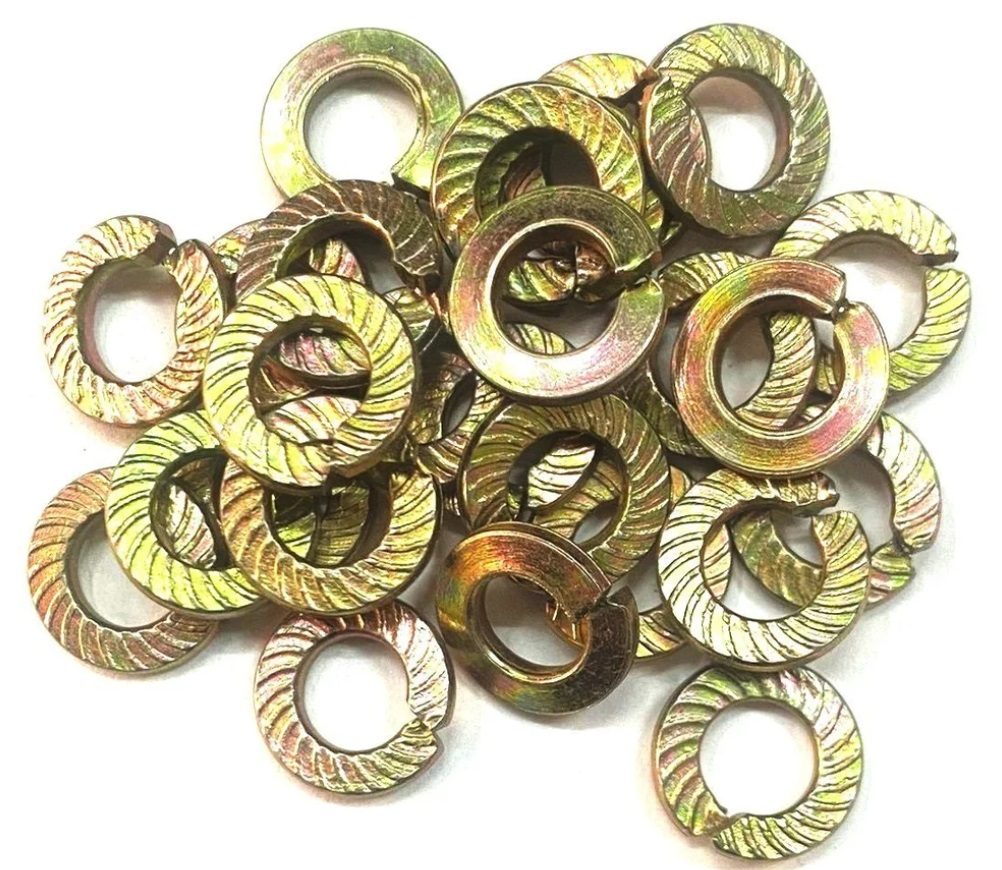
This is the most common type of spring washer you will see across industries. It is a ring cut at one point and twisted so the two ends are offset — like a single coil of a spring. When compressed, the sharp edges bite into the mating surfaces. This is widely used in general industrial and construction applications.
Standard dimensions follow DIN 127, which is one of the most referenced international standards for this type of spring washer.
Belleville Washer (Disc Spring Washer)
This is a conical or dome-shaped washer that provides high spring force in a small axial space. It is used where heavy clamp loads are needed in compact assemblies. Common in valve assemblies, pressure vessels, and heavy industrial equipment.
Wave Washer
A wave-shaped washer that provides lighter spring loads. Used in applications where you need to take up axial play without high clamping force — for example, in bearing assemblies and instrument housings.
Toothed Lock Washer
This has teeth on the inner or outer edge that bite into both the bolt head and the mating surface. Offers good locking performance and is used in smaller fastener assemblies, electrical panels, and light mechanical applications.
Crinkle Washer
A washer with a wavy or crinkled profile that acts as a light spring. Used in applications where consistent but light axial load is needed.
For most heavy industrial applications in India — infrastructure, energy, railways, petrochemical, and heavy manufacturing — the split lock washer (helical type) in grades HV 100, HV 200, or HV 300 is the standard requirement. For stainless steel grades, SS304 and SS316 are the most common specifications depending on corrosion resistance requirements.
Material and Grade Selection for Spring Washers — A Practical Guide
This is the section that most procurement teams should pay closest attention to. The wrong grade of spring washer is one of the most common and most avoidable mistakes in industrial fastener sourcing.
Mild Steel (MS)
Suitable for general applications where there is no significant corrosion risk and loads are moderate. Low cost and widely available. Not suitable for outdoor, marine, or chemically exposed environments.
Carbon Steel (High Tensile)
Used where higher spring force and greater hardness are required. Grades like HV 100, HV 200, and HV 300 are common in structural, wind energy, and infrastructure applications. These offer better mechanical performance than mild steel.
Stainless Steel SS304
For applications where corrosion resistance is needed — water treatment plants, food processing equipment, outdoor structures. Good all-round corrosion performance at moderate temperatures.
Stainless Steel SS316
For harsher environments — marine applications, chemical plants, offshore installations, and pharmaceutical industries. SS316 has better resistance to chloride corrosion compared to SS304, making it the right choice where salt water or aggressive chemicals are present.
The rule of thumb is simple — always match the spring washer grade to the environment it will operate in, not just the bolt grade. Many engineers make the mistake of specifying the right bolt grade but leaving the washer specification loose. That is where failures happen.
Common Standards for Spring Washers You Should Know
If you are working in a technical procurement role or engineering design, knowing the international standards for spring washers helps you write better specifications and evaluate suppliers correctly.
DIN 127 — The most widely used standard for split helical spring washers. Covers dimensions, tolerances, and hardness requirements. Applicable to M2 to M72 sizes.
ISO 7089 — Covers dimensions for plain washers and is referenced alongside spring washer specifications in many projects.
IS 6610 — The Indian standard for spring washers, equivalent to the DIN 127 in terms of dimensional and hardness requirements.
DIN 6796 — Specifically for conical spring washers used under bolt heads and nuts for high-load locking applications.
When you send an enquiry to a fastener supplier for a spring washer, always mention the standard, size (M size or inch size), grade, quantity, and surface finish requirement. A complete specification avoids confusion and ensures you receive exactly what your application needs.
Industries That Depend on Spring Washers Every Single Day
A spring washer is used across almost every industry that involves any kind of mechanical assembly. But some sectors have especially high dependency on this component:
Wind Energy — Wind turbines have tower sections bolted together with thousands of fasteners. These joints are under constant dynamic loading from wind forces. A spring washer at each joint helps maintain clamp load through the life of the tower. HV grade spring washers are the standard in this sector.
Railways — Rail tracks, bogies, rail fastening systems, and coach assemblies all experience continuous vibration. Fastener loosening in railway applications can have serious safety implications. Spring washers are therefore a critical part of every railway fastening specification.
Petrochemical and Oil and Gas — Flanged pipe connections and valve assemblies in these industries operate under high pressures and temperatures that cause thermal expansion and contraction. A spring washer helps maintain joint integrity through these thermal cycles.
Power Plants — Both thermal and nuclear power plants have equipment running continuously for years. Fasteners in these environments need to stay tight for long periods without maintenance access. Spring washers are part of the fastener assembly design in critical zones.
Infrastructure and Construction — Bridges, steel structures, and heavy civil engineering projects use structural bolts with spring washers to ensure joints do not loosen under dynamic loads like traffic, wind, or crowd movement.
Automotive and Heavy Equipment — Engine assemblies, suspension components, and drivetrain joints use spring washers to handle the vibration generated by engines and road surfaces.
What to Check When Sourcing Spring Washers in Bulk
For procurement teams buying spring washers in volume for industrial projects, here is a practical checklist that can save you from expensive mistakes:
Hardness Specification — A spring washer that is too soft will not maintain spring load. Too hard and it becomes brittle. The hardness should fall within the range specified by the standard (typically HRC 40-48 for carbon steel spring washers). Always ask for hardness test reports.
Dimensional Accuracy — Inner diameter, outer diameter, and thickness all affect how the spring washer performs. Even small deviations can cause the washer to sit unevenly or not engage the mating surface correctly. Dimensional inspection reports from the manufacturer are important.
Surface Finish — In corrosive environments, the surface coating of the spring washer must be compatible with the bolt and nut coating. Mixing different coating types can cause galvanic corrosion. Specify whether you need HDG (hot dip galvanised), zinc plated, zinc flake, or stainless steel as per your project requirement.
Material Traceability — For critical applications like power plants, railways, and bridges, you need batch traceability documentation. This means the manufacturer should be able to confirm which raw material heat number was used for each batch of washers.
Supplier Certifications — ISO 9001 certification is the minimum. For specific sectors like railways or nuclear, additional quality approvals may be required. Check if the manufacturer has the relevant certifications before placing a bulk order.
A Quick Word on Choosing the Right Supplier
India has a growing and capable fastener manufacturing industry. When you are sourcing spring washers for critical applications, choosing the right manufacturer matters as much as choosing the right specification.
A good spring washer supplier should offer multiple grades and sizes from a single source, have in-house testing capability, provide material traceability and test certificates, and be able to customise dimensions if your project has non-standard requirements.
One manufacturer worth knowing about in this space is Big Bolt Nut — based in Sonipat, Haryana, they manufacture and export spring washers in MS, HV 100, HV 200, HV 300, SS304, and SS316 grades, with size range from M16 to M72 and 1/2 inch to 3 inch. Their products are available in multiple surface finishes including HDG, zinc plated, zinc flake, black oxide, and Xylan coating. If you are evaluating suppliers for a bulk spring washer requirement, their product page at bigboltnut.com is a useful reference point for understanding the specification options available.
The Most Common Mistakes Engineers and Procurement Teams Make with Spring Washers
Before we close, let us quickly cover the mistakes that keep happening again and again in Indian industrial procurement — because awareness of these is what separates a good purchase from a costly one.
Using a flat washer where a spring washer is needed — This happens when engineers copy paste fastener specs from old drawings without reviewing the vibration environment of the new application. Always re-evaluate.
Choosing MS grade in corrosive environments — Mild steel spring washers in outdoor, marine, or chemical environments will corrode quickly and lose their spring properties. Always match grade to environment.
Not specifying the standard — Ordering “spring washers M20” without specifying the standard (DIN 127 or IS 6610 or others) means you may receive washers that differ in hardness, dimensions, or material from what your application actually needs.
Mixing coatings — Using a zinc-plated bolt with a hot dip galvanised spring washer (or vice versa) creates a potential galvanic corrosion risk. Always coordinate coating specifications across all fastener components.
Ignoring reuse limits — A spring washer that has been fully compressed to flat during assembly should generally not be reused, as it has lost its elastic properties. This is often ignored during maintenance, leading to inadequate clamp loads after reassembly.
Final Thoughts — Small Component, Big Responsibility
In engineering, we talk a lot about big systems — turbines, structures, pipelines, pressure vessels. But the reliability of every one of these systems ultimately depends on the smallest components holding everything together.
A spring washer costs a few rupees. The joint failure it prevents can cost lakhs — in downtime, repairs, and in the worst cases, in safety incidents.
The next time your team is reviewing a fastener specification or placing a bulk order for spring washers, give this component the attention it deserves. Check the grade. Check the standard. Check the coating. Check the supplier’s quality capability.
Because in industrial assembly, getting the spring washer right is not a small decision — it is one of the most important ones you will make for the long-term reliability of your plant, structure, or equipment.
And when you find a supplier who understands that — a supplier who can match grade, size, coating, and documentation to your exact requirement — hold on to that relationship. In the fastener world, a reliable source for a component as critical as the spring washer is worth its weight in gold.
