

Spare Parts Logistics Market Overview 2034
The global Spare Parts Logistics Market is experiencing substantial growth, driven by increasing industrial automation, expanding manufacturing activities, growing demand for efficient aftermarket services, and rising adoption of advanced supply chain management solutions. Industries are increasingly focusing on minimizing equipment downtime and ensuring continuous operational efficiency, making spare parts logistics a critical component of modern maintenance and service strategies.
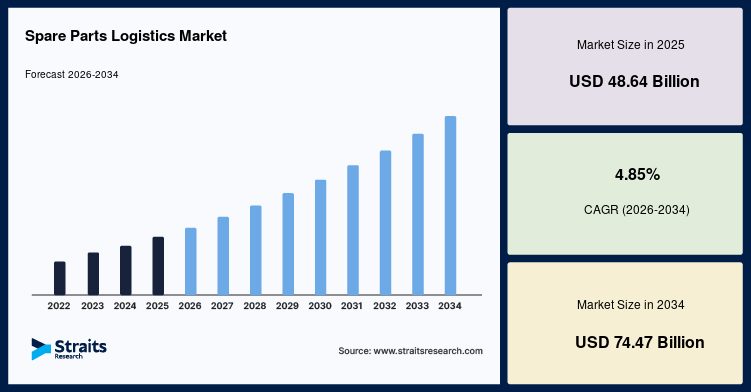
The global spare parts logistics market size was valued at USD 48.64 billion in 2025 and is projected to grow from USD 51 billion in 2026 to USD 74.47 billion by 2034 at a CAGR of 4.85% during the forecast period 2026-2034.
Spare parts logistics involves the planning, transportation, warehousing, inventory management, and distribution of replacement parts required for the maintenance and repair of equipment, machinery, vehicles, and industrial systems. Effective spare parts logistics helps organizations improve service levels, reduce downtime, optimize inventory costs, and enhance customer satisfaction. The growing complexity of global supply chains and increasing demand for rapid delivery services are expected to drive market growth throughout the forecast period.
Market Drivers
Increasing Demand for Aftermarket Services
The growing focus on equipment reliability and operational continuity is driving demand for efficient spare parts management and logistics solutions across industries.
Expansion of Manufacturing and Industrial Activities
Rapid industrialization and increasing manufacturing output are creating substantial demand for spare parts logistics services to support maintenance and repair operations.
Rising Adoption of Predictive Maintenance
Industries are increasingly utilizing predictive maintenance technologies to identify potential equipment failures, creating demand for timely spare parts availability and distribution.
Growth of E-Commerce and Digital Supply Chains
Digital platforms and e-commerce technologies are improving spare parts ordering, inventory visibility, and delivery efficiency, supporting market expansion.
Increasing Complexity of Global Supply Chains
Organizations are seeking advanced logistics solutions to manage complex spare parts networks and ensure timely delivery across multiple regions.
Market Challenges
Inventory Management Complexity
Maintaining optimal inventory levels for thousands of spare parts while minimizing carrying costs remains a significant challenge for organizations.
Supply Chain Disruptions
Global transportation delays, geopolitical uncertainties, and raw material shortages can impact spare parts availability and logistics operations.
High Transportation Costs
Expedited shipping requirements and global distribution networks can increase logistics expenses, particularly for critical spare parts.
Demand Forecasting Difficulties
Accurately predicting spare parts demand can be challenging due to varying equipment lifecycles, maintenance schedules, and unexpected failures.
Market Segmentation
The spare parts logistics market is segmented based on service type, transportation mode, end-user industry, organization size, and region.
By Service Type
The market includes:
-
Transportation Services
-
Warehousing Services
-
Inventory Management
-
Packaging Services
-
Reverse Logistics
Transportation services dominate the market due to the critical need for timely delivery of spare parts across industries.
By Transportation Mode
The market is categorized into:
-
Air Freight
-
Road Freight
-
Rail Freight
-
Sea Freight
Road freight accounts for a significant market share owing to its flexibility, accessibility, and suitability for regional spare parts distribution.
By End-User Industry
The market includes:
-
Automotive
-
Aerospace and Defense
-
Manufacturing
-
Energy and Utilities
-
Healthcare
-
Construction
-
Telecommunications
Manufacturing remains the dominant end-user segment due to extensive maintenance requirements and growing industrial automation initiatives.
By Organization Size
The market is segmented into:
-
Large Enterprises
-
Small and Medium-Sized Enterprises (SMEs)
Large enterprises hold a substantial market share due to extensive supply chain operations and complex spare parts management requirements.
Regional Insights
North America
North America dominates the spare parts logistics market due to advanced logistics infrastructure, strong industrial manufacturing capabilities, widespread adoption of digital supply chain technologies, and significant investments in predictive maintenance solutions. The United States remains the largest contributor to regional growth.
Europe
Europe represents a significant market supported by well-established industrial sectors, advanced transportation networks, and increasing adoption of Industry 4.0 technologies.
Asia-Pacific
Asia-Pacific is expected to witness the fastest growth during the forecast period due to rapid industrialization, expanding manufacturing industries, growing automotive production, and increasing investments in logistics infrastructure across China, India, Japan, and Southeast Asia.
Latin America
Latin America is experiencing steady growth driven by industrial development, expanding transportation networks, and increasing demand for maintenance and repair services.
Middle East & Africa
The Middle East & Africa region is emerging as a promising market due to infrastructure development projects, expanding industrial operations, and growing investments in logistics modernization.
Key Trends and Growth Opportunities
Adoption of Artificial Intelligence and Analytics
Organizations are increasingly utilizing AI-powered forecasting and inventory optimization solutions to improve spare parts availability and reduce logistics costs.
Growth of Predictive Maintenance Ecosystems
The integration of IoT sensors and predictive analytics is creating opportunities for proactive spare parts management and optimized logistics operations.
Expansion of Automated Warehousing
Advanced warehouse automation technologies, including robotics and automated storage systems, are improving efficiency and order fulfillment accuracy.
Increasing Focus on Same-Day and Critical Parts Delivery
Industries are demanding faster delivery services to minimize equipment downtime, creating opportunities for specialized logistics providers.
Key Players Analysis
The spare parts logistics market is highly competitive, with major logistics providers focusing on digital transformation, supply chain optimization, and global distribution capabilities.
Key companies operating in the market include:
-
DHL Supply Chain
-
Kuehne+Nagel International AG
-
DB Schenker
-
United Parcel Service, Inc.
-
FedEx Corporation
-
CEVA Logistics
-
DSV A/S
-
GEODIS
-
Ryder System, Inc.
-
XPO, Inc.
These companies are investing in digital supply chain technologies, warehouse automation, predictive logistics solutions, and global network expansion to strengthen their positions in the global spare parts logistics market.
For Detailed Insights, Visit:
https://straitsresearch.com/report/spare-parts-logistics-market
About Us
Straits Research is a leading research and intelligence organization, specializing in research, analytics, and advisory services, along with providing business insights and research reports.
Contact Us
Email: sales@straitsresearch.com
Tel: +1 646 905 0080 (U.S.), +44 203 695 0070 (U.K.)
