

Introduction
The Smart Irrigation Market encompasses advanced irrigation systems that leverage sensors, Internet of Things (IoT), data analytics, automation, and remote monitoring technologies to optimize water application across agricultural fields, golf courses, residential landscapes, and commercial turf. Smart irrigation systems intelligently manage water resources by integrating soil moisture data, weather forecasting, crop requirements, and real-time flow control, resulting in significant water savings, enhanced crop yields, reduced operational costs, and improved environmental sustainability.
Market Size and Growth Projections
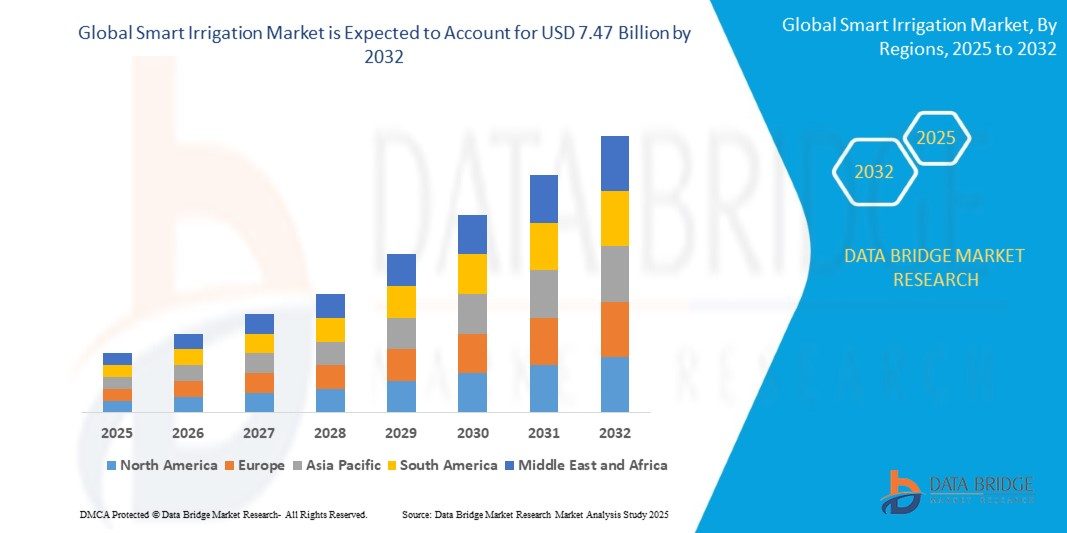
The smart irrigation market has experienced strong adoption globally and is projected to grow at a healthy compound annual growth rate (CAGR) over the forecast period. Growth is driven by increasing concerns over water scarcity, climate variability, and sustainable farming practices, combined with expanding investments in precision agriculture and water management technologies. Advancements in connectivity, autonomous control, and analytics platforms enhance the appeal of smart irrigation solutions for commercial, agricultural, and residential applications.
Get More Details : https://www.databridgemarketresearch.com/reports/global-smart-irrigation-market
Key Growth Factors
-
Increasing demand for water-efficient irrigation solutions
-
Rising adoption of precision agriculture and farm automation
-
Expansion of IoT and data analytics in agriculture and landscaping
-
Government initiatives promoting sustainable water management
-
Enhanced awareness of climate resilience and resource conservation
Market Segmentation
By Component
-
Hardware (Sensors, Controllers, Valves, Flow Meters)
-
Software & Platforms (Irrigation Management, Analytics Dashboards)
-
Services (Installation, Integration, Support & Maintenance)
Hardware components — especially soil moisture sensors and automated controllers — are foundational to smart irrigation systems, enabling real-time data acquisition and responsive irrigation control.
By Technology
-
Wireless Sensor Networks
-
Cloud-Based Irrigation Management
-
Edge Computing and Local Control Systems
-
AI & Predictive Analytics Integration
-
Remote Monitoring via Mobile/PC Interfaces
Cloud-based and AI-integrated systems are leading in adoption due to their scalability, real-time insights, and automated decision support.
By Application
-
Agricultural Irrigation (Field Crops, Orchards, Vineyards)
-
Landscape & Turf Irrigation (Parks, Golf Courses, Urban Greens)
-
Greenhouse & Controlled Environment Agriculture
-
Residential & Commercial Properties
Agricultural irrigation commands the largest market share due to large irrigation requirements and the potential for significant water and yield impact.
By End User
-
Farmers and Agricultural Enterprises
-
Landscape Management Firms
-
Municipal & Government Entities
-
Golf Courses and Sports Complexes
-
Residential Property Owners
Farmers and agricultural enterprises remain the primary adopters, driven by the need to optimize input costs and improve crop performance under variable climate conditions.
Regional Insights
Asia-Pacific leads the smart irrigation market due to intensive agricultural activity, strong adoption of digital farming practices, and government programs encouraging water-use efficiency in countries such as China, India, and Australia. North America follows with mature precision agriculture infrastructure, high technology adoption, and widespread use of satellite, sensor, and automation solutions. Europe demonstrates steady growth propelled by sustainability mandates, water resource policies, and environmental stewardship programs. Latin America and Middle East & Africa are emerging markets, supported by expanding irrigation infrastructure and investments in climate-smart agriculture solutions.
Key Market Drivers
The smart irrigation market is largely driven by global efforts to conserve water resources, increase agricultural productivity, and enhance sustainability. Climate change and growing incidence of drought events have increased pressure on water availability, prompting adoption of systems that minimize waste and tailor water delivery to real, measured plant needs. Integration of weather forecasts and evapotranspiration (ET) data further refines irrigation schedules, reducing unnecessary application and labor demands.
Market Challenges and Restraints
Despite strong potential, the market faces challenges such as high initial costs for advanced systems, connectivity and infrastructure gaps in rural regions, and data analytics complexity for non-technical users. Integration with legacy irrigation systems, variability in soil and crop types, and the need for ongoing calibration and maintenance can also pose barriers for widespread adoption. Additionally, fragmented regulatory environments for water pricing and usage rights may affect investment incentives.
Competitive Landscape with Key Companies
-
Netafim Ltd.
-
Rain Bird Corporation
-
The Toro Company
-
Valmont Industries, Inc.
-
Hunter Industries
-
Lindsay Corporation (Zimmatic)
-
Jain Irrigation Systems Ltd.
-
CropX Technologies
Leading players emphasize sensor integration, predictive analytics platforms, automated control solutions, and global service networks to deliver comprehensive smart irrigation offerings tailored to diverse landscapes and agricultural needs.
Technological Innovations
Technological advancements driving the smart irrigation market include AI-powered predictive irrigation scheduling, multi-sensor fusion for soil, weather, and crop status, edge-enabled controllers with low-latency automation, and drone or satellite data integration for field-wide insights. Innovations in energy-efficient remote sensing, water flow optimization algorithms, and mobile application interfaces enhance user experience and system responsiveness.
SWOT Analysis
| Strengths | Weaknesses |
|---|---|
| Improves water efficiency and crop productivity | High initial investment costs |
| Enables real-time, data-driven irrigation control | Connectivity and infrastructure challenges |
| Supports sustainability and climate resilience | Complexity for non-technical users |
| Opportunities | Threats |
|---|---|
| Integration with precision agriculture ecosystems | Economic fluctuations affecting CAPEX |
| Growth in climate-smart and resource-efficient farming | Regulatory variability in water usage policies |
| Expansion of AI and IoT analytics tools | Competition from traditional irrigation systems |
Future Market Outlook
The future outlook for the smart irrigation market is highly positive as water scarcity concerns, climate variability, and digital agriculture adoption accelerate. Continued investment in AI analytics, sensor technologies, and automation platforms will expand system effectiveness and accessibility. Partnerships between technology providers, agricultural extension services, and government programs will further support adoption among small and mid-sized farms. Smart irrigation is expected to play a central role in sustainable agriculture, precision water management, and climate adaptation strategies globally.
Conclusion
The Smart Irrigation Market is transforming how water is managed in agricultural and landscape environments by enabling precision, efficiency, and sustainability. With strong momentum across global regions and cross-sector applications, smart irrigation solutions are becoming essential tools for optimizing water use, enhancing crop performance, and supporting environmental stewardship. Continued technological innovation, supportive policies, and expanded education and services will drive long-term growth and broader adoption of intelligent irrigation systems worldwide.
