

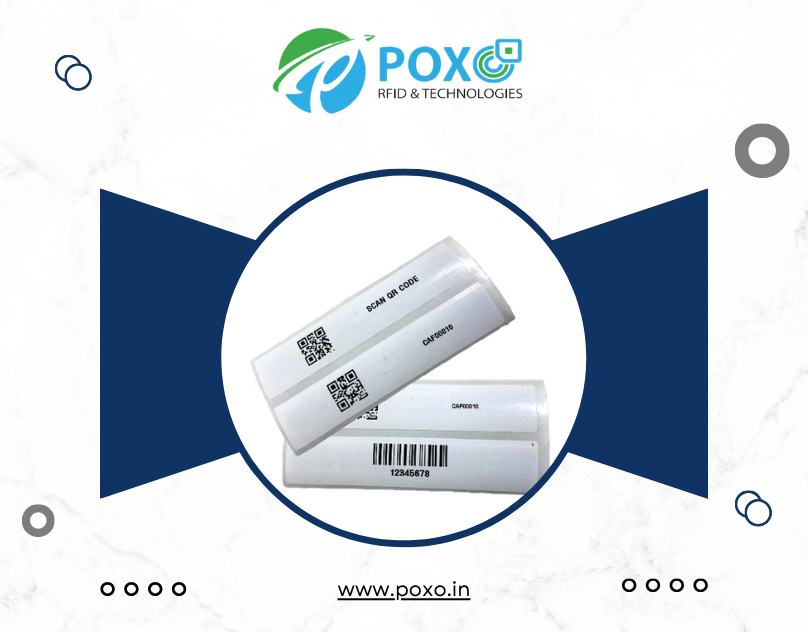
An RFID tag has stored information that can be read from longer distances without line of sight. This property makes RFID tags very effective for inventory control, shipment tracking, and increasing security.
In this article, we will address different types of RFID tags: active, passive, and semi-passive, and touch on when and how they each work well. A thorough understanding of the different tags will show the ways efficiency is affected in industries like retail, logistics, and manufacturing.
What Is an RFID Tag?
RFID tags are small devices that electronically store data. RFID tags are unique microchips that are paired with an antenna to wirelessly transmit information over radio waves. RFID tags access data automatically for tracking and identifying an item quickly and accurately.
Core Components
Most RFID tags have two basic components, a microchip, which is the main functionality of RFID tags, and an antenna, which lets the RFID tag send and receive radio waves. Tags will operate with RFID readers that transmit waves of radio signals that energize the tag and read its stored data. Some tags may also have a battery that will actively send radio signals. It should be apparent that this is a simple method that practices fast and wireless identification of objects.
How RFID Works
When an RFID reader sends a radio signal, it reaches the tag’s antenna. In passive tags, this signal powers the microchip, which then sends back the stored data. In active tags, the built-in battery powers the reply.
The reader picks up this return signal, decodes the data, and sends it to a computer system. This process works without any need for the tag to be visible or touched. It also allows reading many tags in seconds, making it efficient for tracking.
Types of RFID Tags
RFID tags fall mainly into passive, active, and semi-passive types.
- Passive tags do not have batteries. They rely entirely on the reader’s radio signal for power. They last longer and cost less but have shorter reading distances.
- Active tags have a battery that allows them to send signals independently. They work over longer distances but have limited lifespans because of battery life.
- Semi-passive tags use batteries for their microchip only, but still rely on the reader to communicate. This balances power use and reading range.
Each type fits different needs depending on how far and how often items must be tracked.
Applications of RFID Tags
RFID tags help us track and manage items more accurately and quickly. They reduce errors and save time in busy environments. We rely on them in many areas to improve visibility and control over goods and assets.
Inventory Management
We utilize RFID tags to enhance our inventory tracking. RFID tags allow us to scan multiple items at a time without the necessity to handle each item individually, speeding up our stocktaking and reducing inaccuracies. With regards to RFID, we are able to monitor product movement in real time, leading to less lost product and fewer out-of-stock scenarios, as well as speeding up replenishment due to our knowledge of what is on hand. RFID tags provide us with the ability to track any item of inventory from merchandise in your retail operation to stock in a large warehouse. RFID is inherently more accurate than barcode tracking as RFID does not require line of sight scanning.
Supply Chain Tracking
RFID tags significantly improve our ability to track product through the supply chain, from production until it reach our delivery location. We can follow each step of the shipment and verify that it has reached its intended destination, reducing the chance of delay and loss. It not only provides us clear view of the location of goods, but also their movement. Such visibility allows us to identify bottlenecks in the process and improve logistics. RFID can also facilitate automatic verification of shipments, thus saving time on checks. When used for supply chain, RFID can help to connect data between suppliers, transporters, and retailers, which generates improved flows of goods as well as enhanced communication and coordination at all levels of the supply chain.
Asset Identification
RFID tags let us identify and manage valuable assets easily. By tagging equipment or tools, we know their location and usage history. This helps prevent loss and theft.
We can also schedule maintenance more effectively by using data from RFID tags. Knowing when an asset was last serviced helps us keep it in good condition and avoid breakdowns.
For businesses, RFID in asset identification supports compliance and auditing. The tags provide reliable, up-to-date records without extra manual work. This makes managing assets simpler and safer.
Benefits of Using RFID Tags
RFID tags enable us to monitor and control items with greater speed and accuracy. They provide us with immediate information and fewer errors, allowing us to streamline many processes and save time.
Increased Efficiency
RFID tags allow for more efficient operations because they can identify many items all at once. With RFID, you don’t need a line of sight or to manually handle items one by one as with barcodes. This eliminates time spent checking inventory or shipping products.
We can reduce manual work and other labor costs and errors associated with human error. The processes involved with the RFID system, for example, sorting, stocking, and asset tracking, are vastly simplified and sped up.
This efficiency can be especially valuable for busy warehouses, retail warehouses and store fronts, and manufacturing plants, when quick movement are required.
Improved Accuracy
RFID tags are the most accurate option we have available, in fact, this partly relies on the technology itself. The data is always captured automatically and electronically. Each RFID tag has a unique ID, which protects us from duplicating or getting confused by similar identification numbers. Access to correct records lets us know where our items are and when they move.
Because RFID data is accurate, it helps us avoid stock mistakes, like running out of items or ordering too much of something.
Better quality information results in better decision-making and trust in our results and inventory systems.
Real-Time Visibility
RFID technology delivers real-time data. As soon as an RFID tag passes a reader we are aware of its location, time stamp, and status.
This is critical for visibility, as it allows us to respond to changes, such as restocking or locating lost assets, quickly.
Real-time data allows for a reduction of lag and increased control in supply chain management.
We have visibility into our inventory flow from beginning to end, without having to wait for manual reports. Our control and operations are smoother, because we can take corrective action when we actually observe the data.
Emerging capabilities
RFID tag technology continues to advance along several of the significant distinctions of RFID tag types. These include a preference for smaller size, connections to the Internet of Things (IoT), and new materials. As tags improve and evolve, they impact our ability to track, analyze, and manage items across industries.
Miniaturization
RFID tags are becoming much smaller and more affordable. This shrinking size helps us place tags on small or delicate items that were hard to tag before. We can now tag medical supplies, small tools, or electronics with ease.
Along with size, these smaller tags still keep strong performance. Advances in chip design mean tags can read from longer distances despite being tiny. This lets us track items better without losing accuracy.
Miniaturization also makes RFID more accessible to smaller businesses. Lower costs and flexible designs open new uses in healthcare, agriculture, and retail.
Integration with IoT
We are seeing RFID tags link more closely to IoT systems. This connection helps us collect data in real time and send it directly to cloud platforms for analysis.
By integrating with IoT, RFID tags contribute to smarter supply chains. For example, tags can alert us instantly if temperature or location changes, improving inventory control.
Smart RFID systems use AI and machine learning on collected data. This allows us to predict maintenance needs or detect problems early in tracked assets.
Sustainable Materials
Sustainable options are becoming more important in the creation of RFID tags. We have already implemented some sustainable or recyclable materials, in order to lessen the effect that we can have on the environment.
Various options are now available to limit the harmful effects of RFID tags. Examples would include biodegradable substrates, along with inks that limit the harmful effects. This is going to reduce the footprint from RFID tags overall, especially for one–time–use RFID tags and large-volume manufactured tags.
Furthermore, by utilizing sustainable materials, we enable industries to support their own green endeavors. Sustainable practices and products are important to industries like agriculture, food packaging, and retail, to benefit consumer marketing with eco-friendly products.
When early adoption of smart, scalable RFID solutions are in your organizational goals, Poxo designs RFID tags and systems for industrial applications. Operational gains in retail and logistics. With greater control, accuracy, and reliability in all aspects of your business.
