

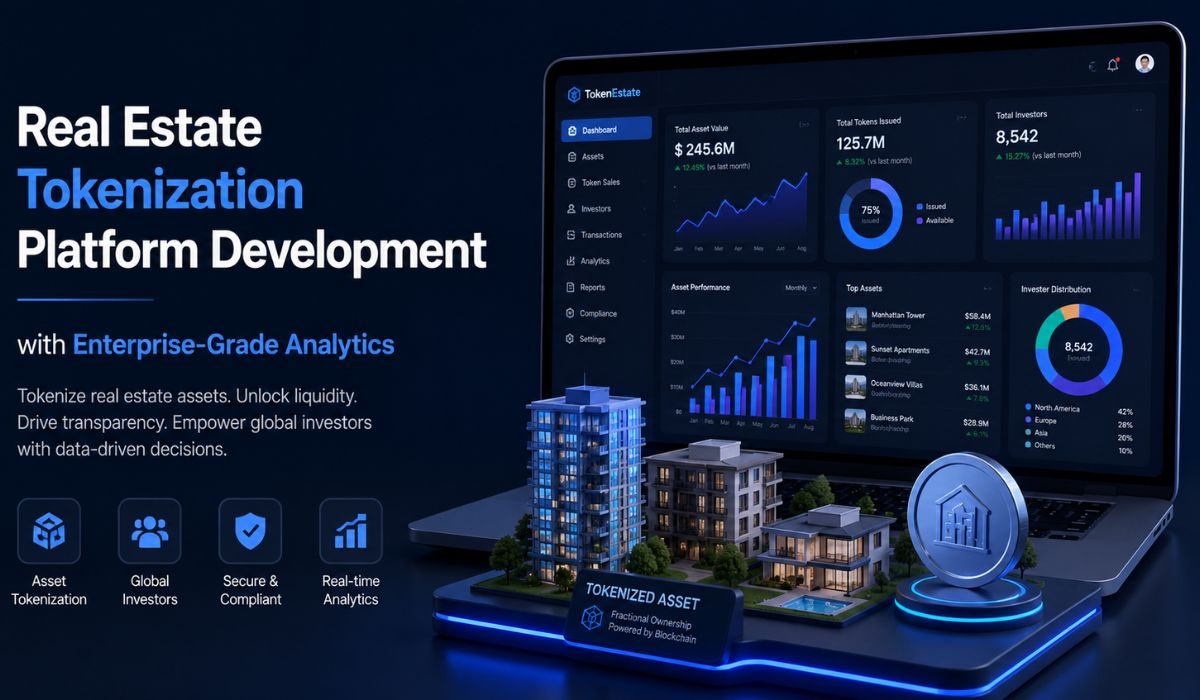
The real estate market has long been known for its stability and long-term investment potential. However, traditional property investment often comes with high capital requirements, lengthy transactions, and limited liquidity. Businesses are now adopting blockchain-based platforms to modernize how real estate assets are managed, traded, and monitored. Along with digital ownership, organizations also expect meaningful business intelligence to evaluate performance, investor activity, compliance, and portfolio growth.
This is where Real Estate Tokenization Platform Development with enterprise-grade analytics becomes valuable. Beyond creating digital tokens that represent property ownership, businesses require reporting systems that convert operational data into actionable insights. From monitoring token circulation and investor participation to analyzing asset performance and transaction history, analytics help organizations make informed business decisions. Whether serving commercial developers, investment firms, property managers, or institutional investors, analytics play an important role throughout the lifecycle of digital real estate assets.
Understanding Real Estate Tokenization Platform Development
Real Estate Tokenization Platform Development refers to the process of creating blockchain-based platforms where physical property ownership is represented through digital tokens. Every token represents a fraction of ownership, allowing multiple investors to participate in a single property without purchasing the entire asset.
Unlike traditional investment models, tokenized platforms provide digital records for ownership, transactions, compliance, and investor activities. These records become valuable data sources that businesses can analyze continuously.
A professional Real Estate Tokenization Development company generally develops platforms with features such as:
- Property listing management
- Investor onboarding
- Token issuance
- Smart contract execution
- Wallet integration
- Compliance verification
- Asset management dashboards
- Reporting and analytics modules
While tokenization manages ownership efficiently, enterprise analytics help organizations understand how the platform performs from both operational and financial perspectives.
Why Enterprise Analytics Matter in Tokenized Real Estate
Analytics provide much more than charts and graphs. They offer measurable information that supports daily operations and long-term planning.
Organizations managing several tokenized properties need answers to questions such as:
- Which assets receive the highest investor participation?
- How many token transfers occur every month?
- Which regions attract more investments?
- What percentage of tokens remain unsold?
- How frequently are rental distributions completed?
- Which investors are most active?
Without organized reporting, these answers require manual work across multiple systems.
Enterprise analytics consolidate information into one environment, allowing decision-makers to evaluate portfolio performance, identify operational gaps, and plan future investments.
Companies investing in real estate tokenization development increasingly view analytics as an operational requirement rather than an optional feature.
Data Collection Across the Entire Platform
Analytics begin with accurate data collection.
Every activity performed on the platform generates valuable information. Enterprise systems continuously collect data from multiple modules, including:
Investor Activity
Investor registrations, wallet connections, KYC approvals, investment history, and token purchases create valuable behavioral insights.
Businesses can identify investor preferences, investment frequency, average investment values, and regional participation.
Property Performance
Every listed property generates operational data including:
- Occupancy rates
- Rental income
- Property valuation
- Token availability
- Asset appreciation
- Dividend distributions
Monitoring these indicators helps organizations compare multiple properties efficiently.
Transaction Records
Blockchain transactions create permanent records containing:
- Token transfers
- Ownership updates
- Marketplace activities
- Distribution history
- Smart contract execution logs
These records become useful when generating financial reports or conducting audits.
Compliance Activities
Enterprise platforms also collect information regarding:
- KYC verification
- AML screening
- Regulatory reporting
- Document verification
- Audit trails
These reports simplify regulatory monitoring for businesses operating across multiple jurisdictions.
Portfolio Analytics for Enterprise Investors
Many organizations manage dozens or even hundreds of tokenized properties.
Portfolio analytics combine information from all investments into centralized dashboards.
Executives can monitor:
- Total portfolio valuation
- Asset allocation
- Geographic distribution
- Rental income trends
- Occupancy statistics
- Monthly investment inflows
- Token circulation
- Asset appreciation
Instead of reviewing individual reports separately, management teams obtain a complete portfolio overview.
A Real Estate Tokenization company serving institutional clients often considers portfolio analytics a standard requirement.
Investor Behavior Analysis
Understanding investor behavior supports better business planning.
Enterprise-grade reporting can identify:
- Most active investment periods
- Frequently traded assets
- Long-term investors
- Short-term participants
- Average holding periods
- Repeat investment patterns
- Preferred investment categories
These insights help organizations improve investor communication and introduce suitable investment opportunities.
Investor analytics also assist marketing teams in evaluating campaign performance across different regions.
Property Performance Dashboards
Every property generates operational metrics beyond token sales.
Enterprise dashboards typically display:
Rental Revenue
Businesses monitor recurring rental income and compare monthly trends.
Occupancy Performance
Vacancy rates directly influence investment returns. Analytics highlight changes over time.
Property Appreciation
Market valuation changes are tracked alongside investment performance.
Dividend Distribution
Organizations monitor payment schedules, completed distributions, pending transfers, and investor payouts.
Asset Utilization
Commercial buildings, residential apartments, warehouses, and hospitality properties generate different usage statistics.
Comparing utilization helps businesses allocate future investments more effectively.
Token Economy Monitoring
Digital tokens have their own operational lifecycle.
Enterprise analytics monitor:
- Tokens issued
- Tokens sold
- Unsold inventory
- Secondary market transactions
- Token redemption
- Burn events
- Ownership concentration
Businesses gain a better understanding of token circulation and market activity.
These reports become increasingly valuable as more assets enter the platform.
Risk Monitoring Through Analytics
Risk management becomes easier when businesses receive continuous reporting instead of waiting for periodic reviews.
Enterprise analytics identify situations such as:
- Unusual trading activity
- High transaction frequency
- Concentrated ownership
- Compliance violations
- Suspicious wallet behavior
- Delayed rental payments
- Reduced occupancy
- Property value fluctuations
Early identification allows organizations to respond before problems affect larger investment portfolios.
This reporting approach adds value to Real Estate Tokenization Development Services offered to enterprise clients.
Executive Dashboards for Decision Makers
Senior management requires concise reports rather than operational details.
Executive dashboards present summarized information such as:
- Portfolio growth
- Monthly revenue
- Investment trends
- Regional performance
- Investor growth
- Compliance status
- Token circulation
- Financial summaries
These dashboards reduce reporting time while supporting faster management decisions.
Different departments can also receive dashboards designed for finance, compliance, operations, investor relations, and property management.
Compliance Reporting for Enterprise Operations
Regulatory compliance remains an important consideration for digital investment platforms.
Enterprise reporting simplifies documentation by generating reports for:
- Investor verification
- AML monitoring
- Transaction history
- Audit records
- Ownership changes
- Tax reporting
- Distribution records
Businesses no longer need to compile reports manually before audits.
A Real Estate Tokenization Development company often integrates automated reporting to reduce administrative work while maintaining accurate records.
Multi-Property Performance Comparison
Organizations rarely manage only one property.
Enterprise analytics compare assets based on:
- Revenue generation
- Investor participation
- Property appreciation
- Rental performance
- Geographic demand
- Vacancy levels
- Token sales
- Operational costs
These comparisons help investment firms prioritize future acquisitions and portfolio expansion.
They also assist management when evaluating underperforming assets.
Predictive Business Insights
Historical information provides useful business intelligence when combined with analytical models.
Enterprise reporting may estimate:
- Future investment demand
- Seasonal investment activity
- Rental income projections
- Property appreciation trends
- Occupancy forecasts
- Dividend expectations
Rather than relying solely on historical reports, organizations can prepare for expected market conditions using data collected over time
Integration with Enterprise Business Systems
Analytics become more useful when connected with existing enterprise software.
Many organizations integrate reporting with:
- ERP platforms
- CRM software
- Accounting systems
- Property management applications
- Business intelligence tools
- Financial reporting platforms
This integration reduces duplicate work while maintaining consistent reporting across departments.
Businesses investing in Real Estate Tokenization Platform Development often request these integrations during implementation.
Security Monitoring Through Analytics
Security reporting is another important aspect of enterprise platforms.
Analytics help administrators monitor:
- Login history
- Device activity
- Wallet access
- Failed authentication attempts
- Administrative actions
- Smart contract interactions
- API usage
- System alerts
Continuous monitoring supports internal governance and operational oversight.
Combined with blockchain records, organizations maintain reliable audit documentation for internal reviews.
Supporting Long-Term Business Growth
Enterprise analytics continue providing value long after a platform goes live.
As additional properties enter the ecosystem, reporting becomes increasingly useful for:
- Investment planning
- Portfolio management
- Budget allocation
- Resource planning
- Market expansion
- Investor engagement
- Operational improvement
- Financial analysis
Organizations that regularly review performance data are better positioned to refine their strategies and improve business outcomes over time.
For companies planning large-scale real estate asset tokenization initiatives, analytics become an ongoing business resource rather than a reporting feature.
Conclusion
Real Estate Tokenization is changing how businesses manage property ownership, investment participation, and digital asset operations. However, successful platforms depend on more than token issuance and blockchain records. Enterprise-grade analytics provide meaningful insights into investor activity, property performance, compliance, financial reporting, token circulation, and operational efficiency. These reporting capabilities help organizations evaluate business performance with greater confidence while supporting informed decision-making across multiple departments. Businesses planning long-term Real Estate Tokenization Platform Development should consider analytics from the beginning rather than adding them later. Blockchain App Factory provides Real Estate Tokenization Services, helping enterprises develop secure platforms with comprehensive reporting, analytics, compliance support, and business-focused solutions for modern real estate investment ecosystems.
FAQs
1. What is enterprise-grade analytics in a real estate tokenization platform?
Enterprise-grade analytics refers to reporting tools that collect and present information related to property performance, investor activity, token transactions, compliance records, financial performance, and portfolio growth. These insights help businesses monitor operations and make informed decisions.
2. Why are analytics important in Real Estate Tokenization Platform Development?
Analytics provide visibility into investment trends, asset performance, rental income, investor participation, and compliance activities. Businesses can identify opportunities, monitor operational efficiency, and improve portfolio management using accurate reports.
3. Can analytics support multiple tokenized properties?
Yes. Enterprise analytics are designed to monitor multiple properties from a centralized dashboard. Businesses can compare revenue, occupancy, investor participation, token sales, and overall asset performance across different locations.
4. What business systems can integrate with a tokenization platform?
A platform can integrate with ERP software, CRM systems, accounting applications, property management software, business intelligence platforms, payment gateways, and compliance solutions to maintain consistent reporting across departments.
5. How does a Real Estate Tokenization Development company implement analytics?
A Real Estate Tokenization Development company develops reporting modules that collect blockchain transaction data, investor records, financial information, compliance logs, and property metrics. These datasets are presented through dashboards, reports, and performance indicators that support business management.
