

In today’s fast-moving digital economy, automation has moved from being a back-office convenience to a core product and operational strategy. For tech product companies—especially early-stage startups and scaling teams—automation efficiencies can drive faster release cycles, higher productivity, and even new revenue streams. According to Gartner, more than 85% of enterprise applications will include some level of automation by 2026, underscoring how essential these tools have become.
However, automation has grown increasingly complex. Simple “if this, then that” workflows no longer cut it. Platforms now integrate AI workflows, intelligent triggers, and generative logic that stretch beyond basic task automation. Choosing the wrong platform can cost time, money, and engineering bandwidth especially for startups operating with lean teams.
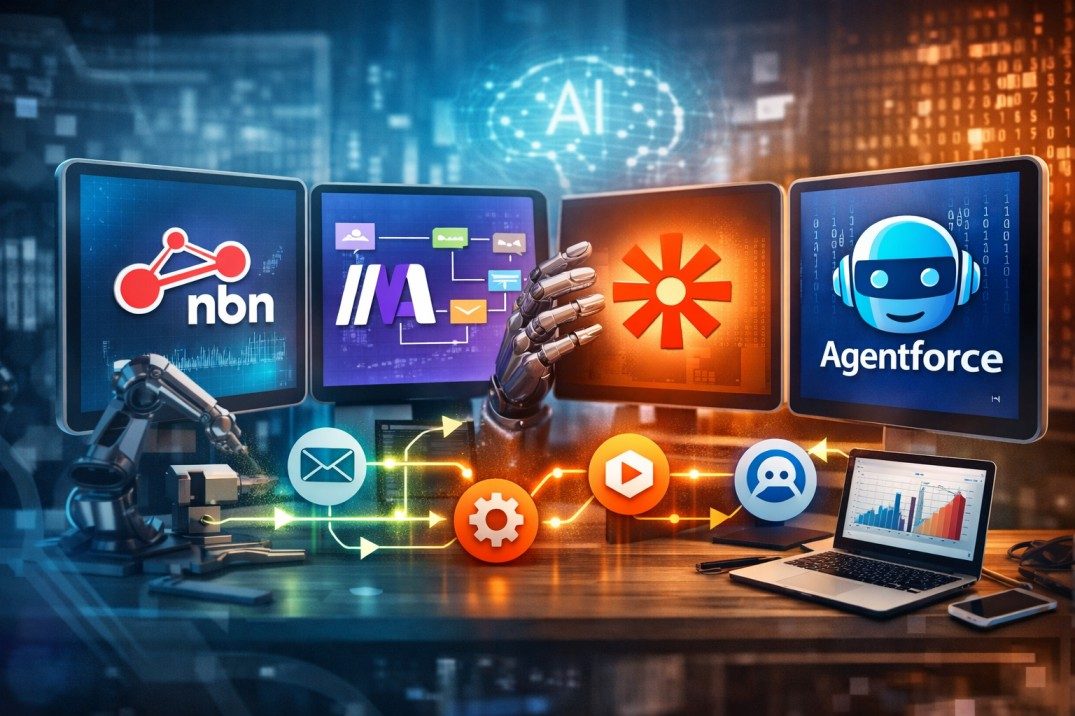
This article compares four leading automation platforms n8n, Make, Zapier, and Agentforce—through a strategic lens, helping you choose the best fit for your product roadmap and operational needs. Along the way, we’ll highlight when expert support like AI Consulting Solutions can accelerate adoption and ensure success.
The Rise of AI-Enabled Automation in the Startup Tech Stack
In 2025, automation isn’t just about reducing manual work it’s about embedding intelligence into workflows. Modern platforms increasingly incorporate artificial intelligence to understand context, handle decision logic, and respond dynamically to changing states.
AI-driven automation extends far beyond repetitive tasks. It includes things like classifying data, generating content, triggering complex sequences based on predictions, and orchestrating cross-system processes. For product teams, this means workflow logic that previously required custom engineering can now be assembled rapidly using platform tools.
However, the landscape is crowded, and startups must weigh trade-offs between ease of use, extensibility, integration depth, and AI sophistication.
Why This Comparison Matters
With dozens of automation platforms available, teams often default to the most familiar names—like Zapier—without evaluating how well they solve long-term needs. Each platform supports automation, but not all platforms are equally suited for AI-first workflows or enterprise-level extensibility. Selecting the right platform impacts:
-
Product velocity
-
Operational resilience
-
Long-term maintainability
-
Cost structure
-
Competitive differentiation
For example, an eCommerce startup might need dynamic AI triggers that respond to user sentiment data, while a SaaS provider might need automation that bridges internal systems and external APIs with robust error handling. These goals require different automation capabilities.
Additionally, many startups underestimate the importance of structured support. Partnering with experienced AI Consulting Solutions helps teams architect automation strategically rather than incrementally.
Evaluation Criteria: What to Consider When Choosing an Automation Platform
Before comparing platforms, it’s important to define a set of evaluation criteria that matter most in modern automation.
First, integration breadth and ecosystem support define how many tools and systems a platform can connect to, whether CRM systems, analytics pipelines, or bespoke internal APIs.
Second, AI automation capabilities including support for generative models, natural language understanding, and AI-triggered conditions—set modern platforms apart from legacy automation tools.
Third, customization and extensibility determine whether a platform can grow with your product’s complexity. Startups often outgrow simple triggers and require branching logic, error compensation, custom scripts, or hooks.
Finally, considerations around governance, security, and scaling are essential for startups transitioning from early stage to broader adoption.
These criteria support a structured comparison rather than an ad-hoc choice driven by familiarity or marketing.
n8n: Open, Extensible, and Developer-Friendly Automation
n8n is widely recognized for its open-source, extensible design. Unlike many proprietary automation tools, n8n allows teams to self-host workflows and connect deeply with internal systems. This makes it highly attractive for startups that prioritize control, data governance, and integration flexibility.
One of n8n’s distinguishing characteristics is its developer-friendly nature. It supports custom code nodes, which allow teams to inject logic directly into workflows when needed. This is a powerful differentiator for teams building complex orchestrations that go beyond simple event triggers.
From an AI perspective, n8n can be integrated with external machine learning APIs or on-premise models as part of broader AI Consulting Solutions engagements. This means teams can combine n8n’s flexible workflow layer with custom intelligence pipelines tailored to their product needs.
However, n8n’s flexibility comes with a learning curve. Teams without dedicated engineering resources may need external support to tap into its full potential, particularly when integrating AI workflows or architecting scalable automation.
Make: Visual, Powerful, and Highly Flexible for Complex Workflows
Make provides a visually intuitive automation builder with strong support for complex data transformation. Its modular interface allows teams to design intricate workflows that include branching, loops, and conditional logic without writing code.
This visual paradigm makes Make particularly appealing to hybrid teams where both technical and non-technical contributors need visibility into automation logic. For example, a product operations team can design multi-step workflows involving data enrichment, CRM updates, and downstream notifications.
Make also integrates with a wide variety of services, and supports AI workflows via external connectors—although this typically requires additional configuration or integration with an AI service provider.
The platform’s strength lies in balancing power with accessibility. Complex workflows can be built without extensive engineering, but this comes with trade-offs. Make’s billing model, which charges based on operations and complexity, can become expensive at scale. For startups with rapidly growing automation needs, careful planning and optimization are needed to manage cost effectively.
Zapier: Simplicity and Ecosystem Breadth for Rapid Automations
Zapier is often the first automation tool startups reach for, and for good reason: it is simple, widely adopted, and integrates with over 5,000 apps across business and productivity categories. Its core strength is enabling teams to automate routine processes quickly without writing code.
For basic or mid-tier automation needs such as syncing contacts, triggering notifications, or routing form submissions, Zapier is hard to beat in terms of speed of implementation.
Zapier also offers AI actions that integrate generative responses or decision logic triggered by events. However, these AI capabilities are more limited compared to platforms built with AI workflow automation in mind. Zapier tends to focus on breadth rather than depth.
While ideal for early automation needs, Zapier’s limitations surface as workflow logic grows in complexity or when teams need tight integration with internal systems. In such cases, startups often transition to platforms like Make or n8n.
Agentforce: AI-Native Automation with Intelligent Agents
Agentforce represents a newer paradigm in automation: AI-centric automation driven by autonomous agents rather than triggers and actions. Instead of predefined workflows, Agentforce’s model allows systems to respond dynamically based on context, goals, and environment—making it well suited to AI-heavy use cases like intelligent assistants or self-healing operational workflows.
For startups building autonomous or product-embedded automation features, Agentforce offers a differentiated value proposition. It aims to handle decision points, multi-step reasoning, and task execution with minimal manual orchestration.
However, its relative maturity in the market and narrower integration ecosystem can be limitations compared to more established tools like n8n, Make, or Zapier. Deploying Agentforce effectively often requires close alignment with AI Consulting Solutions to define boundaries, guardrails, and operational validation.
Side-by-Side Comparison
When comparing these platforms, several key differences emerge:
-
Integration capabilities: Zapier leads in sheer app count; Make and n8n excel at deep, structured integration.
-
AI maturity: Agentforce leads in AI-centric automation; n8n supports custom AI workflows via integration; Make and Zapier leverage external AI sources.
-
Customization and developer control: n8n offers the most extensibility; Make balances power with accessibility; Zapier prioritizes ease of use.
-
Cost and scalability: Zapier is great for early automation needs; n8n and Make offer scalable options with engineering investment.
A concise comparison table (omitted here for brevity) can help decision-makers quickly assess which attributes matter most for their use cases.
Choosing the Right Platform for Your Business
No single platform is universally “best.” The right choice depends on:
-
Product maturity: Early startups may prioritize ease of use; scaling teams need extensibility and performance.
-
Engineering capacity: Teams with engineering bandwidth benefit from n8n’s flexibility; others may prefer Make or Zapier.
-
AI requirements: Intelligent, autonomous automations favor platforms like Agentforce or custom workflows with n8n.
Engaging the right AI Consulting Solutions partner early helps clarify requirements, prevent costly architectural mistakes, and ensure the automation stack aligns with the broader product roadmap.
Implementation Best Practices Across Platforms
Regardless of platform choice, certain best practices ensure success:
-
Define clear automation goals and metrics before building workflows
-
Modularize processes to support reuse and governance
-
Monitor execution, latency, and error rates to prevent silent failures
-
Manage credentials and permissions securely to protect data
Treat automation as part of the product engineering lifecycle, not a one-off side project.
Future Trends in AI Automation Platforms
Looking forward, automation platforms are converging with AI agents, predictive workflows, and self-optimizing automation patterns. The integration of generative AI into core automation engines will enable end-to-end decisioning and planning within workflows. As this trend accelerates, platforms that lower the barrier to intelligent orchestration will gain strategic advantage among startups and scaling product companies.
Conclusion: Making a Decision With Confidence
Selecting the right automation platform is a strategic decision that impacts scalability, cost, and product velocity. Zapier offers rapid, easy automation for early needs. Make balances visual design with powerful workflows. n8n delivers flexibility and extensibility ideal for engineering-led teams. Agentforce introduces intelligent, autonomous automation.
Startups that align platform choice with business priorities and engage experienced AI Consulting Solutions where needed—can unlock exponential productivity gains and future-proof their automation stack.
Sources –
https://www.valuecoders.com/blog/ai-ml/n8n-vs-make-vs-zapier-vs-agentforce/
https://www.linkedin.com/pulse/n8n-vs-make-zapier-agentforce-which-ai-automation-platform-lekhi-qgg9c
https://finbyz.tech/n8n/insights/n8n-vs-zapier-vs-make-comparison
