

The global Multiple Sclerosis Drugs Market is experiencing steady growth as the prevalence of multiple sclerosis (MS) continues to rise and pharmaceutical companies invest heavily in developing advanced disease-modifying therapies (DMTs). Multiple sclerosis is a chronic autoimmune disease that affects the central nervous system, damaging the protective myelin sheath surrounding nerve fibers and leading to progressive neurological impairment. Increasing awareness, early diagnosis, and continuous innovation in targeted therapies are significantly contributing to market expansion.
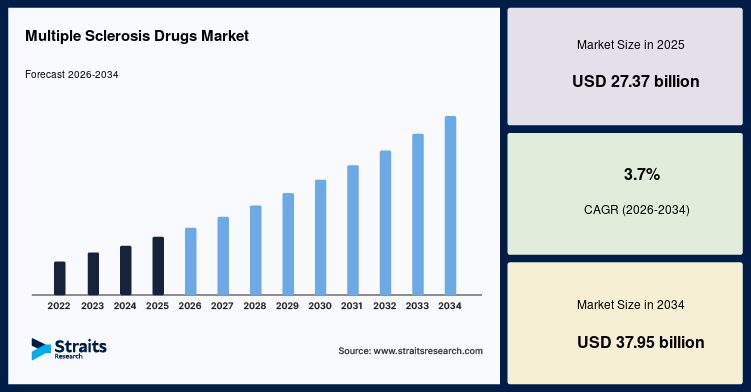
According to industry analysis, the global Multiple Sclerosis Drugs Market size was valued at USD 27.37 billion in 2025 and is projected to grow from USD 28.38 billion in 2026 to USD 37.95 billion by 2034, exhibiting a CAGR of 3.7% during the forecast period (2026–2034).
Read Full Report: https://straitsresearch.com/report/multiple-sclerosis-drugs-market
The growing prevalence of multiple sclerosis, increasing adoption of disease-modifying therapies, advancements in biologics and monoclonal antibodies, expanding healthcare infrastructure, and ongoing clinical research are among the primary factors driving market growth. Pharmaceutical companies are focusing on developing safer, more effective therapies that reduce relapse rates, slow disease progression, and improve patients’ quality of life.
Rising Prevalence of Multiple Sclerosis Fuels Market Growth
One of the primary drivers of the Multiple Sclerosis Drugs Market is the increasing number of patients diagnosed with multiple sclerosis worldwide. Improved awareness campaigns, better access to neurological care, and advancements in diagnostic imaging have contributed to earlier and more accurate diagnosis of the disease.
As the global patient population continues to grow, healthcare providers are increasingly adopting long-term treatment strategies that include disease-modifying therapies, symptomatic medications, and supportive care. This expanding patient base is creating sustained demand for innovative MS drugs.
The continued increase in multiple sclerosis diagnoses is expected to support long-term market growth.
Growing Adoption of Disease-Modifying Therapies
Disease-modifying therapies have become the cornerstone of multiple sclerosis treatment by helping reduce relapse frequency, delay disability progression, and minimize inflammatory activity within the central nervous system. These therapies are widely prescribed for patients with relapsing forms of multiple sclerosis and are increasingly being evaluated for progressive disease management.
The introduction of oral medications, injectable therapies, and intravenous biologics has expanded treatment options while improving patient adherence and clinical outcomes. Healthcare providers are increasingly recommending personalized treatment plans based on disease progression and patient-specific characteristics.
The growing adoption of disease-modifying therapies is expected to remain a major driver of market expansion.
Advancements in Biologics and Monoclonal Antibodies
Continuous innovation in biotechnology has significantly improved multiple sclerosis treatment. Monoclonal antibodies and advanced biologic therapies target specific components of the immune system responsible for disease progression, offering improved efficacy for many patients.
These therapies help reduce inflammatory activity, decrease relapse rates, and slow neurological damage while providing new treatment options for patients who do not respond adequately to conventional therapies. Ongoing research continues to explore novel biologic agents with enhanced safety profiles and long-term effectiveness.
Advancements in biologic drug development are expected to strengthen market competitiveness throughout the forecast period.
Increasing Focus on Personalized Medicine
Personalized medicine is becoming increasingly important in multiple sclerosis treatment as clinicians seek therapies tailored to individual patient characteristics, disease severity, and genetic profiles. Biomarker research, advanced imaging technologies, and genomic analysis are helping physicians select the most appropriate treatment strategies.
Personalized therapeutic approaches improve treatment effectiveness while reducing unnecessary side effects and optimizing long-term disease management. Pharmaceutical companies continue investing in precision medicine research to support individualized patient care.
The growing adoption of personalized medicine is expected to create significant opportunities for future market growth.
Ongoing Clinical Research Expands Treatment Options
The Multiple Sclerosis Drugs Market continues to benefit from extensive clinical research focused on developing next-generation therapies. Pharmaceutical companies and research institutions are evaluating new immunomodulators, remyelination therapies, neuroprotective agents, and regenerative medicine approaches that aim to address unmet clinical needs.
Clinical trials are also investigating combination therapies and innovative drug delivery methods designed to improve treatment outcomes and patient convenience. Continued research investments are expected to accelerate the introduction of advanced therapeutic options over the coming years.
The expanding pipeline of investigational drugs is expected to support sustained market development.
Improving Healthcare Infrastructure and Access to Treatment
Healthcare systems across many countries are investing in specialized neurology centers, advanced diagnostic technologies, and improved access to chronic disease management services. Expanded healthcare coverage and greater availability of specialty medications are enabling more patients to receive timely diagnosis and treatment.
Government healthcare initiatives, reimbursement programs, and patient assistance schemes are also improving access to multiple sclerosis therapies, particularly in emerging markets. These developments are contributing to higher treatment adoption rates and better patient outcomes.
Improving healthcare infrastructure is expected to further support market expansion.
North America Maintains Market Leadership
North America currently holds a significant share of the global Multiple Sclerosis Drugs Market due to a high prevalence of multiple sclerosis, advanced healthcare infrastructure, strong pharmaceutical research capabilities, and widespread access to innovative therapies. The United States remains the largest contributor to regional market growth, supported by continuous drug development, favorable reimbursement systems, and increasing investment in neurological research.
The region’s leadership in biotechnology and pharmaceutical innovation continues to strengthen market development.
Europe Benefits from Advanced Neurological Care
Europe represents a major market for multiple sclerosis drugs, driven by increasing disease awareness, well-established healthcare systems, and broad availability of disease-modifying therapies. Countries such as Germany, the United Kingdom, France, Italy, Spain, and Sweden continue investing in neurological research and patient-centered treatment programs.
Government support for chronic disease management and expanding access to innovative biologic therapies are further encouraging market growth across the region.
Asia-Pacific Emerges as the Fastest-Growing Region
Asia-Pacific is expected to witness the highest growth rate during the forecast period. Improving healthcare infrastructure, increasing awareness of neurological disorders, expanding access to diagnostic services, and rising healthcare expenditure are driving regional demand for multiple sclerosis therapies.
Countries such as China, India, Japan, South Korea, and Australia are strengthening neurological care through investments in specialty hospitals, advanced imaging technologies, pharmaceutical research, and patient support programs. Growing adoption of disease-modifying therapies and expanding clinical research activities are further accelerating market growth.
As healthcare systems continue modernizing across the region, Asia-Pacific is expected to become the primary growth engine for the global Multiple Sclerosis Drugs Market.
Competitive Landscape Focuses on Innovative Therapies and Clinical Research
The Multiple Sclerosis Drugs Market remains highly competitive, with leading pharmaceutical companies focusing on disease-modifying therapies, biologics, monoclonal antibodies, oral medications, and personalized treatment approaches. Companies are investing heavily in research and development to improve treatment efficacy, reduce adverse effects, and develop therapies for progressive forms of multiple sclerosis.
Strategic collaborations, mergers, acquisitions, licensing agreements, and clinical trial partnerships are helping companies strengthen their product portfolios and accelerate drug development. Pharmaceutical manufacturers are also expanding investments in biomarker research, regenerative medicine, and next-generation immunotherapies.
These initiatives are expected to drive continuous innovation and strengthen competition across the industry.
Future Outlook for the Multiple Sclerosis Drugs Market
The future of the Multiple Sclerosis Drugs Market remains promising as pharmaceutical innovation continues to improve long-term disease management and patient outcomes. Rising prevalence of multiple sclerosis, growing adoption of disease-modifying therapies, advancements in biologics, expanding personalized medicine, ongoing clinical research, and improving healthcare access are expected to support sustained market growth through 2034.
Innovations in targeted immunotherapies, remyelination therapies, gene-based treatments, biomarker-guided precision medicine, and regenerative approaches will continue to reshape the multiple sclerosis treatment landscape. As healthcare providers seek more effective and individualized therapies, advanced multiple sclerosis drugs will remain central to improving patient care and quality of life.
Frequently Asked Questions
What is the current size of the Multiple Sclerosis Drugs Market?
The market was valued at USD 27.37 billion in 2025.
What is the projected market size by 2034?
The market is expected to reach USD 37.95 billion by 2034.
What is the CAGR of the Multiple Sclerosis Drugs Market?
The market is projected to grow at a CAGR of 3.7% during 2026–2034.
What factors are driving market growth?
Key drivers include the rising prevalence of multiple sclerosis, growing adoption of disease-modifying therapies, advancements in biologics and monoclonal antibodies, increasing focus on personalized medicine, ongoing clinical research, and improving healthcare infrastructure.
Which region holds a significant market share?
North America currently maintains a significant share of the global Multiple Sclerosis Drugs Market.
Which region is expected to grow the fastest?
Asia-Pacific is expected to witness the highest growth rate during the forecast period due to improving healthcare infrastructure, increasing neurological disease awareness, expanding access to advanced therapies, rising healthcare expenditure, and growing investments in pharmaceutical research and specialized neurological care.
