

Military Wearables Market Analysis 2034
The global Military Wearables Market is witnessing significant growth, driven by increasing defense modernization initiatives, rising investments in soldier modernization programs, growing adoption of wearable technologies for battlefield operations, and advancements in communication and sensor technologies. Military organizations across the globe are focusing on enhancing soldier performance, safety, and situational awareness through the deployment of advanced wearable devices and integrated systems.
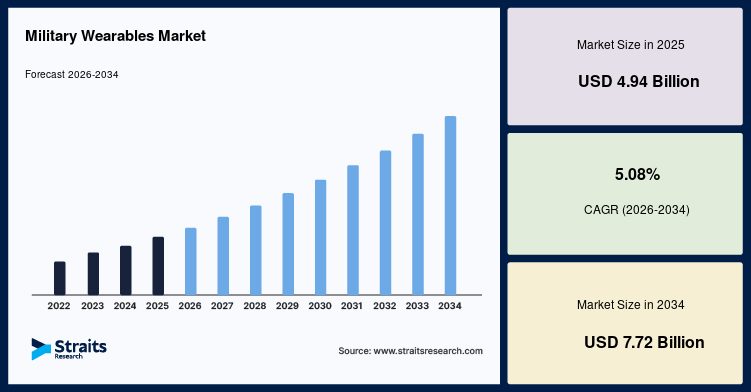
The global military wearables market size was valued at USD 4.94 billion in 2025 and is projected to grow from USD 5.19 billion in 2026 to USD 7.72 billion by 2034 at a CAGR of 5.08% during the forecast period 2026-2034.
Military wearables are smart electronic devices and equipment designed to be worn by military personnel to improve operational effectiveness and survivability. These devices include smart helmets, wearable sensors, communication systems, body-worn computers, exoskeletons, night vision systems, and health monitoring devices. By providing real-time information, environmental awareness, and biometric monitoring, military wearables help soldiers make informed decisions in complex combat environments. The growing emphasis on digital warfare and connected battlefield technologies is expected to drive market expansion during the forecast period.
Market Drivers
Increasing Soldier Modernization Programs
One of the primary drivers of the military wearables market is the growing investment in soldier modernization initiatives. Defense agencies are increasingly adopting advanced wearable technologies to improve combat effectiveness, enhance communication capabilities, and provide real-time battlefield intelligence.
Rising Demand for Enhanced Situational Awareness
Modern military operations require soldiers to access critical information instantly. Wearable devices equipped with augmented reality displays, GPS tracking, and integrated communication systems enable troops to maintain superior situational awareness during missions.
Growing Adoption of Health Monitoring Systems
Military organizations are implementing wearable biometric sensors to monitor soldiers’ health, fatigue levels, hydration status, and physical performance. These systems help improve mission readiness and reduce health-related risks.
Advancements in Wearable Electronics
Continuous innovations in miniaturized electronics, wireless connectivity, sensor technologies, and battery systems are making military wearables more efficient, lightweight, and durable.
Increasing Focus on Soldier Safety
The growing need to protect military personnel in high-risk environments is encouraging the adoption of advanced wearable protective systems, including smart body armor, blast sensors, and integrated threat detection technologies.
Market Challenges
High Development and Procurement Costs
Military wearables incorporate sophisticated technologies that require substantial research, development, and testing investments. High procurement costs may limit adoption in certain defense budgets.
Cybersecurity Risks
Connected wearable systems transmit sensitive operational data, making them vulnerable to cyberattacks, data breaches, and electronic warfare threats.
Power Management Limitations
Ensuring long battery life and reliable power supply for wearable devices remains a significant challenge during extended military operations.
Integration Complexity
Integrating wearable technologies with existing military communication, command, and control systems can be technically challenging and resource-intensive.
Market Segmentation
The military wearables market is segmented based on product type, technology, application, end-user, and region.
By Product Type
The market includes:
-
Smart Helmets
-
Wearable Computers
-
Communication Devices
-
Head-Mounted Displays
-
Exoskeletons
-
Health Monitoring Devices
-
Smart Textiles
-
Others
Communication devices dominate the market due to their critical role in enabling real-time information exchange and battlefield coordination.
By Technology
The market is categorized into:
-
Augmented Reality (AR)
-
Internet of Things (IoT)
-
Artificial Intelligence (AI)
-
Wearable Sensors
-
Advanced Communication Technologies
Wearable sensors account for a significant market share owing to their extensive use in health monitoring, environmental sensing, and performance tracking applications.
By Application
The market includes:
-
Communication and Navigation
-
Health Monitoring
-
Surveillance and Reconnaissance
-
Training and Simulation
-
Combat Operations
Communication and navigation remain the leading application segment due to the increasing need for seamless battlefield connectivity.
By End-User
The market is segmented into:
-
Army
-
Navy
-
Air Force
-
Special Operations Forces
The army segment holds the largest market share due to the extensive deployment of wearable technologies among ground troops.
Regional Insights
North America
North America dominates the military wearables market due to substantial defense spending, advanced military modernization programs, and strong investments in wearable technology research and development. The United States remains the largest contributor to regional growth.
Europe
Europe represents a significant market supported by increasing defense modernization initiatives, rising security concerns, and growing adoption of next-generation soldier systems across major NATO countries.
Asia-Pacific
Asia-Pacific is expected to witness substantial growth during the forecast period due to increasing defense budgets, military modernization programs, and rising geopolitical tensions in countries such as China, India, Japan, and South Korea.
Latin America
Latin America is gradually expanding its military wearable technology adoption through defense modernization efforts and investments in advanced communication systems.
Middle East & Africa
The Middle East & Africa region is emerging as a promising market due to rising defense expenditures, growing security challenges, and increasing procurement of advanced soldier equipment.
Key Players Analysis
The military wearables market is highly competitive, with leading defense contractors and technology companies focusing on innovation, strategic partnerships, and product development to strengthen their market positions.
Key companies operating in the market include:
-
BAE Systems plc
-
RTX Corporation
-
Lockheed Martin Corporation
-
Northrop Grumman Corporation
-
Elbit Systems Ltd.
-
Thales Group
-
General Dynamics Corporation
-
L3Harris Technologies, Inc.
-
Saab AB
-
Aselsan A.S.
These companies are investing in advanced wearable electronics, augmented reality systems, integrated communication platforms, and soldier modernization technologies to enhance military capabilities and maintain competitive advantages.
For Detailed Insights, Visit:
https://straitsresearch.com/report/military-wearables-market
About Us
Straits Research is a leading research and intelligence organization, specializing in research, analytics, and advisory services, along with providing business insights and research reports.
Contact Us
Email: sales@straitsresearch.com
Tel: +1 646 905 0080 (U.S.), +44 203 695 0070 (U.K.)
