

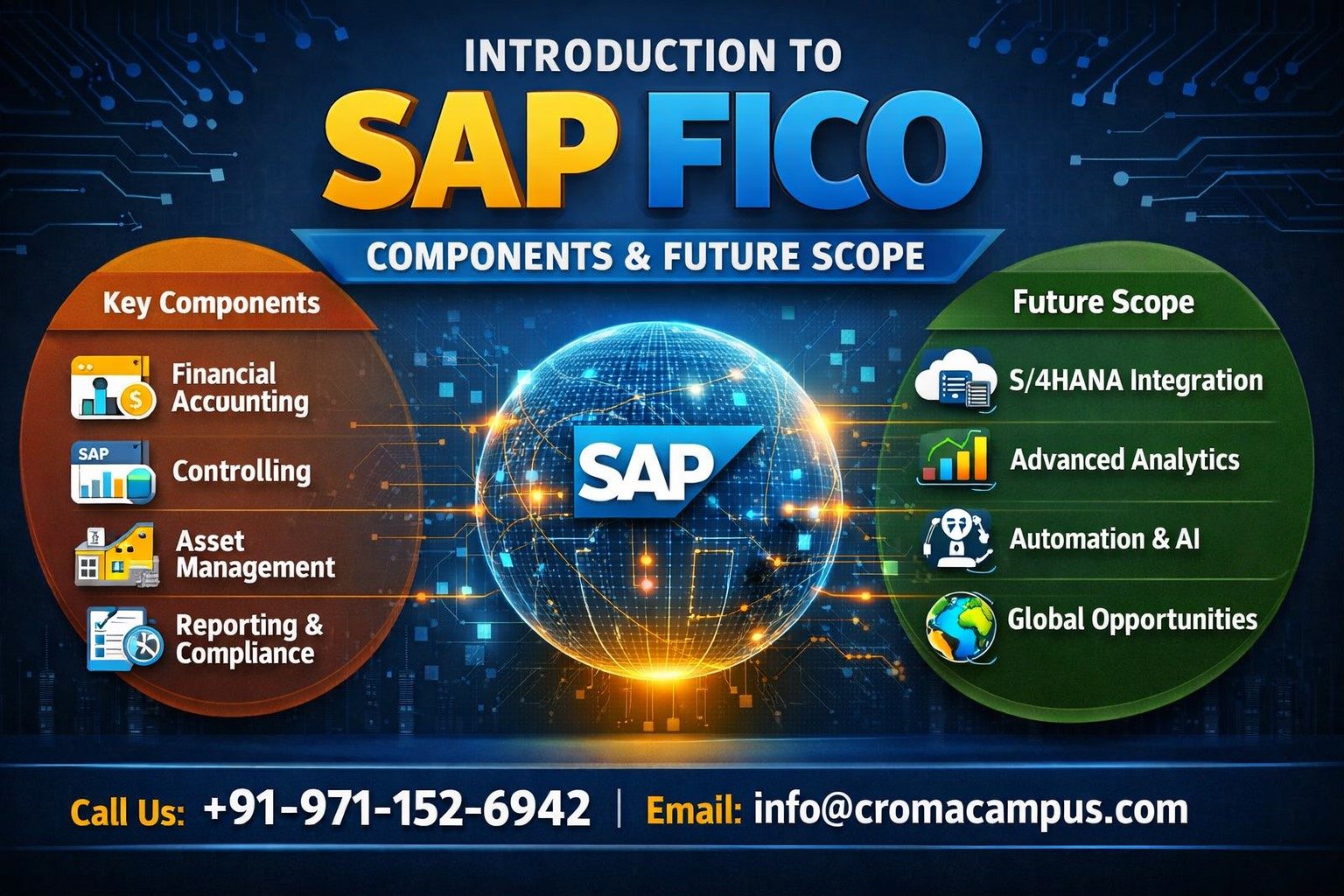
One of the most significant modules in the SAP ERP ecosystem is SAP FICO, which is meant to handle financial information and assist in making strategic business decisions. It includes two major elements, namely Financial Accounting (FI) and Controlling (CO), to offer a complete solution to record, analyze, and report on financial transactions. Companies in various industries have been using SAP FICO to keep their financial records straight, comply with the regulations, and also get real-time information about their financial performances. It is a pillar of operations in the enterprise because it is integrated with other SAP modules such as Sales, Materials Management, and Human Resources.
Key Components of SAP FICO
SAP FICO has two major modules, each used to serve different but related purposes. The Financial Accounting (FI) module is dedicated to reporting to the outside world, whereas the Controlling (CO) module deals with the management of costs and the performance analysis within the company. To further know about it, one can visit the SAP FICO Course Online. When combined, they help organizations to ensure financial transparency and efficiency.
- Financial Accounting (FI): Operates the general ledger, accounts payable, accounts receivable, and financial statements.
- Controlling (CO): Manages cost centers, profit centers, internal orders and cost analysis.
- Integration: End-to-end financial tracking by seamlessly integrating with other SAP modules.
- Real-time Processing: Provides real-time processing of financial transactions.
Features of SAP FICO
SAP FICO has a large scope of functions that enable organizations to ensure that financial operations are streamlined and enhance accuracy in reporting. Many institutes provide SAP FICO Training, and enrolling in them can help you start a career in this domain. These attributes are aimed at the automation process, minimizing manual errors, and generating insights.
- General Ledger Accounting: This is the center of all the financial transactions.
- Accounts Payable and Receivable: Effective vendor and customer procedures.
- Asset Accounting: Manages the fixed assets and depreciation.
- Cost Element Accounting: Monitors costs and revenues to the advantage of planning.
- Profitability Analysis: Tests the business performance separately.
Benefits of SAP FICO
Application of SAP FICO to organizations has been associated with huge benefits, such as increased financial transparency and enhanced productivity. It allows making crucial decisions because of precise data and sophisticated reporting capabilities.
- Enhanced Financial Transparency: Prepares transparent and viable financial reports.
- Regulatory Compliance: Refers to the observance of accounting standards and legal requirements.
- Automation: Saves time and effort and removes mistakes.
- Real-time Insights: Allows fast and informed decision-making.
- Scalability: Applicable to any business of any size and type.
Implementation of SAP FICO
The deployment of SAP FICO is a complex process that needs proper planning and execution in order to achieve success. Companies have to design what they need to do in business, set up the system to be used and train the users efficiently.
- Requirement Analysis: Determine business requirements and financial operations.
- Configuration of the system: Adapt SAP FICO according to org. needs.
- Data Migration: Move on current financial information to the system.
- Testing: Unit testing and integration testing to be done to verify accuracy.
- User Training: Train employees on how to use the systems.
- Go-Live and Support: Implement the system and maintain it.
Future Scope of SAP FICO
As digital technologies develop, SAP FICO keeps increasing and changing according to the present-day business requirements. Many institutes provide SAP FICO Certification courses, and enrolling in them can help you start a career in this domain. The future of financial management is being integrated with sophisticated technologies.
- Cloud Integration: The implementation of cloud-based software such as SAP S/4HANA.
- Automation: AI Use artificial intelligence to predictive analysis.
- Real-Time Analytics: Advanced analytics reporting.
- Global Compliance: Better international accounting standards support.
Conclusion
SAP FICO is an effective financial management tool that helps organisations to streamline their financial operations and obtain insights into their financial well-being. Major IT hubs like Hyderabad and Bangalore offer high-paying jobs for skilled professionals. An SAP FICO Course in Hyderabad can surely help you start a career in this domain. It also provides its Financial Accounting and Controlling, which makes it accurate in its external reporting and cost-efficient internally. In spite of the difficulty in implementation, the long-term advantages of SAP FICO establish it as a critical investment for companies that want to attain financial excellence and operational efficiency in the competitive environment.
