

I recently came across a UK company finalising a major international commercial agreement that relied on a low-cost translator who looked perfectly qualified on paper. The final translation certainly looked the part—clean formatting, formal terminology. However, a single, subtly mistranslated property clause altered the legal meaning of the entire agreement. The fallout involved months of delays, bitter disputes, and substantial legal costs post-signing.
Choosing the correct business translator matters far more than most companies realise. If you are a UK business dealing with cross-border contracts, financial disclosures, shareholder agreements, or regulatory compliance records, translation accuracy isn’t just a linguistic tick-box exercise. It directly impacts contract enforceability, financial risk, and your commercial credibility.
Far too often, companies make the critical mistake of hiring translators based purely on the lowest quote or conversational fluency. True business and legal translation demands a grounded understanding of how UK law, commercial terminology, and regulatory standards actually operate in the real world.
In this guide, we will outline exactly how to choose a business translator who genuinely understands UK legal and commercial requirements, which qualifications matter, the red flags to watch out for, and a practical checklist to use before trusting a linguist with high-value corporate documents.
Why UK Law Knowledge Matters in Business Translation
It is a common misconception that business translation is just about swapping words between languages. In reality, commercial agreements and compliance records rely entirely on precise terminology, strict contractual interpretation, and dense regulatory context. A translator might be brilliantly fluent, yet completely misunderstand the mechanics of UK legal and business systems.
This distinction is crucial because the UK legal framework differs drastically from many civil law jurisdictions overseas:
- England and Wales operate firmly under common law principles, whereas Scotland maintains its own, partially separate legal system.
- UK courts rely heavily on the exact, literal wording of a contract.
- The Home Office, HMRC, and other regulatory bodies demand certified translations that meet specific, uncompromising standards.
- Standard UK legal terminology rarely has a perfect, direct equivalent in international legal systems.
When a translator is not deeply familiar with these structures, they can easily—and unintentionally—weaken binding contractual obligations, mistranslate specific compliance terminology, or introduce dangerous ambiguities into previously watertight agreements. In many cases, this results in documents being flat-out rejected by official bodies during FCDO legalisation or apostille processes.
Ultimately, an innate understanding of UK law is just as critical as the language itself. This is exactly why businesses that rely on certified business translation services UK for contracts, compliance records, or financial reporting increasingly prioritise practitioners with proven legal and corporate expertise over generalists.
The Biggest Mistake Businesses Make When Hiring Translators
Time and time again, companies make the dangerous assumption that any fluent bilingual speaker can handle business documents. From our experience, this is one of the most expensive mistakes a business can make.
True commercial translation goes far beyond everyday vocabulary; it requires a specialist grasp of contractual intent, complex financial terminology, and strict regulatory phrasing. A translator must understand the commercial implications behind the wording—not simply translate sentences literally.
This deep commercial understanding is exactly why highly experienced business translators narrow their focus. Instead of offering a catch-all general service, they usually specialise in distinct, high-stakes areas:
- Legal and corporate contracts
- Financial statements and accounting disclosures
- Corporate governance and shareholder records
- Regulatory compliance filings
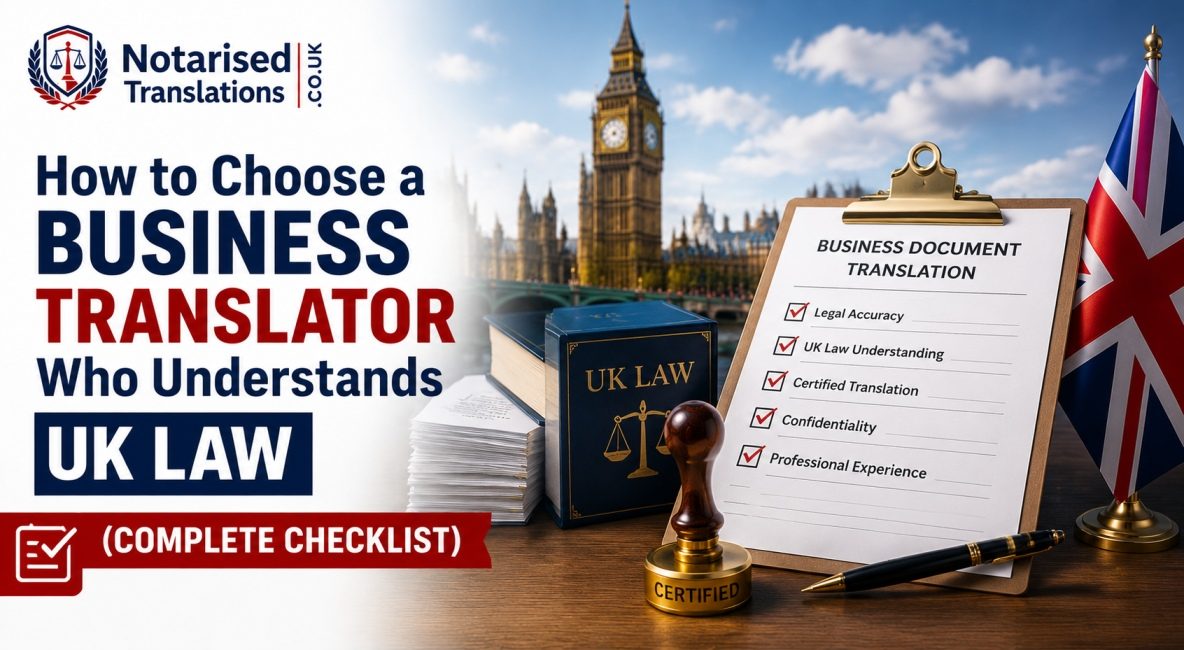
The Complete Checklist for Choosing a Business Translator Who Understands UK Law
1. Check for Recognised UK Translation Credentials
When evaluating potential partners, verify whether the translator or agency holds formal credentials from recognised professional bodies here in the UK. Look for:
- ITI (Institute of Translation & Interpreting)
- CIOL (Chartered Institute of Linguists)
- ATC (Association of Translation Companies)
While these credentials do not automatically guarantee flawless work on their own, they serve as reliable proof that the linguist adheres to verified professional standards, possesses real-world industry experience, and is bound by a strict ethical code. Any specialist handling your documents should be entirely comfortable explaining their qualifications and previous track record.
2. Make Sure They Specialise in Business or Legal Translation
True commercial translation is a highly specialised craft. A linguist whose daily routine involves personal certificates or tourism brochures may completely miss the mark on a complex corporate file.
Commercial documents are packed with terms carrying precise legal weight under UK law. Concepts like indemnity, force majeure, liquidated damages, governing law, and reasonable endeavours cannot be translated accurately without an intimate grasp of how they operate in a commercial context. This is why many UK businesses prefer working with specialist commercial translation providers over generalist translation agencies.
3. Verify Their Understanding of UK Legal and Regulatory Systems
A translator working with UK business documents needs to understand the local framework. UK authorities often require ironclad alignment with specific local regulatory systems. Ensure your translator has a solid working familiarity with English contract law, Companies House filing terminology, FCA-related compliance standards, and FCDO legalisation processes. Without this contextual knowledge, a translation can introduce serious operational risks.
4. Ensure They Translate Into Their Native Language
It is an unwritten rule in professional linguistics that qualified business translators should translate exclusively into their native language. This ensures a natural commercial tone, professional readability, and accurate legal phrasing that aligns with local expectations.
For documents intended for a UK audience, translators should ideally be native English speakers who inherently understand British commercial tone. Many applicants face frustrating setbacks when translated texts read like clunky, literal imports from another language.
5. Ask About Their Quality Assurance Process
To spot the difference between a budget setup and a professional provider, look directly at their review process. A reliable corporate translation workflow never relies on a single pass. Instead, it follows a structured lifecycle: Initial translation $rightarrow$ Detailed editing $rightarrow$ Dedicated proofreading $rightarrow$ Final quality assurance review. This multi-layered safety net is designed to catch terminology inconsistencies, numerical errors, formatting slip-ups, or missing content. Businesses relying on unreviewed, first-draft translations often discover mistakes only after the documents are already signed and legally binding.
6. Look for Experience With Similar Business Documents
Not all corporate translation projects carry the same level of risk. A translator experienced with employment contracts, procurement agreements, financial statements, shareholder records, and compliance reports is far more reliable than someone handling unfamiliar material for the first time. Industry familiarity significantly reduces translation risk.
7. Confirm They Offer Certified or Notarised Translation
Depending on where and how your paperwork will be used, some UK business documents require certified translation, notarised translation, or apostille-ready documentation. Home Office submissions, High Court litigation, overseas regulatory filings, and cross-border property transactions may all require formal certification.
A professional provider should clearly explain what type of certification is required for your specific use case. Discovering a glitch after documents have been submitted causes highly frustrating, avoidable delays and additional costs.
8. Be Careful of Prices That Seem Too Cheap
High-quality business translation is highly specialised professional work. Exceptionally low pricing is a major red flag indicating raw machine translation, a lack of independent QA reviews, or inexperienced linguists. For high-value contracts, opting for a cheap translation can become incredibly expensive later if agreements are disputed, compliance issues arise, or documents are flat-out rejected.
Red Flags That Suggest You Should Walk Away
Be highly cautious if a translation provider:
- Claims “any fluent translator can do it” without needing specific industry expertise.
- Offers upfront pricing that looks unrealistically cheap compared to market standards.
- Struggles to clearly explain UK certification or notarisation requirements.
- Relies entirely on raw AI translation tools without independent human review.
- Actively avoids explaining their internal proofreading or quality assurance procedures.
- Offers no clear, traceable UK address or direct contact information.
Frequently Asked Questions About Choosing a Business Translator in the UK
Do I need a specialist legal translator for commercial contracts?
For any contract of material value, yes. Legal and commercial agreements rely on high-stakes, binding terminology. You need a translator who fundamentally understands contract law and UK business regulations to avoid missing the subtle legal weights attached to specific phrases.
Can AI translation tools handle business contracts safely?
Not safely on their own. While modern AI systems are fast, they still struggle with nuanced legal interpretation, regional commercial context, and complex financial terminology. For any document carrying legal or financial weight, expert human review is non-negotiable.
What qualifications should a UK business translator have?
Look for professional memberships with accredited bodies like the ITI, CIOL, or ATC. These are widely recognised benchmarks of professional standards and technical translation expertise in the UK.
What is the difference between certified and notarised translation?
A certified translation includes a formal signed declaration from the translator or agency confirming its accuracy. A notarised translation takes this a step further, requiring a Notary Public to officially witness and verify the signature on that declaration, which is often required for overseas official use.
Should business translators be based in the UK?
While it isn’t strictly mandatory, working with UK-based translators offers an enormous advantage. They often possess a far more intuitive grasp of local terminology, strict compliance requirements, and the professional communication standards expected by local authorities.
Choosing the Right Translator Protects More Than Language Accuracy
For UK businesses navigating the global stage, commercial translation affects so much more than basic readability. It directly impacts your contracts, compliance standing, financial interpretations, and international reputation.
The safest path forward is straightforward: partner with specialist commercial translators, prioritise legal and financial expertise, insist on robust quality assurance, and avoid relying solely on unvetted machine translation. By treating professional translation services as an essential risk-mitigation tool, you ensure your international business operates with absolute confidence and legal certainty.
Also Read: 7 Common Business Document Translation Mistakes UK Companies Make And How to Avoid Them
