

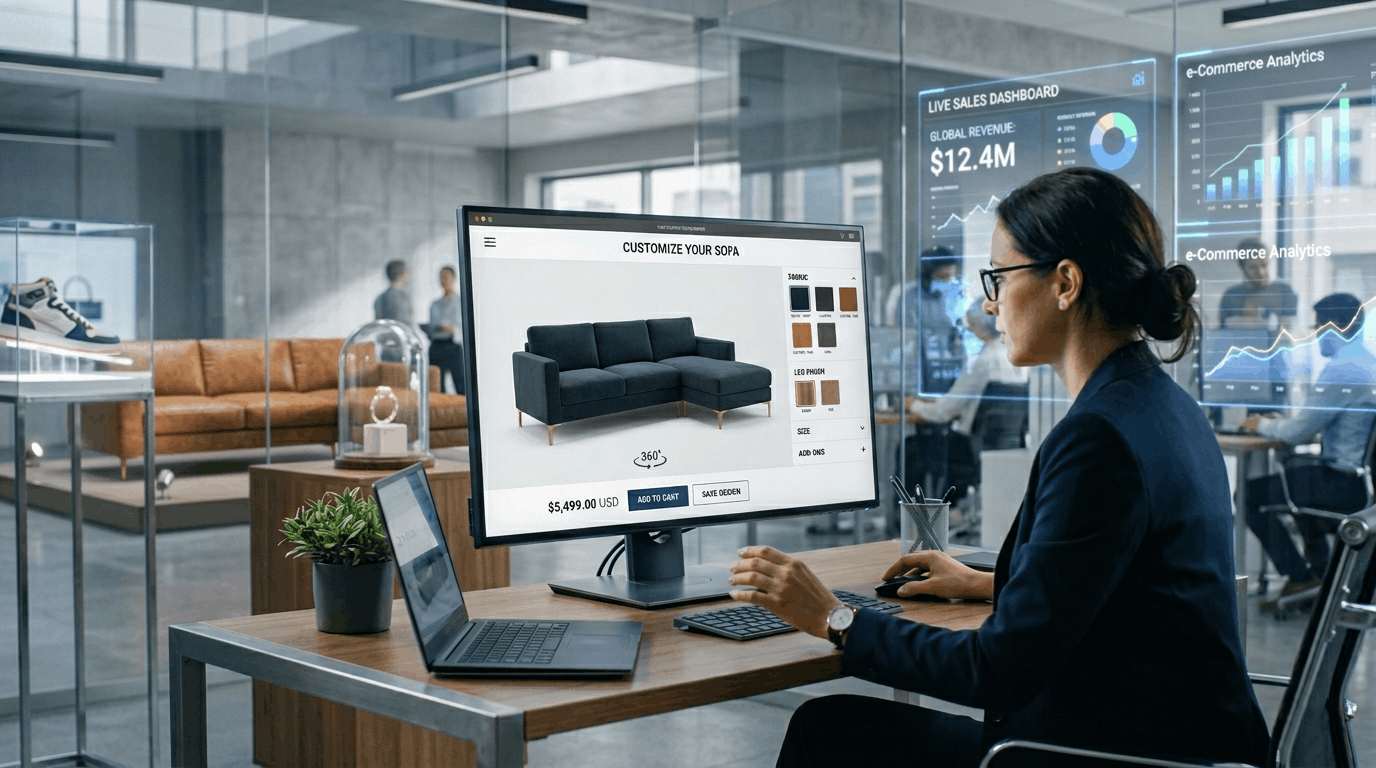
Imagine you are shopping online for a custom sofa. You find one you like, but it only comes in three fabric options shown as tiny swatches. You wonder how the dark grey version would actually look in your living room. You are not sure about the leg finish. So you close the tab and visit a physical store instead.
This is the exact problem that an online 3d configurator solves and why businesses that deploy this technology are seeing dramatic improvements in their sales numbers.
In 2026, buyers are more demanding and more distracted than ever. Winning their attention and trust requires more than good photography. It requires giving them control. The online 3d configurator hands control directly to the customer, letting them build, visualize, and personalize a product in real time before committing to a purchase. The business results that follow are difficult to argue with.
What Exactly Is an Online 3D Configurator?
An online 3d configurator is an interactive tool embedded on a product page that allows shoppers to customize a product using a real-time 3D model. As the customer adjusts options material, color, size, and components the 3D visual updates instantly to reflect their choices.
Unlike a product video or a gallery of preset images, the configurator is responsive. It is not showing the customer what someone else designed. It is showing them what they designed. That distinction changes everything about how a buyer relates to the product.
The technology runs in a standard web browser using WebGL rendering frameworks, requiring no software installation or extra plugins on the customer’s end. It works on desktop, tablet, and mobile, and integrates directly with major e-commerce platforms, including Shopify, WooCommerce, and Magento.
The Numbers That Are Driving Adoption
Businesses do not adopt new technology out of curiosity. They adopt it because it delivers measurable results. The data behind the online 3d configurator is compelling enough that it has shifted from a competitive advantage to a table-stakes expectation in several industries.
Here is what the research consistently shows:
- Adding 3D product content to a page drives an average 94% increase in conversion rates, according to Shopify data
- Businesses using configurators report a 20% to 40% improvement in conversion rate alongside a 35% increase in average engagement time
- Sales productivity improves by an average of 38%
- Product return rates fall by 30% to 40% after configurator implementation
- 82% of product page visitors interact with a 3D asset when one is present
- 66% of shoppers say that seeing a 3D model on a product page directly increases their confidence in making a purchase
- Studies show that 86% of buyers are willing to pay more for a better purchasing experience
These are not soft metrics. Conversion rate, return rate, and sales productivity are the numbers that determine whether a business is profitable. The fact that a single technology tool moves all three in a favorable direction simultaneously explains why adoption is accelerating so quickly.
How Different Industries Are Using It
Furniture and Home Décor
Buying furniture online has always been a leap of faith. Will the sofa fit? Will the color match the floors? Will the fabric feel right? These unanswered questions push buyers toward physical stores or, worse, toward high return rates after the product arrives.
An online 3d configurator addresses every one of these concerns before checkout. Customers select their preferred dimensions, fabric, and leg finish and see an accurate photorealistic rendering of the result. When combined with augmented reality, they can place the configured product into a live view of their actual room through a smartphone camera.
Norwegian company BEDD used a 3d configurator to sell custom garden boxes and plant furniture. The outcomes included higher conversion rates, larger average order values, and growth in sales through retail partners all from giving customers the ability to see and build their own version of the product. UK-based Elltek Systems saw a 25% increase in custom product sales after implementing a configurator on its Shopify store. In roughly 90% of orders, customers completed the configuration and placed the order entirely without contacting a sales representative.
Automotive
Car manufacturers have used configurators longer than most industries. Buyers expect to choose their paint color, interior trim, wheel style, and optional packages online before ever visiting a dealership. This expectation has become an industry standard.
London Dynamics partnered with AutoTrader Canada to build a 3D car customization tool that allows buyers to rotate vehicles, explore interiors, and adjust trim levels with photographic accuracy. Session durations increased dramatically compared to standard static product pages, meaning buyers were more engaged, more informed, and more confident when they moved toward a purchase decision.
Jewelry
Few purchases carry as much emotional weight as jewelry, and few purchases are as difficult to make online from a static image. An online 3d configurator changes the entire experience. Customers choose their metal type, stone, cut, and engraving options and watch the piece take shape in real time.
The personalization effect here is particularly powerful. A customer who has spent time designing their own ring develops an emotional attachment to it before they have even placed the order. This directly reduces cart abandonment, reduces returns jewelry retailers using 3D tools report up to a 35% drop in return rates and increases average order value as customers naturally gravitate toward premium material options during the customization process.
Fashion and Footwear
Nike’s “Nike By You” is one of the most recognized examples of this technology in consumer culture. Customers design their shoes from scratch choosing colorways, materials, and adding custom text and see the result in a photorealistic 3D preview before purchase.
Beyond the major brands, fashion retailers at every level are using configurators to present unlimited product variations without carrying physical inventory for each one. A product with five color options and four material variants once required 20 separate photoshoots. A configurator collapses all of that into a single interactive 3D model.
B2B and Industrial Manufacturing
The ROI story in B2B is particularly striking. Industrial buyers deal in complex products, long sales cycles, and high-stakes specifications where an error does not just mean a return. It means manufacturing the wrong product entirely.
An online 3d configurator integrated with CPQ (Configure, Price, Quote) functionality transforms the B2B buying process. As a buyer selects components and materials, the system validates the configuration in real time, blocks incompatible combinations, and generates an accurate price quote instantly. What previously took days of back-and-forth emails between buyer and sales team can be completed in under ten minutes.
Scavolini, an Italian kitchen and bathroom furniture manufacturer, deployed a 3d configurator that allows customers to design entire room layouts selecting furniture sizes, materials, and finishes with the precise specifications feeding directly into the production workflow. The results include fewer manufacturing errors, faster order processing, and a dramatically improved customer experience.
Why Return Rates Drop So Sharply
One of the most underappreciated benefits of the online 3d configurator is what it does to product returns. US retailers lose an estimated $550 billion annually to returns. A significant portion of those returns happens simply because the product did not match the buyer’s mental image of it.
When a customer has built and previewed a photorealistic 3D version of exactly what they ordered in their chosen color, material, and size that gap between expectation and delivery largely disappears. They know what is coming. They chose it themselves. This is why the return rate reduction associated with configurator adoption is so consistent across such different product categories.
Lower returns mean lower logistics costs, lower restocking costs, and higher net margins. For many businesses, the return-rate improvement alone is enough to justify the investment.
Features That Make the Difference
Not every configurator delivers equal results. The tools generating the strongest commercial outcomes share a consistent set of features:
- Instant rendering changes appear without lag; any delay breaks engagement
- Rules-based logic in the system prevents customers from selecting incompatible options, guiding them toward valid, manufacturable configurations.
- Live pricing the total price updates dynamically as options are added or changed, removing checkout surprises
- Augmented reality integration allows customers to place the configured product in their real-world space through a phone camera.
- Mobile optimization over half of e-commerce traffic; a configurator that does not work fluidly on a phone loses a majority of its potential users
- Save and share customers who can save a configuration and return to it later, or share it with a partner for input, are far more likely to complete the purchase.
Is Your Business Ready?
An online 3d configurator delivers the strongest results when a business sells products with multiple customizable attributes, when customers regularly ask “what does it look like in X?” before buying, and when return rates are driven by unmet visual expectations.
If your sales team spends meaningful time answering configuration questions that a tool could handle automatically, or if your B2B sales cycles are slowed by manual quote generation, the case for configurator investment is straightforward.
The fastest path to implementation is through a proven SaaS platform. Tools like Hexacoder, VividWorks, Zoovu, and WP Configurator allow businesses to launch quickly without building an in-house 3D engineering team. Start with your highest-value, most-customizable products. Invest in high-quality 3D asset creation. Measure conversion rate, return rate, and average order value before and after launch.
Closing Thoughts
The online 3d configurator is no longer a feature that sets a brand apart. In categories like furniture, jewelry, fashion, automotive, and B2B manufacturing, it is increasingly what buyers expect.
The businesses winning in 2026 are the ones that recognized early that the real job of a product page is not to display a product. It is to give a customer enough confidence to buy. The configurator does that better than any static image or video ever could.
When buyers can see, build, and own their version of a product before checkout, hesitation disappears. Confidence takes its place. And revenue follows.
