

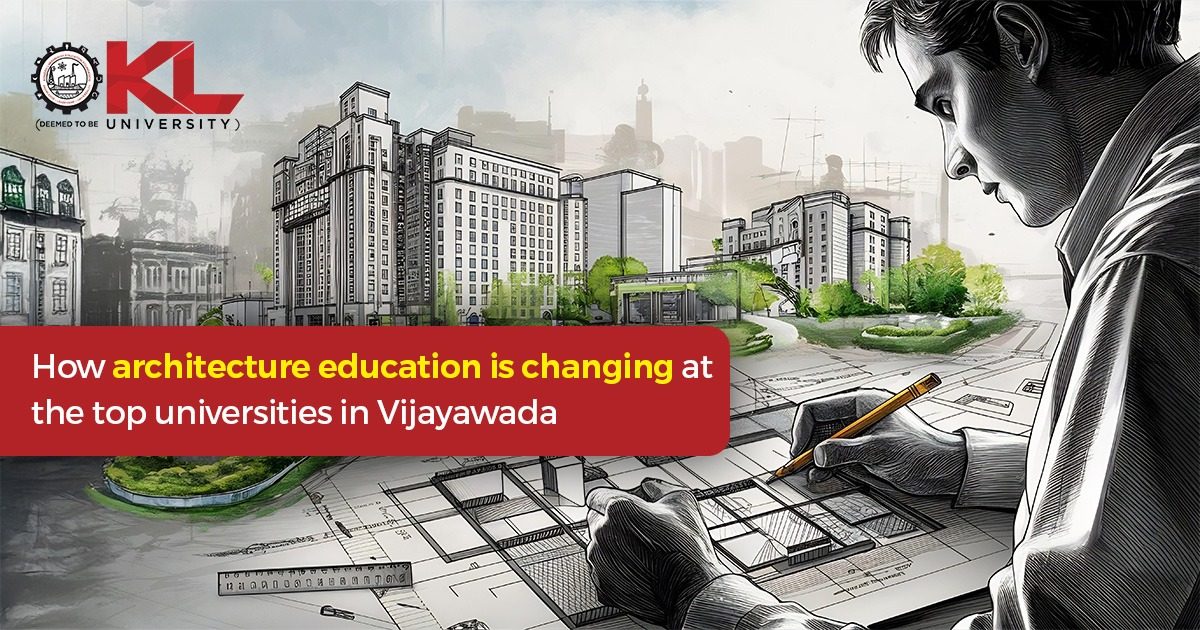
“Sketching, model making, construction basics, and visual design. I know it all, I am an architect.”
Well, if you are thinking this way, then you’re wrong. Students exploring the top universities in Vijayawada for architecture need to understand that the industry looks quite different from what it was a decade ago. Now, climate challenges, rapid urbanisation, new building materials, and powerful design technologies play an important role in the field.
And so the next generation entering the top universities in Vijayawada are redefining their architecture programs to mirror these demands, ensuring students grow into designers ready for the cities of tomorrow.
Let’s dive in and know exactly how.
Sustainability is the foundation of design
You must have noticed how sustainable has shifted from just a “good to have” to a core necessity. Extreme heat, flooding, water scarcity, and carbon-heavy construction have forced us to rethink everything, right from materials to energy use. This is why the architecture curriculum at the top universities in Vijaywada is laying a heavy focus on sustainability.
If we go by numbers, according to the UNEP, buildings contribute nearly 37% of global CO₂ emissions. Which means, beautiful buildings don’t cut it anymore, they must also be energy-efficient and climate responsive.
Circling back to institutions. At KLU, sustainability is woven into studio courses and workshops through green-building design labs, environmental simulation tools, and interdisciplinary mentoring. And such a hands-on exposure is seen only at some of the top universities in Vijayawada, such as KL University, that prepare students to design responsibly since their first year.
Computational architecture and parametric design are redefining creativity
Back in the day, architecture was more about intuition and manual drafting. But today, all thanks to digital modelling tools, architects test ideas, optimise structures and create forms that nobody could even imagine. Computational architecture, especially parametric design, which uses algorithms or certain parameters for complex designs, is the most important skill taught at the top universities in Vijayawada.
Software such as Rhino, Grasshopper, Revit, Dynamo and Blender has become essential. These tools help students understand how changing one variable, such as material thickness or window orientation, influences the entire design. Suddenly, architecture becomes a conversation between creativity and computation.
For all this, KL University has different tools, software training, and labs. And this intersection of design and tech makes it one of the top universities in Vijayawada.
Smart cities are creating new opportunities for architects
India’s rapid urban expansion brings a fresh set of challenges with it. We are talking about mobility, pollution, housing density, green spaces and digital infrastructure. Smart-city missions across the country are pushing architects to think beyond buildings and consider systems-level design.
Students entering the top universities in Vijayawada now engage with urban data, GIS mapping, transport modelling and sustainable city frameworks. Instead of designing a single neighbourhood block, they learn to understand how water networks, energy grids, pedestrian paths and public spaces depend on each other.
This is opening new career paths such as:
- Urban analytics
- Mobility planning
- Environmental modelling
- Smart infrastructure design
- Sustainable urban systems
Architects with these skills are in high demand because they bridge creativity with urban problem-solving. As cities grow vertically and horizontally, professionals who can design with data, not just drawings, will play major roles in India’s future development.
At KLU, one of the top universities in Vijayawada, students often collaborate on urban-scale studio projects, using research center resources to study climate impact, spatial patterns and community needs. Architecture that understands the city as a living system? You’ll find it at KLU.
Modern labs and software exposure define the new architecture classroom
Students evaluating the top universities in Vijayawada for architecture should look beyond classrooms and studios. Today, an architect’s education depends heavily on access to advanced labs and computational tools.
Modern architecture programs now integrate:
- Environmental simulation labs
- Materials and fabrication workshops
- Building Information Modelling suites
- VR-based spatial visualisation
- Robotics and digital fabrication setups
- Climate-analysis software
These spaces allow students to test concepts physically and digitally, assessing airflow, measuring daylight, exploring structural efficiency and fabricating prototypes.
KLU’s architecture department benefits from university-wide research infrastructure: 36+ research centers, interdisciplinary labs, and computing facilities shared with engineering and design programs. Students learn to approach design holistically, combining environmental science, engineering logic and architectural intent. This is exactly the kind of exposure expected from the top universities in Vijayawada today.
Final thoughts…
Architecture is entering one of its most exciting phases. Students choosing among the top universities in Vijayawada should look for programs that reflect this new reality, programs that teach tools, systems, and future-ready thinking, not just traditional drafting.
With strong labs, interdisciplinary collaboration, and an evolving curriculum, KL University continues to offer the kind of environment modern architecture demands, one that equips students to design not just buildings, but better cities and better futures.
