

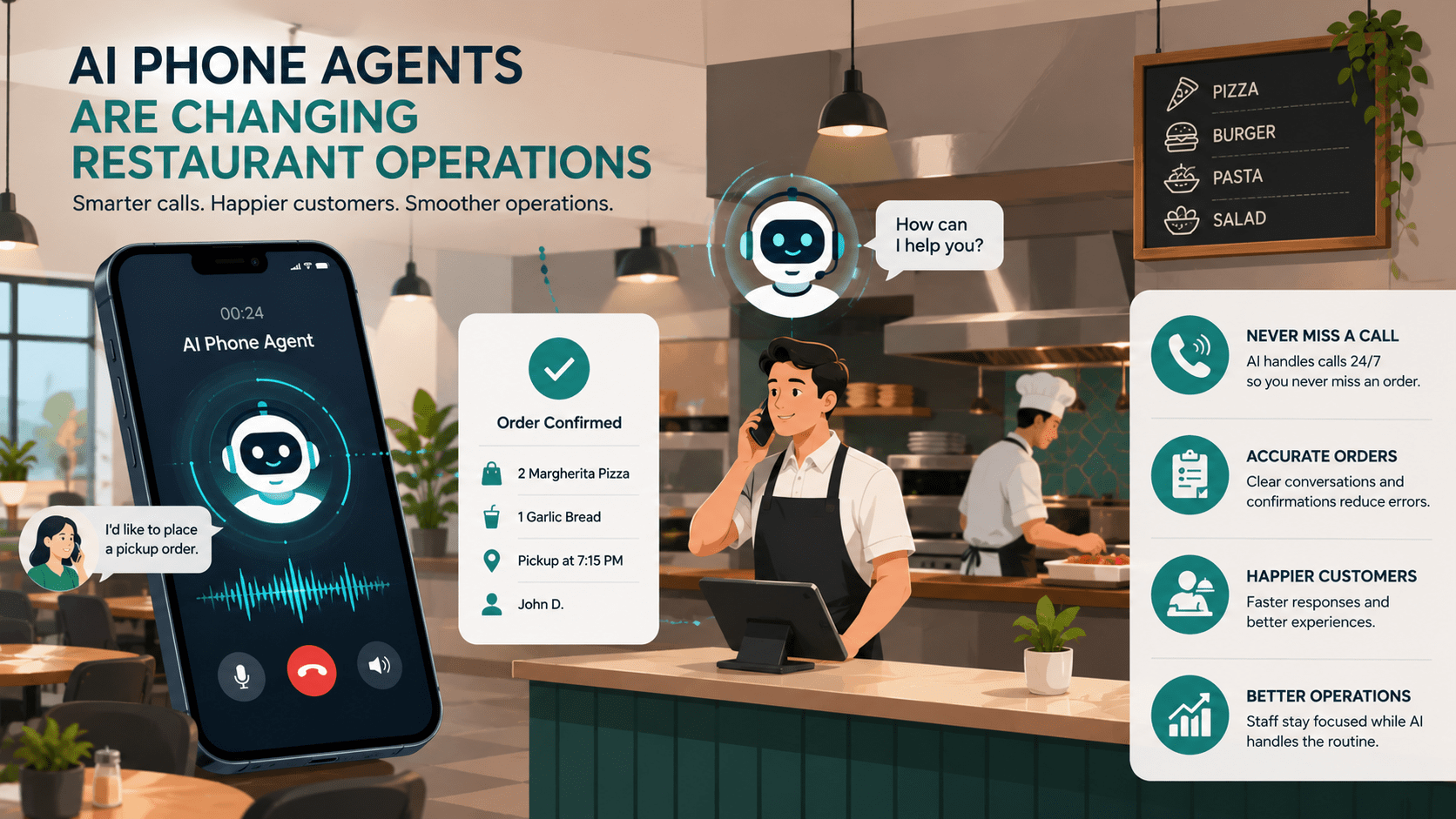
Restaurant operations have changed significantly over the last few years. Customers now expect faster responses, smoother ordering experiences, and consistent communication across every channel. At the same time, restaurant teams are dealing with staffing pressure, high call volumes, and growing operational demands.
One area that continues to create problems for restaurants is phone communication.
During busy hours, staff are expected to answer calls, manage guests, coordinate orders, and keep service moving at the same time. Even well-managed restaurants struggle when phones start ringing nonstop during lunch or dinner rushes.
This is where technologies like an AI Phone Agent for Restaurants are beginning to make a real difference.
Instead of treating phone calls as interruptions, restaurants are now using voice AI systems to handle repetitive customer interactions more efficiently while allowing staff to stay focused on hospitality.
Why Restaurants Still Depend on Phone Orders
Even with online ordering apps and delivery platforms, phone calls remain an important part of restaurant operations.
Customers still call restaurants to:
- Place takeout orders
- Ask about menu items
- Confirm operating hours
- Check reservation availability
- Ask dietary or allergy questions
- Request catering information
For many restaurants, especially independent locations, phone orders still represent a significant portion of daily revenue.
The problem is that answering every call manually becomes difficult during peak hours.
A missed call can quickly turn into a lost order.
The Rise of Restaurant Voice AI
To solve this issue, many restaurants are starting to implement Restaurant Voice AI systems.
Unlike traditional phone trees or robotic automated systems, modern voice AI platforms are designed to have more natural conversations with customers.
Instead of:
“Press 1 for orders.”
Customers can simply speak naturally:
“I’d like to place a pickup order.”
The system then guides the conversation, confirms details, and processes the request in real time.
This creates a smoother customer experience while reducing pressure on staff.
What an AI Phone Agent for Restaurants Actually Does
A modern AI Phone Agent for Restaurants can handle a wide range of routine customer interactions.
These systems are commonly used for:
- Phone order taking
- Reservation requests
- Basic customer questions
- Business hours inquiries
- Menu-related conversations
- Call routing during peak periods
The goal is not to replace restaurant staff. The goal is to reduce interruptions so teams can focus on in-person service and kitchen operations.
Many restaurants find that staff burnout often comes from constant task-switching rather than the workload itself. Phones ringing during busy service hours create distractions that slow everything down.
An AI voice system helps absorb those repetitive interactions in the background.
AI Phone Ordering System and Order Accuracy
One of the biggest operational benefits comes from using an AI Phone Ordering System.
Phone orders can become chaotic during rush periods. Staff may:
- Mishear items
- Miss modifiers
- Forget customer details
- Put callers on hold
- Rush through conversations
This creates mistakes, refunds, and frustrated customers.
An AI ordering system helps standardize the process.
The system:
- Confirms order details clearly
- Captures customer information accurately
- Reduces rushed conversations
- Sends cleaner order data into workflows
For restaurants handling high takeout volume, this can significantly improve consistency.
Why Generic AI Tools Often Struggle in Restaurants
Not every AI phone system works well in restaurant environments.
Restaurants are operationally messy. Menus change. Inventory shifts. Customers modify orders constantly. Staff override systems during rush periods.
Generic AI call tools often struggle because they are not designed around restaurant workflows.
Some systems work well for simple scheduling or customer support, but restaurant communication requires:
- Faster conversations
- Real-time accuracy
- Flexible order handling
- Human handoff when needed
This is why restaurant-specific solutions are becoming more important.
Why Restaurant-Focused Voice AI Matters
Restaurant-focused platforms are designed around how restaurants actually operate during busy service hours.
Instead of functioning like a generic chatbot, systems built specifically for restaurants can better manage:
- Order-related conversations
- Peak-hour call spikes
- Menu interactions
- Customer service workflows
This is where platforms like Certus AI are positioning themselves differently.
Rather than treating restaurants as just another business category, Certus AI focuses specifically on restaurant communication and phone ordering workflows.
That distinction matters because restaurant operations move much faster than many other industries.
AI Is Supporting Restaurant Staff, Not Replacing Them
One of the biggest misconceptions around automation is that AI exists to replace employees.
In reality, most restaurants use AI to support staff, not eliminate them.
Hospitality still depends heavily on people.
Guests still expect:
- Human interaction
- Problem solving
- Flexibility
- Emotional intelligence
AI simply handles repetitive communication tasks that create operational pressure.
When an AI Phone Agent for Restaurants answers routine calls, staff can spend more time:
- Helping dine-in guests
- Managing kitchen coordination
- Improving service quality
- Solving complex customer issues
The result is often a calmer and more efficient environment.
Restaurant Voice AI Is Becoming More Common
AI adoption in restaurants is no longer limited to large chains.
Independent restaurants, cafés, pizza shops, and regional brands are increasingly exploring voice AI systems because the operational benefits are becoming easier to see.
Restaurants are realizing that:
- Missed calls lead to lost revenue
- Constant interruptions hurt service
- Staffing challenges are ongoing
- Customers still prefer phone communication in many situations
This has created strong demand for smarter communication systems.
As voice AI technology becomes more natural and reliable, adoption will likely continue growing across the industry.
What Restaurants Should Look for in an AI Phone System
Restaurants evaluating voice AI systems should focus on practical operational fit rather than marketing claims.
Important factors include:
- Natural conversation flow
- Easy human handoff
- Order accuracy
- Integration capabilities
- Restaurant-specific workflows
- Reliability during busy hours
The best systems are usually the ones that simplify operations rather than adding more complexity.
Testing during real service periods is also critical. Many systems perform well in demos but struggle under actual restaurant conditions.
The Future of AI in Restaurant Communication
Restaurant technology is moving toward smarter operational support rather than full automation.
AI is becoming most valuable in areas where restaurants experience constant repetitive pressure:
- Phone communication
- Order intake
- Customer inquiries
- Reservation handling
Voice systems will likely become a standard operational layer for many restaurants over the next few years.
But the human side of hospitality will remain essential.
The restaurants that succeed will be the ones that use AI strategically to improve operations while still keeping people at the center of the guest experience.
Conclusion
Restaurants today face growing pressure to deliver fast and consistent customer service while managing staffing challenges and operational complexity.
An AI Phone Agent for Restaurants helps reduce that pressure by handling repetitive calls and streamlining communication workflows.
As Restaurant Voice AI technology improves, more restaurants are adopting systems that support staff rather than overwhelm them. Whether it’s answering calls, managing customer questions, or improving phone order accuracy through an AI Phone Ordering System, voice AI is becoming a practical operational tool rather than a futuristic experiment.
Platforms like Certus AI are part of this shift toward restaurant-specific communication automation that works alongside teams instead of replacing them.
If restaurants can reduce interruptions while improving customer response times, both staff and guests benefit.
