

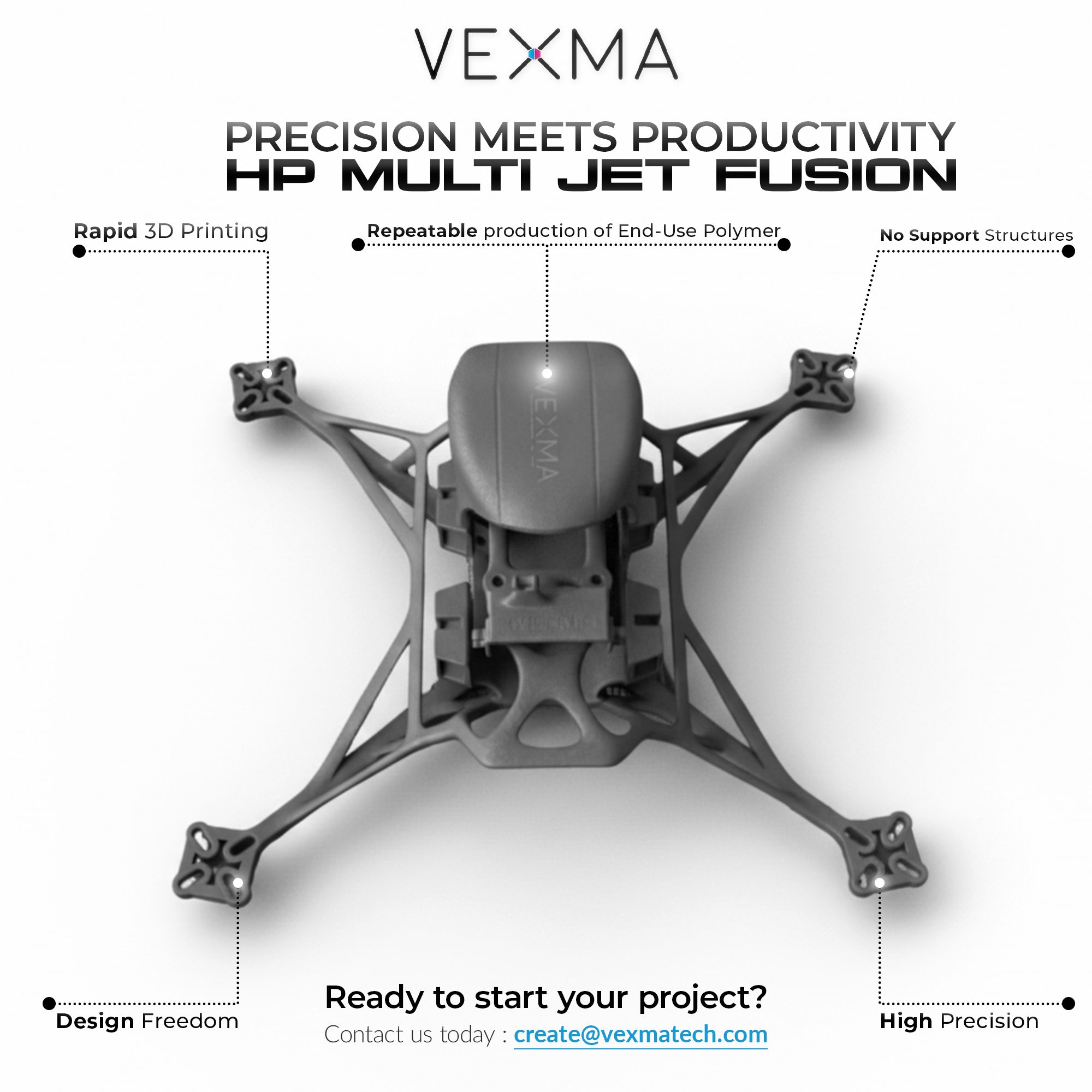
The drone industry is evolving rapidly, driven by applications in defence, surveillance, agriculture, logistics, infrastructure inspection, and mapping. As performance expectations increase, manufacturers face growing pressure to deliver drones that are lighter, stronger, more reliable, and faster to market. Traditional manufacturing methods often struggle to keep pace with these demands.
This is where industrial 3D printing, also known as additive manufacturing, is changing how drone components are designed, tested, and produced.
Key Manufacturing Challenges in Drone Development
1. Weight Reduction Without Strength Loss
One of the biggest challenges in drone manufacturing is achieving optimal strength-to-weight ratios. Heavier components reduce flight time, payload capacity, and efficiency. Conventional manufacturing techniques often require additional material for strength, leading to unnecessary weight.
2. Complex Geometries and Internal Features
Modern drones require internal channels, lattice structures, and integrated mounting features. These geometries are difficult or sometimes impossible to manufacture using CNC machining or injection molding without multiple assemblies.
3. Rapid Design Iterations
Drone designs evolve quickly due to testing, regulation changes, and performance optimization. Traditional tooling-based processes slow down iteration cycles and increase development costs.
4. Low-to-Medium Volume Production
Many drone programs start with small batch production before scaling. Traditional manufacturing methods are often cost-inefficient at low volumes due to tooling and setup requirements.
5. Part Consolidation and Assembly Complexity
Multiple machined or molded parts increase assembly time, tolerance stack-ups, and potential failure points—critical concerns for aerial systems.
How 3D Printing Solves These Challenges
Lightweight, Optimized Designs
Additive manufacturing allows engineers to apply topology optimization and lattice structures, removing unnecessary material while maintaining structural integrity. This results in lighter components without compromising performance.
Design Freedom and Internal Optimization
With 3D printing, complex geometries and internal features can be produced in a single build, eliminating the need for multiple parts or secondary operations.
Faster Prototyping to Production
3D printing enables manufacturers to move seamlessly from prototype to production using the same material and process. This significantly reduces lead times and accelerates product validation.
Cost-Effective Small-Batch Manufacturing
Without tooling requirements, additive manufacturing is well-suited for low- and mid-volume drone production, making it ideal for startups, R&D teams, and specialized UAV programs.
Reduced Assembly and Improved Reliability
Part consolidation reduces assembly complexity, improves dimensional accuracy, and enhances overall reliability—critical for drones operating in demanding environments.
The Role of HP Multi Jet Fusion in Drone Manufacturing
Among industrial 3D printing technologies, HP Multi Jet Fusion (MJF) stands out for its mechanical strength, surface quality, and repeatability. MJF-produced parts are suitable for functional testing and end-use applications, making the technology particularly effective for drone components such as frames, enclosures, mounts, and structural housings.
How Vexma Supports Drone Manufacturing
At Vexma, industrial 3D printing is used to manufacture production-ready drone components using advanced polymer technologies like HP Multi Jet Fusion. By combining engineering expertise with scalable additive manufacturing, Vexma helps drone manufacturers:
-
Reduce component weight
-
Accelerate development cycles
-
Produce repeatable, high-strength parts
-
Transition smoothly from design to deployment
This approach enables drone teams to focus on performance and innovation while ensuring manufacturing consistency and control.
Conclusion
As drone applications continue to expand, manufacturers must overcome challenges related to weight, complexity, speed, and scalability. Industrial 3D printing provides a practical solution by enabling optimized designs, faster iteration, and cost-effective production.
By leveraging additive manufacturing technologies and structured manufacturing systems, companies like Vexma are helping drive the next phase of drone innovation with confidence and reliability.
Author Bio
Vexma is an advanced manufacturing company specializing in industrial 3D printing and digital manufacturing solutions. With expertise in technologies such as HP Multi Jet Fusion, Vexma supports industries including drones, automotive, and aerospace in building production-ready components.
