

Collimating Lens Market Size 2034
The global Collimating Lens Market is witnessing notable growth due to increasing demand for precision optics, expanding applications in laser systems, rising adoption of optical communication technologies, and growing investments in medical and industrial photonics. Advancements in optical engineering and the increasing use of laser-based technologies across various industries are expected to drive market expansion during the forecast period.
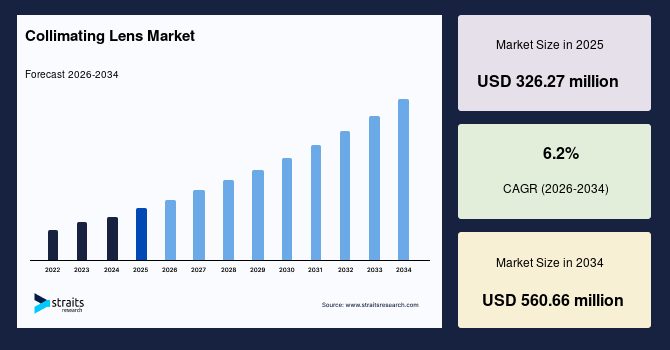
The global collimating lens market size was valued at USD 326.27 million in 2025 and is projected to grow from USD 346.5 million in 2026 to USD 560.66 million by 2034 at a CAGR of 6.2% during the forecast period 2026-2034.
A collimating lens is an optical component designed to convert divergent light rays into parallel beams or vice versa. These lenses are widely used in laser systems, fiber optic communication, medical devices, automotive sensors, consumer electronics, and scientific instrumentation. Their ability to improve beam quality, enhance optical efficiency, and ensure accurate light transmission makes them essential in modern optical systems.
Market Drivers
Growing Demand for Laser-Based Technologies
The increasing adoption of laser systems in industrial manufacturing, healthcare, telecommunications, and defense applications is a major driver of the collimating lens market. These lenses play a critical role in optimizing laser beam performance and precision.
Expansion of Optical Communication Networks
The growing deployment of fiber optic networks for high-speed internet and data transmission is driving demand for collimating lenses. These components help improve signal quality and transmission efficiency in optical communication systems.
Rising Adoption in Medical Devices
Collimating lenses are widely utilized in medical imaging systems, diagnostic equipment, laser surgery devices, and ophthalmic instruments. The growing healthcare sector and advancements in medical technology are supporting market growth.
Increasing Use in Consumer Electronics
The demand for compact optical components in smartphones, cameras, wearable devices, and augmented reality systems is increasing. Collimating lenses enable enhanced optical performance and miniaturization of electronic products.
Advancements in Automotive Sensor Technologies
The automotive industry’s growing use of LiDAR systems, advanced driver-assistance systems (ADAS), and autonomous vehicle technologies is creating new opportunities for collimating lens manufacturers.
Market Challenges
High Manufacturing Precision Requirements
Collimating lenses require highly accurate manufacturing processes and strict quality control measures. Maintaining optical precision can increase production complexity and costs.
Fluctuations in Raw Material Prices
Variations in the prices of optical glass, plastics, and specialty materials can impact manufacturing expenses and profit margins.
Intense Market Competition
The optical components industry is highly competitive, with manufacturers focusing on innovation, pricing strategies, and product differentiation to maintain market share.
Technical Integration Challenges
Integrating collimating lenses into advanced optical systems requires specialized expertise and engineering capabilities, which can present challenges for end-users and manufacturers.
Market Segmentation
The collimating lens market is segmented based on material type, lens type, application, end-user industry, and region.
By Material Type
The market is categorized into:
-
Glass Lenses
-
Plastic Lenses
-
Aspheric Lenses
-
Others
Glass lenses dominate the market due to their superior optical performance, durability, and extensive use in high-precision applications.
By Lens Type
The market includes:
-
Convex Lenses
-
Plano-Convex Lenses
-
Aspheric Lenses
-
Cylindrical Lenses
Aspheric lenses account for a significant market share owing to their ability to reduce optical aberrations and improve beam quality.
By Application
The market is segmented into:
-
Laser Systems
-
Optical Communication
-
Medical Devices
-
Scientific Instruments
-
Imaging Systems
-
Others
Laser systems remain the leading application segment due to increasing utilization across industrial, healthcare, and defense sectors.
By End-User Industry
The market includes:
-
Telecommunications
-
Healthcare
-
Automotive
-
Consumer Electronics
-
Aerospace & Defense
-
Industrial Manufacturing
Telecommunications holds a substantial market share owing to the growing expansion of fiber optic communication infrastructure worldwide.
By Region
The market is analyzed across:
-
North America
-
Europe
-
Asia-Pacific
-
Latin America
-
Middle East & Africa
Regional Insights
North America
North America dominates the collimating lens market due to strong investments in photonics, advanced telecommunications infrastructure, and the presence of leading optical technology companies. The United States remains the primary contributor to regional growth.
Europe
Europe represents a significant market supported by advancements in industrial automation, automotive technologies, and scientific research activities. Germany, France, and the United Kingdom are major contributors to regional demand.
Asia-Pacific
Asia-Pacific is expected to witness the fastest growth during the forecast period. Expanding electronics manufacturing, increasing telecommunications investments, and growing adoption of laser technologies in China, Japan, South Korea, and India are driving market expansion.
Latin America and Middle East & Africa
These regions are gradually adopting advanced optical technologies as investments in telecommunications, healthcare, and industrial infrastructure continue to grow.
Technology Trends and Market Opportunities
The collimating lens market is witnessing innovations in precision optics, miniaturized optical components, advanced lens coatings, and high-performance photonic systems. Manufacturers are developing lightweight and compact lens solutions to support emerging applications in wearable electronics, autonomous vehicles, and next-generation communication networks.
The increasing adoption of LiDAR technologies, 5G infrastructure, augmented reality devices, and laser-based manufacturing systems is expected to create significant growth opportunities. Furthermore, advancements in photonics research and optical engineering are likely to support long-term market development.
Key Players Analysis
The collimating lens market is moderately competitive, with manufacturers focusing on product innovation, precision engineering, and strategic collaborations to strengthen their market positions.
Major companies operating in the market include:
-
Thorlabs, Inc.
-
Edmund Optics Inc.
-
Newport Corporation
-
LightPath Technologies, Inc.
-
Asahi Glass Co., Ltd.
-
Coherent Corp.
-
Hamamatsu Photonics K.K.
-
Jenoptik AG
-
SCHOTT AG
-
Knight Optical Ltd.
These companies are investing in advanced optical technologies, research and development activities, and global expansion strategies to enhance their competitive advantage.
For Detailed Insights, Visit:
https://straitsresearch.com/report/collimating-lens-market
About Us
Straits Research is a leading market research and intelligence organization specializing in analytics, advisory services, and comprehensive market research reports across multiple industries.
Contact Us
Email: sales@straitsresearch.com
Tel: +1 646 905 0080 (U.S.), +44 203 695 0070 (U.K.)
