

Market Overview
The global Ball Valve Market is witnessing steady growth due to increasing demand for reliable flow control solutions across industries such as oil and gas, water and wastewater treatment, chemicals, pharmaceuticals, power generation, and manufacturing. Ball valves are widely preferred for their durability, operational efficiency, leak-proof performance, and ability to handle high-pressure applications, making them essential components in modern industrial systems.
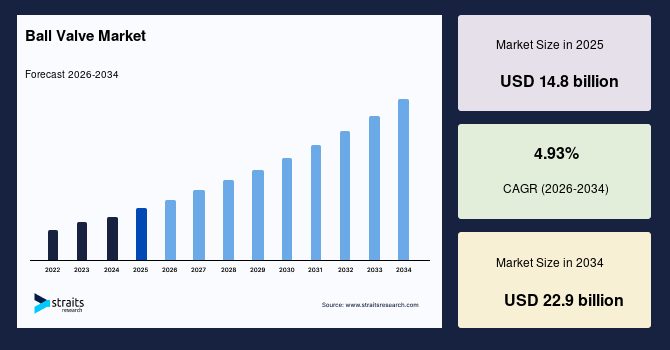
The global ball valve market size was valued at USD 14.80 billion in 2025 and is projected to reach USD 22.90 billion by 2034, growing at a CAGR of 4.93% during the forecast period (2026–2034).
The growing emphasis on industrial automation, infrastructure modernization, and efficient fluid management systems is significantly contributing to market growth. In addition, increasing investments in energy projects, expanding water treatment facilities, and rising demand for advanced valve technologies are creating favorable opportunities for the global ball valve market.
Market Drivers
One of the major drivers of the ball valve market is the continued expansion of the oil and gas industry. Ball valves play a critical role in upstream, midstream, and downstream operations by ensuring reliable flow control, pressure regulation, and leak prevention. Increasing investments in pipeline infrastructure, refinery upgrades, and natural gas projects are driving demand for high-performance valve solutions.
The rapid growth of water and wastewater treatment infrastructure is also supporting market expansion. Governments and municipalities worldwide are investing in water management projects to improve water quality and address growing urban populations. Ball valves are extensively used in these systems due to their reliability and long service life.
Another important growth factor is the increasing adoption of industrial automation. Industries are implementing automated process control systems to improve efficiency, reduce downtime, and enhance operational safety. Automated ball valves are becoming an integral part of modern industrial facilities, enabling precise control and monitoring of fluid systems.
Furthermore, growing industrialization across emerging economies is generating strong demand for ball valves in sectors such as chemicals, pharmaceuticals, food processing, and power generation. The expansion of manufacturing activities and infrastructure development projects continues to create new growth opportunities for market participants.
Market Challenges
Despite favorable growth prospects, the ball valve market faces several challenges. One of the primary concerns is the fluctuation in raw material prices, particularly stainless steel and specialty alloys used in valve manufacturing. Variations in material costs can impact production expenses and profit margins for manufacturers.
Another challenge is the increasing complexity of environmental and industrial safety regulations. Manufacturers must continuously adapt their products and production processes to comply with evolving standards, which can increase operational costs and development timelines.
The market also faces intense competition from regional and international players. Price pressures and the availability of low-cost alternatives may affect profitability, particularly in highly competitive markets.
In addition, supply chain disruptions and delays in the procurement of critical components can impact production schedules and project execution, creating operational challenges for manufacturers and end users alike.
Market Segmentation
The ball valve market is segmented based on type, material, operation, and end-user industry.
By type, the market includes floating ball valves and trunnion-mounted ball valves. Floating ball valves account for a significant share of the market due to their simple design, cost-effectiveness, and widespread use across various industrial applications. Trunnion-mounted ball valves are gaining popularity in high-pressure and large-diameter applications where enhanced stability and performance are required.
Based on material, the market is categorized into stainless steel, alloy-based materials, and other specialized materials. Stainless steel valves dominate the market owing to their excellent corrosion resistance, durability, and suitability for demanding industrial environments.
By operation, the market includes manual, pneumatic, hydraulic, and electric ball valves. Automated valve systems are witnessing increasing adoption due to the growing trend toward industrial automation and smart manufacturing environments.
Based on end-user industry, the market serves oil and gas, water and wastewater treatment, chemicals, pharmaceuticals, power generation, manufacturing, and other industrial sectors. The oil and gas industry continues to represent a major share of market demand due to extensive valve usage across exploration, transportation, and refining activities.
Regional Insights
North America dominates a significant portion of the global ball valve market due to its well-established industrial infrastructure, strong presence of oil and gas operations, and increasing investments in industrial automation technologies. The region continues to witness growing demand for advanced valve systems across multiple industries.
Europe represents a substantial market share driven by stringent environmental regulations, increasing adoption of smart industrial technologies, and growing investments in sustainable infrastructure projects. The region’s focus on operational efficiency and regulatory compliance supports market expansion.
Asia-Pacific is expected to witness the fastest growth during the forecast period. Rapid industrialization, urbanization, and infrastructure development in countries such as China, India, Japan, and South Korea are creating significant demand for ball valves across manufacturing, energy, and water treatment sectors.
Latin America is experiencing steady market growth due to increasing investments in energy projects, industrial facilities, and water management infrastructure. Expanding industrial activities across the region continue to support market development.
The Middle East and Africa remain important markets due to ongoing investments in oil and gas production, refinery modernization, and industrial infrastructure development. The growing need for reliable flow control systems is expected to support long-term market growth throughout the region.
Key Players Analysis
The ball valve market is highly competitive, with leading manufacturers focusing on product innovation, technological advancements, and global expansion strategies to strengthen their market positions. Companies are increasingly investing in automated valve technologies, smart monitoring systems, and digital solutions that improve operational efficiency and reduce maintenance requirements.
Market participants are also pursuing strategic partnerships, mergers, acquisitions, and capacity expansion initiatives to broaden their product portfolios and enhance their geographic presence. The growing demand for energy-efficient and high-performance valve solutions is encouraging continuous investment in research and development activities.
As industries increasingly adopt automation and digital process control systems, competition among manufacturers is expected to intensify, driving further innovation and product differentiation across the market.
Leading Companies
-
Emerson Electric Co.
-
Flowserve Corporation
-
IMI plc
-
Schlumberger Limited
-
Parker-Hannifin Corporation
-
Curtiss-Wright Corporation
-
KITZ Corporation
-
Crane Co.
-
Cameron International Corporation
-
Metso Corporation
For detailed insights, visit:
https://straitsresearch.com/report/ball-valve-market
About Us
Straits Research is a leading research and intelligence organization, specializing in research, analytics, and advisory services, along with providing business insights and research reports.
Contact Us
Email: sales@straitsresearch.com
Tel: +1 646 905 0080 (U.S.), +44 203 695 0070 (U.K.)
