

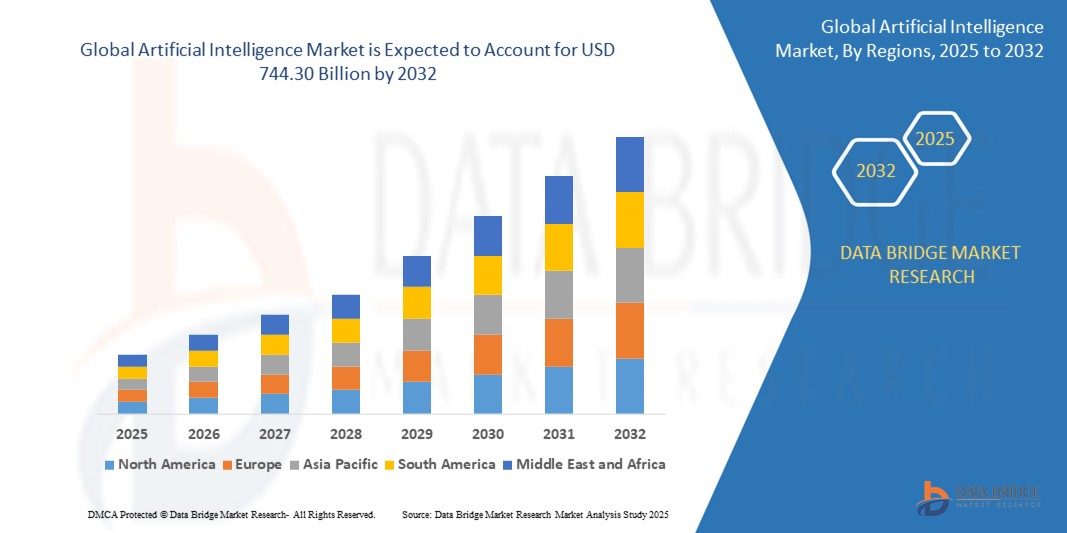
The artificial intelligence market is experiencing rapid and sustained growth across the global economy. Organizations are adopting artificial intelligence to improve efficiency, accuracy, and decision-making. What was once an experimental technology has now become a core business enabler.
Artificial intelligence supports automation, data analysis, and intelligent forecasting. As digital systems become more complex, businesses rely on artificial intelligence to manage scale and speed. This shift positions artificial intelligence as a foundation of modern enterprise operations.
Introduction
Artificial intelligence refers to systems designed to perform tasks that normally require human intelligence. These tasks include learning from data, recognizing patterns, and making predictions. Artificial intelligence systems improve continuously as they process more information.
Today, artificial intelligence is embedded in daily business activities. Companies use it to streamline operations, improve customer interactions, and optimize resources. As digital transformation accelerates, artificial intelligence adoption continues to expand across industries and regions.
Market Overview
The artificial intelligence market includes software platforms, hardware infrastructure, and professional services. Software solutions enable analytics, automation, and intelligent decision-making. Hardware supports high-performance computing and data processing. Services ensure successful implementation and long-term system optimization.
Cloud-based artificial intelligence solutions dominate the market due to scalability and flexibility. Organizations benefit from lower upfront costs and faster deployment. Meanwhile, on-site and hybrid models remain relevant for businesses with strict data governance needs.
Market expansion occurs across developed and emerging economies. Advanced regions lead in adoption, while emerging markets show strong growth driven by digital initiatives and innovation programs.
Key Drivers of Market Growth
Rapid digital transformation
Organizations increasingly digitize operations to remain competitive. Artificial intelligence enhances digital systems by enabling automation and intelligent insights. As digital adoption rises, artificial intelligence demand grows.
Growing data volumes
Businesses generate vast amounts of data from operations, customers, and connected systems. Artificial intelligence helps process this data efficiently. As data creation accelerates, artificial intelligence becomes essential.
Demand for operational efficiency
Companies seek to reduce costs and improve productivity. Artificial intelligence automates repetitive tasks and improves workflow accuracy. This efficiency drives widespread adoption.
Advances in computing technology
Improved processors, storage systems, and algorithms make artificial intelligence more accessible. These advances reduce complexity and speed up implementation.
Strong investment and innovation
Public and private investment supports artificial intelligence research and deployment. Innovation continues to expand capabilities and use cases.
Market Segmentation
By Component
Software
Includes machine learning platforms, analytics tools, and intelligent automation systems. Software represents the largest market share.
Hardware
Includes processors, servers, and data storage optimized for artificial intelligence workloads.
Services
Includes consulting, system integration, training, and support. Services play a vital role in successful adoption.
By Deployment Model
Cloud-based deployment
Offers scalability, flexibility, and cost efficiency. This model supports rapid innovation.
On-site deployment
Provides greater control and data security. It remains important for regulated industries.
Hybrid deployment
Combines cloud advantages with on-site control. Many enterprises prefer this balanced approach.
By Industry Vertical
Healthcare
Artificial intelligence improves diagnostics, data management, and operational planning.
Finance
Used for risk assessment, customer analytics, and process automation.
Manufacturing
Supports predictive maintenance, quality control, and production optimization.
Retail
Enhances demand forecasting, inventory planning, and personalized experiences.
Logistics and transportation
Optimizes routing, tracking, and supply chain efficiency.
Education
Improves digital learning systems and administrative processes.
Key Market Trends
Expansion of intelligent automation
Organizations move beyond basic automation toward intelligent workflows. Artificial intelligence enables systems to adapt and improve over time.
Increased use of predictive analytics
Businesses rely on artificial intelligence to forecast trends and outcomes. Predictive insights support better planning and strategy.
Customization and industry-specific solutions
Companies prefer tailored artificial intelligence tools. Industry-specific solutions deliver higher accuracy and relevance.
Focus on responsible artificial intelligence
Organizations emphasize transparency, fairness, and accountability. Responsible usage builds trust and long-term adoption.
Integration with connected systems
Artificial intelligence integrates with connected devices and platforms. This supports real-time insights and smart operations.
Competitive Landscape
The artificial intelligence market includes global technology leaders and specialized innovators. Large firms invest heavily in infrastructure and research. Smaller companies focus on niche applications and advanced algorithms.
Competition centers on performance, scalability, ease of integration, and service quality. Strategic partnerships and acquisitions shape market dynamics. Continuous innovation remains critical for success.
Challenges in the Market
Data privacy and compliance
Organizations must manage data securely and meet regulatory requirements. This increases implementation complexity.
Talent and skill shortages
Artificial intelligence requires specialized expertise. Limited skilled professionals slow adoption in some regions.
High implementation costs
Advanced systems may require significant investment. Cost remains a barrier for smaller enterprises.
Integration with legacy systems
Existing infrastructure may not support advanced artificial intelligence tools. Integration challenges require careful planning.
Trust and adoption concerns
Users expect reliable and explainable outcomes. Lack of transparency can reduce confidence.
Regional Analysis
North America leads the artificial intelligence market due to strong infrastructure and investment. Europe follows with a focus on responsible deployment and innovation. Asia Pacific shows rapid growth driven by digital transformation and large-scale adoption. Other regions steadily expand as technology access improves.
Future Outlook
The future of the artificial intelligence market remains highly positive. Continued innovation will enhance system capabilities and efficiency. Artificial intelligence will support advanced automation, intelligent decision-making, and business transformation.
Emerging applications will expand adoption across industries. Improved accessibility will allow small and medium enterprises to benefit. Responsible implementation will strengthen trust and regulatory alignment.
Artificial intelligence will continue to shape how organizations operate and compete. Its role as a foundational technology will only grow.
Source: https://www.databridgemarketresearch.com/reports/global-artificial-intelligence-market
Conclusion
The artificial intelligence market stands at the center of global digital transformation. Strong demand, technological progress, and broad industry adoption drive sustained growth. While challenges exist, innovation and strategic investment continue to overcome barriers.
As organizations prioritize efficiency, insight, and scalability, artificial intelligence remains a critical enabler. Its long-term impact on business and society will be profound, making it one of the most important markets of the modern era.
