

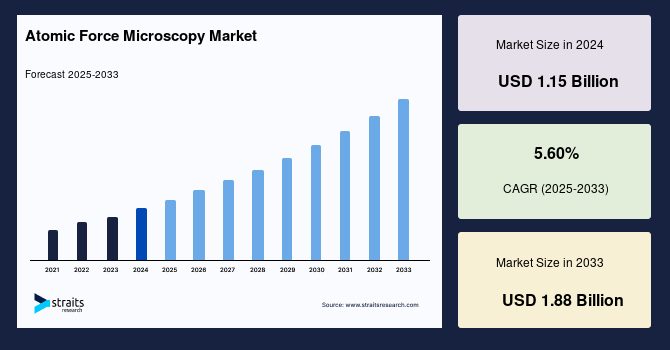
The global Atomic Force Microscopy (AFM) Market is witnessing significant growth due to increasing demand for nanoscale imaging technologies, rapid advancements in nanotechnology research, and growing adoption of high-resolution microscopy across life sciences, semiconductors, and material science industries. According to the latest report by Straits Research, the global atomic force microscopy market was valued at USD 1.15 billion in 2024 and is projected to grow from USD 1.22 billion in 2025 to reach USD 1.88 billion by 2033, registering a CAGR of 5.60% during the forecast period.
Atomic force microscopy is a highly advanced scanning probe microscopy technique used for imaging, measuring, and analyzing materials at the nanoscale level. AFM enables researchers and manufacturers to obtain ultra-high-resolution three-dimensional surface images and measure mechanical, electrical, magnetic, and thermal properties of materials with exceptional precision. The increasing application of AFM in nanotechnology, semiconductor manufacturing, and biomedical research is significantly contributing to market growth worldwide.
Market Drivers
One of the major drivers of the atomic force microscopy market is the growing investment in nanotechnology research and development activities. Governments, research institutions, and private organizations are increasingly investing in nanoscale material analysis and nanoscience innovation to support advancements in electronics, biotechnology, and advanced materials manufacturing. AFM technology plays a critical role in analyzing nanoparticles, thin films, biomolecules, and nanostructures with atomic-level precision.
Another significant growth factor is the increasing demand for high-resolution imaging solutions in semiconductor and electronics manufacturing. As semiconductor devices continue to shrink in size and increase in complexity, manufacturers require highly precise nanoscale inspection and defect analysis technologies. AFM systems are widely utilized for semiconductor metrology, surface characterization, and quality control processes.
Technological advancements in atomic force microscopy systems are also supporting market growth. Manufacturers are increasingly developing high-speed AFM systems, multimodal imaging technologies, AI-assisted image analysis platforms, and automated scanning solutions to improve imaging accuracy, operational efficiency, and data interpretation capabilities. The integration of AFM with complementary techniques such as Raman spectroscopy and electron microscopy is further expanding its application scope.
Additionally, the increasing use of AFM in biomedical and life sciences research is accelerating market expansion. Researchers are utilizing AFM systems for studying cells, proteins, DNA structures, tissues, and biomolecular interactions in their native environments, supporting advancements in drug discovery, diagnostics, and medical research.
Market Challenges
Despite strong growth prospects, the atomic force microscopy market faces several challenges. One of the primary restraints is the high cost associated with AFM equipment and maintenance. Advanced atomic force microscopes require sophisticated hardware, high-precision probes, and specialized operational environments, making them expensive for smaller research institutions and laboratories.
Another challenge is the technical complexity involved in operating AFM systems and interpreting nanoscale imaging data. Highly skilled professionals and specialized training are often required to operate advanced microscopy instruments efficiently and accurately.
Slow scanning speed and limited sample throughput compared to other imaging technologies also present operational challenges in industrial applications requiring rapid analysis and high-volume inspection processes.
Furthermore, the risk of sample damage during contact-mode imaging and the need for regular calibration and maintenance can affect operational efficiency and increase overall ownership costs for end-users.
Market Segmentation
The atomic force microscopy market is segmented based on type, application, offering, and region.
By type, the market is categorized into research-grade atomic force microscopy and industrial-grade atomic force microscopy. Research-grade AFM systems hold a significant market share due to their extensive use in academic institutions, nanotechnology laboratories, and biomedical research facilities. Industrial-grade AFM systems are also witnessing rapid growth owing to increasing adoption in semiconductor manufacturing and industrial quality control applications.
Based on application, the market includes life sciences and biology, semiconductors and electronics, nanomaterial science, material science, and others. The semiconductors and electronics segment dominates the market due to rising demand for nanoscale inspection and metrology solutions in advanced chip manufacturing.
By offering, the market is segmented into atomic force microscopes, probes, software, and related services. Atomic force microscope systems account for a major market share due to increasing investments in advanced nanoscale imaging technologies.
Regional Insights
North America dominates the global atomic force microscopy market due to strong investments in nanotechnology research, advanced semiconductor manufacturing infrastructure, and the presence of major AFM manufacturers. The United States remains the leading contributor owing to extensive research activities in biotechnology, electronics, and material science sectors.
Asia-Pacific is expected to witness the fastest growth during the forecast period. Rapid expansion of semiconductor manufacturing, increasing investments in nanotechnology research, and growing industrial automation across China, Japan, South Korea, Taiwan, and India are significantly driving regional market expansion.
Europe also represents a significant market share, supported by strong academic research infrastructure, increasing government funding for nanoscience initiatives, and growing adoption of advanced microscopy technologies in industrial applications. Germany, France, and the United Kingdom are major contributors to regional market growth.
Latin America and the Middle East & Africa are emerging markets supported by increasing investments in scientific research infrastructure and expanding industrial modernization activities.
Key Players Analysis
The atomic force microscopy market is highly competitive, with leading companies focusing on technological innovation, automation capabilities, and advanced nanoscale imaging solutions to strengthen their market position. Major companies operating in the market include Bruker Corporation, Park Systems, Hitachi High-Tech Corporation, Horiba Ltd., Oxford Instruments, Nanosurf AG, WITec GmbH, NT-MDT, NanoMagnetics Instruments, and Nanonics Imaging Ltd.
These companies are increasingly investing in high-speed AFM systems, AI-assisted microscopy technologies, multimodal imaging platforms, and semiconductor metrology solutions to improve nanoscale imaging performance and expand application capabilities across research and industrial sectors.
For detailed insights, visit: https://straitsresearch.com/report/atomic-force-microscopy-market
About Us
Straits Research is a leading market research and intelligence organization specializing in analytics, advisory services, and comprehensive market research reports across multiple industries. The company provides actionable business insights and strategic market intelligence to help organizations identify growth opportunities and make informed business decisions.
Contact Us
Email: sales@straitsresearch.com
Tel: +1 646 905 0080 (U.S.), +44 203 695 0070 (U.K.)
