

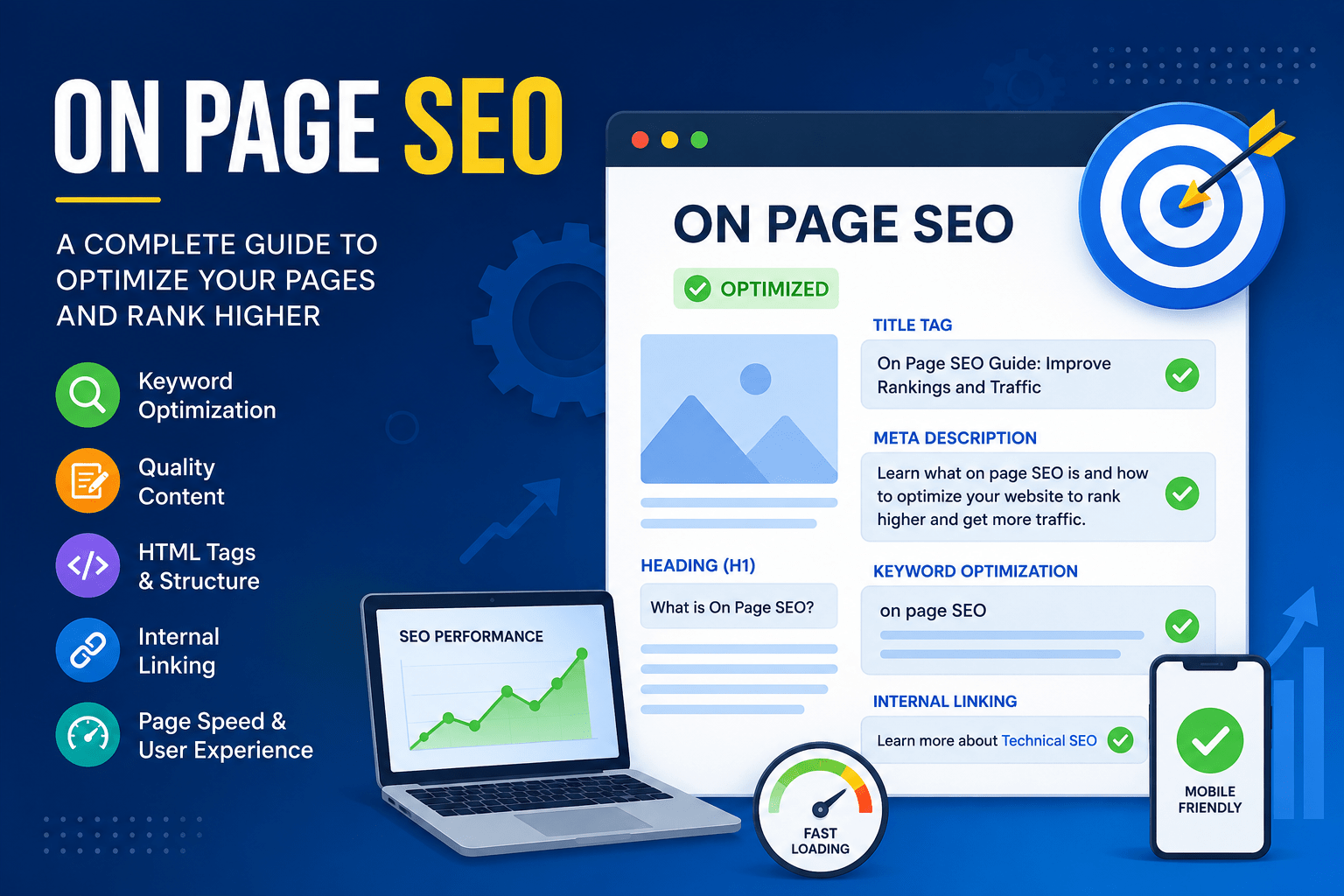
What is on page SEO?
On page SEO is the process of optimizing individual web pages to rank higher in search engines and attract more relevant traffic. It involves improving content, HTML elements, and user experience directly on your website.
With proper on page SEO, you can:
-
Help search engines understand your content
-
Improve your rankings for target keywords
-
Increase organic traffic
-
Enhance user experience
If you want your website to perform well in search results, on page SEO is the first place to start.
Why on page SEO is important
Search engines like Google analyze your page content to decide where it should rank. Without proper optimization, even high-quality content may not perform well.
On page SEO helps you:
-
Align content with search intent
-
Improve click-through rates (CTR)
-
Reduce bounce rates
-
Increase time spent on your site
For developers, marketers, and business owners, mastering on page SEO is essential for long-term growth.
Key elements of on page SEO
To implement effective on page SEO, you need to focus on several core elements.
1. Title tags
The title tag is one of the most important ranking factors.
Best practices:
-
Include your main keyword naturally
-
Keep it under 60 characters
-
Make it clear and compelling
Example:
“On Page SEO Guide: Improve Rankings and Traffic”
2. Meta descriptions
Meta descriptions influence click-through rates.
Tips:
-
Keep it between 140–155 characters
-
Include your primary keyword
-
Write a clear summary of the page
Although not a direct ranking factor, it impacts user behavior.
3. URL structure
Clean URLs improve both SEO and user experience.
Good URL example:
-
yoursite.com/on-page-seo-guide
Best practices:
-
Keep URLs short
-
Use hyphens instead of underscores
-
Include your main keyword
4. Headings (H1, H2, H3)
Headings help structure your content.
Guidelines:
-
Use only one H1 tag
-
Include keywords in H2/H3 naturally
-
Keep headings clear and descriptive
This improves readability and helps search engines understand your content.
5. Keyword optimization
Keywords are the foundation of on page SEO.
Tips:
-
Use your main keyword in the first 100 words
-
Maintain natural keyword density (0.8%–1.2%)
-
Use related terms and synonyms
Avoid keyword stuffing. Focus on readability.
6. Content quality
Content is the most important factor.
Your content should be:
-
Useful and relevant
-
Easy to read
-
Well-structured
Write for users first, then optimize for search engines.
7. Internal linking
Internal links connect your pages.
Benefits:
-
Improve navigation
-
Help search engines crawl your site
-
Distribute page authority
For example, you can link to related services like Webflow Website Development to guide users to relevant pages.
8. Image optimization
Images can improve engagement, but they must be optimized.
Best practices:
-
Use descriptive file names
-
Add alt text with keywords
-
Compress images for faster loading
This improves both SEO and page speed.
9. Page speed
Page speed is a ranking factor.
To improve speed:
-
Optimize images
-
Use caching
-
Minimize code
Faster pages provide a better user experience.
10. Mobile friendliness
Most users access websites on mobile devices.
Ensure your site:
-
Is responsive
-
Loads quickly on mobile
-
Has easy navigation
Google uses mobile-first indexing, so this is critical.
On page SEO checklist
Here’s a simple checklist you can follow:
-
Add keyword to title and meta description
-
Use proper heading structure
-
Optimize images with alt text
-
Improve page speed
-
Add internal links
-
Ensure mobile responsiveness
Following this checklist helps you cover all essential aspects of on page SEO.
Common on page SEO mistakes
Avoid these mistakes when optimizing your pages:
-
Keyword stuffing
-
Duplicate content
-
Missing meta tags
-
Slow page loading
-
Poor mobile experience
Fixing these issues can significantly improve your rankings.
Tools for on page SEO
You can use various tools to improve your on page SEO:
-
Google Search Console
-
Google Analytics
-
SEO plugins (like Yoast SEO)
-
Page speed tools
These tools help you analyze performance and identify issues.
Best practices for developers
If you are a developer, focus on technical aspects of on page SEO:
-
Use clean and semantic HTML
-
Implement structured data (schema markup)
-
Optimize Core Web Vitals
-
Ensure proper indexing
Working with experts like just digital gurus can also help you align development with SEO goals.
How to improve your on page SEO
To improve your on page SEO:
-
Start with keyword research
-
Create high-quality content
-
Optimize all page elements
-
Monitor performance regularly
-
Update content as needed
SEO is not a one-time task. It requires continuous improvement.
Conclusion
On page SEO is the foundation of any successful SEO strategy. It helps search engines understand your content and improves your chances of ranking higher in search results.
By optimizing your titles, content, images, and overall user experience, you can drive more traffic and achieve better results.
Whether you’re a beginner or an experienced developer, focusing on on page SEO will give you a strong advantage in the digital landscape.
FAQs
1. What is on page SEO?
On page SEO is the process of optimizing individual web pages to improve their search engine rankings and visibility.
2. Why is on page SEO important?
It helps search engines understand your content and improves user experience, leading to better rankings.
3. What are the key elements of on page SEO?
Key elements include title tags, meta descriptions, headings, keywords, content quality, and internal linking.
4. How often should I update on page SEO?
You should review and update your pages regularly to keep content fresh and relevant.
5. Is on page SEO enough for ranking?
No, you also need off-page SEO and technical SEO for the best results.
