

According to the U.S. Bureau of Labour Statistics (BLS), project that the demand for nurses is now high, compared to many fields.
It estimates that around 193,000 plus job openings will be available by 2032. The reasons are an ageing population, increased healthcare access and retirements.
That is why nurses are typically defined as the backbone or heartbeat of the healthcare domain. They donate a unique link where clinical expertise comes across huge human compassion.
In addition, nurses use clinical expertise to handle tricky care needs. They normally serve as the key point of contact in hospitals, clinics, and community settings.
Whether you are a promising nursing student or a mid-career professional who wants to start and change your career in healthcare, this guide is made for you.
How to begin a Nursing Career in 2026?
In 2026, beginning a career in nursing is an exciting step into a field that is fast-changing due to high-tech growth.
So, the need for nurses is now more than ever. The career provides great job stability and a variety of career options, and is at an all-time high due to the expected global shortfall of healthcare workers.
Further, the path of becoming a nurse starts with a mixture of formal education and practical clinical training. And as well as a devotion to patient care in the digital era.
Regardless of whether you are tense in the fast-paced atmosphere of an emergency room or the flexibility of remote telehealth.
And finally, you have to write a compelling personal statement and SOP to the admission committee. And tell them the reasons why you want to become a nurse in the first place.
Main Pathways to Nursing in 2026
Here are the different pathways you can choose to become a nurse.
- Traditional BSc (Hons) Degree- It is a 3-year full-time university program. In many of the cases, it can be 4 years, that depend on the university. Further, it integrates academic study with clinical placements.
- Postgraduate Degree (MSc)- It is basically a 2-year quicker route for students who did their bachelor’s degrees in different fields.
- Registered nurse degree Apprenticeship (RNDA)- This program is a 4-year nursing degree. It allows you to earn once you learn. Means you can do a job and study at the same time. You will be doing a job for a health trust while training. Hence, it enables you to do your graduation with a degree, and you will also grab an NMC registration without taking tuition debt.
- Nursing Associate to Nurse- Lastly, if you do not have any Level 3 qualifications, which means GCSE and A-level, you can begin your training as a nursing associate. It takes 2 years to finish, and then you can obtain a top-up to a registered nurse.
Entry Requirements
Plenty of entry-level nursing programs also have some basics. Although specifics differ by state and institution, you will often need:
- A GED or high school diploma
- A minimum GPA, usually between 2.5 and 3.0 or higher
- Biology, chemistry, mathematics, and occasionally psychology or anatomy are prerequisite subjects.
- The TEAS (Test of Essential Academic Skills) or a similar exam, like the HESI, is regularly used as an admission exam for many RN schools.
- Vaccination records, CPR certification, and even a physical examination
- Before beginning clinical, a background check and fingerprints are required (states take patient safety seriously).
The Application Process
The application process of becoming a nurse is vital. The process changes from a strategic transition from academic training to an expert license.
So, once you are accepted by an approved nursing program, you must pass stringent exams and obtain government approval.
Here is the application process you need to follow.
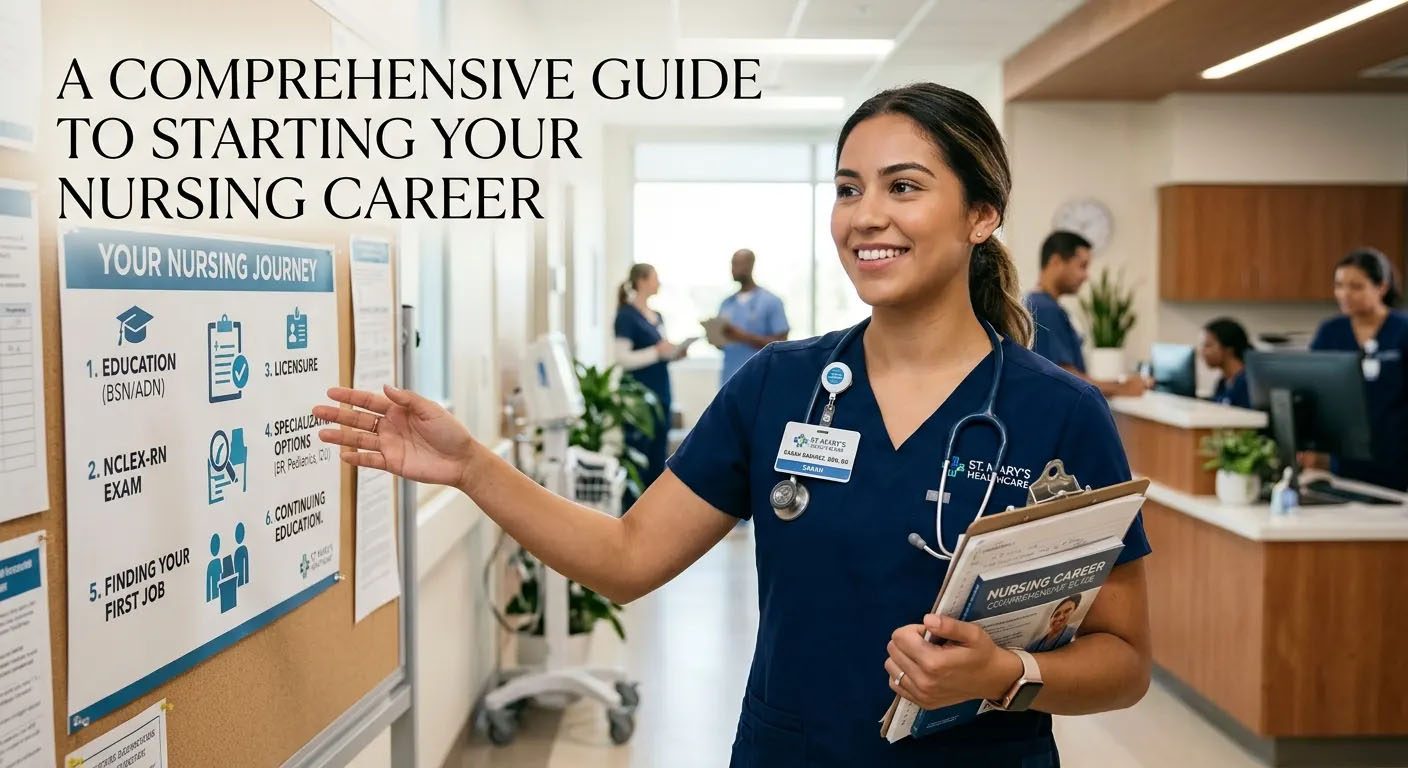
1. Academic Application:
First of all, enrol in a (BSN) or (ADN) program. This often entails finishing science requirements like anatomy and passing the TEAS or HESI admission tests.
2. Board of Nursing (BON) Eligibility:
Now, apply to the Board of Nursing in your state during your last semester. In order to verify professional fitness, this entails a fee, a criminal background check, and fingerprints.
3. NCLEX Registration:
To take the NCLEX exam, you have to register with Pearson VUE. You will get an Approval to Test (ATT) when the BON confirms your graduation.
4. Final Licensure
In the final step, you need to get licensure by passing the computerised adaptive NCLEX-RN exam.
Your license is decided after passing. Also allow you to apply for nursing residency posts and begin practising.
If you need any help before you start your career as a nurse, consult a good Nursing care plan writing help. The brand owns a team of certified healthcare tutors with years of experience. Hence, they will help you boost your career by offering valuable insights.
What Kinds of Skills Does a Career in Nursing need?
Here are the essential skills you will need to thrive as a nurse.
- Patience, organisation, compassion, and attention to detail
- Being able to perform well under pressure and being open to learning new things as the medical field develops
- Strong critical thinking abilities and the ability to think quickly
- A passion for math and science
- The capacity to act as a team well with others and perform extended shifts, typically while standing
Effective Steps to Begin
These are the effective steps you have to follow to begin your career as a nurse.
- Select a domain- First of all, choose which speciality you need, like Adult, Children’s, Mental Health, or Learning Disability nursing.
- Apply via UCAS: You need to apply via UCAS for university degrees such as BSN and MSN. And apply for a visa for NHS jobs for training.
- Secure funding- You can easily apply for an NHSA learning support fund that is NSF. And obtain a grant of 5000 GBP every year. The good part is that you will not need to pay for this grant.
- Prepare for Interviews- Finally, you have to prepare for interviews, numeracy tests, and literacy tests to start your career in nursing.
Final Note
By using our effective tips, you will begin your career in nursing in a quick amount of time. Remember, the nursing field is changing; it’s not the same field that it used to be 10 or 20 years ago.
The healthcare field is not about taking care of patients anymore; nurses now work in many fields. You will need to develop skills to thrive in a healthcare career.
