

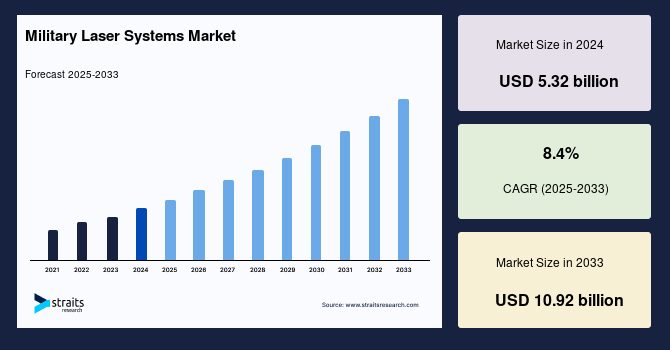
The global Military Laser Systems Market is witnessing substantial growth due to increasing defense modernization programs, rising military expenditure, and growing demand for advanced precision-targeting technologies. According to the latest report by Straits Research, the global military laser systems market was valued at USD 5.32 billion in 2024 and is projected to grow from USD 5.74 billion in 2025 to reach USD 10.92 billion by 2033, registering a CAGR of 8.4% during the forecast period.
Military laser systems are advanced defense technologies used for precision targeting, communication, surveillance, range finding, missile guidance, and directed energy weapons. These systems are increasingly becoming critical components of modern warfare due to their high speed, accuracy, and ability to minimize collateral damage during combat operations. Rising geopolitical tensions and increasing adoption of next-generation defense technologies are significantly contributing to market expansion.
Market Drivers
One of the major drivers of the military laser systems market is the growing shift toward directed energy weapons (DEWs). Defense organizations worldwide are investing heavily in laser-based weapons capable of intercepting drones, missiles, rockets, and other airborne threats with exceptional precision and reduced operational costs. Laser systems provide speed-of-light engagement capabilities and significantly lower ammunition costs compared to traditional defense systems.
Another significant growth factor is the increasing demand for anti-drone and missile defense systems. The growing use of unmanned aerial vehicles (UAVs) in modern warfare has accelerated the development of laser-based counter-drone technologies. Military organizations are increasingly deploying high-energy laser systems to neutralize UAV threats efficiently while minimizing collateral damage.
Technological advancements in solid-state lasers, fiber lasers, and semiconductor laser technologies are also supporting market growth. Continuous innovations are enabling manufacturers to develop more compact, energy-efficient, and powerful laser systems suitable for airborne, naval, and ground-based defense platforms. The integration of AI-driven targeting systems and advanced sensor technologies is further improving operational performance and accuracy.
Additionally, rising global defense expenditure is significantly contributing to market expansion. Countries such as the United States, China, India, Russia, and Israel are actively investing in advanced laser technologies to strengthen national defense capabilities and modernize military operations.
Market Challenges
Despite strong growth prospects, the military laser systems market faces several challenges. One of the primary restraints is the high development and deployment cost associated with advanced laser weapon systems. Research, testing, manufacturing, and integration of high-energy laser technologies require substantial financial investments and specialized infrastructure.
Another challenge is the technical complexity involved in maintaining laser efficiency and reliability under harsh battlefield conditions. Factors such as atmospheric interference, extreme weather conditions, heat management, and power supply limitations can affect system performance during military operations.
Regulatory restrictions and international arms control agreements also present challenges for manufacturers and defense organizations involved in developing directed energy weapon systems.
Furthermore, cybersecurity concerns and the growing sophistication of electronic warfare technologies may create operational vulnerabilities for advanced military laser systems.
Market Segmentation
The military laser systems market is segmented based on product type, technology, application, and region.
By product type, the market is categorized into laser designators, LIDAR, 3D scanning systems, laser weapons, laser range finders, ring laser gyros, laser altimeters, and others. The 3D scanning segment holds a significant market share due to its growing application in battlefield surveillance, mapping, and situational awareness systems.
Based on technology, the market includes fiber lasers, solid-state lasers, chemical lasers, CO2 lasers, semiconductor lasers, and others. Solid-state lasers dominate the market owing to their high power efficiency, beam quality, and extensive use in military targeting and directed energy applications.
By application, the market is segmented into target designation and ranging, guiding munitions, directed energy weapons, defensive countermeasures, and others. Defensive countermeasures account for a major market share due to increasing deployment of laser-based systems for missile interception and drone neutralization.
Regional Insights
North America dominates the global military laser systems market due to the strong presence of major defense contractors, advanced military R&D infrastructure, and substantial defense spending. The United States remains the leading contributor owing to continuous investments in laser weapon systems, missile defense technologies, and directed energy programs.
Asia-Pacific is expected to witness the fastest growth during the forecast period. Rising geopolitical tensions, increasing military modernization programs, and expanding defense budgets across China, India, Japan, and South Korea are significantly driving regional market expansion.
Europe also represents a significant market share, supported by increasing investments in advanced defense technologies and collaborative military modernization initiatives among NATO countries. Germany, France, and the United Kingdom are major contributors to regional growth.
Latin America and the Middle East & Africa are emerging markets supported by rising security concerns, increasing defense procurement activities, and growing investments in border surveillance and defense systems.
Key Players Analysis
The military laser systems market is highly competitive, with leading companies focusing on technological innovation, strategic defense contracts, and advanced directed energy weapon development to strengthen their market position. Major companies operating in the market include BAE Systems, L3 Technologies, Elbit Systems Ltd, Lockheed Martin Corporation, FLIR Systems Inc., Northrop Grumman Corporation, Safran Electronics and Defense, Saab AB, Raytheon Company, and Thales Group.
These companies are increasingly investing in high-energy laser technologies, AI-powered targeting systems, and integrated battlefield solutions to improve military operational capabilities and support next-generation defense strategies.
For detailed insights, visit: https://straitsresearch.com/report/military-laser-systems-market
About Us
Straits Research is a leading market research and intelligence organization specializing in analytics, advisory services, and comprehensive market research reports across multiple industries. The company provides actionable business insights and strategic market intelligence to help organizations identify growth opportunities and make informed business decisions.
Contact Us
Email: sales@straitsresearch.com
Tel: +1 646 905 0080 (U.S.), +44 203 695 0070 (U.K.)
