

There was a phase in my life — roughly between the ages of twenty-four and twenty-nine — when I believed that the quality of a gift was directly related to its size, its price, or the effort required to carry it home from the shop.
I gave big gifts. Carefully chosen, sometimes expensive, always well-intentioned. A leather wallet for my brother’s birthday that he used for about three months before switching back to the old one that “fits better.” A kitchen appliance for my parents’ anniversary that sat in its box for two years before my mother quietly donated it. A perfume set for my best friend that smelled wonderful in the shop and less wonderful on her, which she discovered only after I left.
Every gift was given with genuine love. Almost none of them lasted.
It took me a long time to understand why. And the understanding arrived, as most useful things do, not through a sudden realisation but through a small and slightly embarrassing experience that changed how I think about giving things to people entirely.
The Wedding Gift Nobody Talked About
My cousin Shreya got married three years ago in Bhopal. It was a large wedding — three days, four hundred people, enough flowers to fill a small greenhouse. Everyone brought gifts. There were envelopes of cash, silk sarees still in their shop bags, large decorative items in gold and cream that looked beautiful in a wedding hall and somewhat overwhelming in an actual flat.
I had agonised for two weeks over what to give her. I wanted something personal. Something she would keep. I had a budget and a list and three different ideas that I kept switching between.
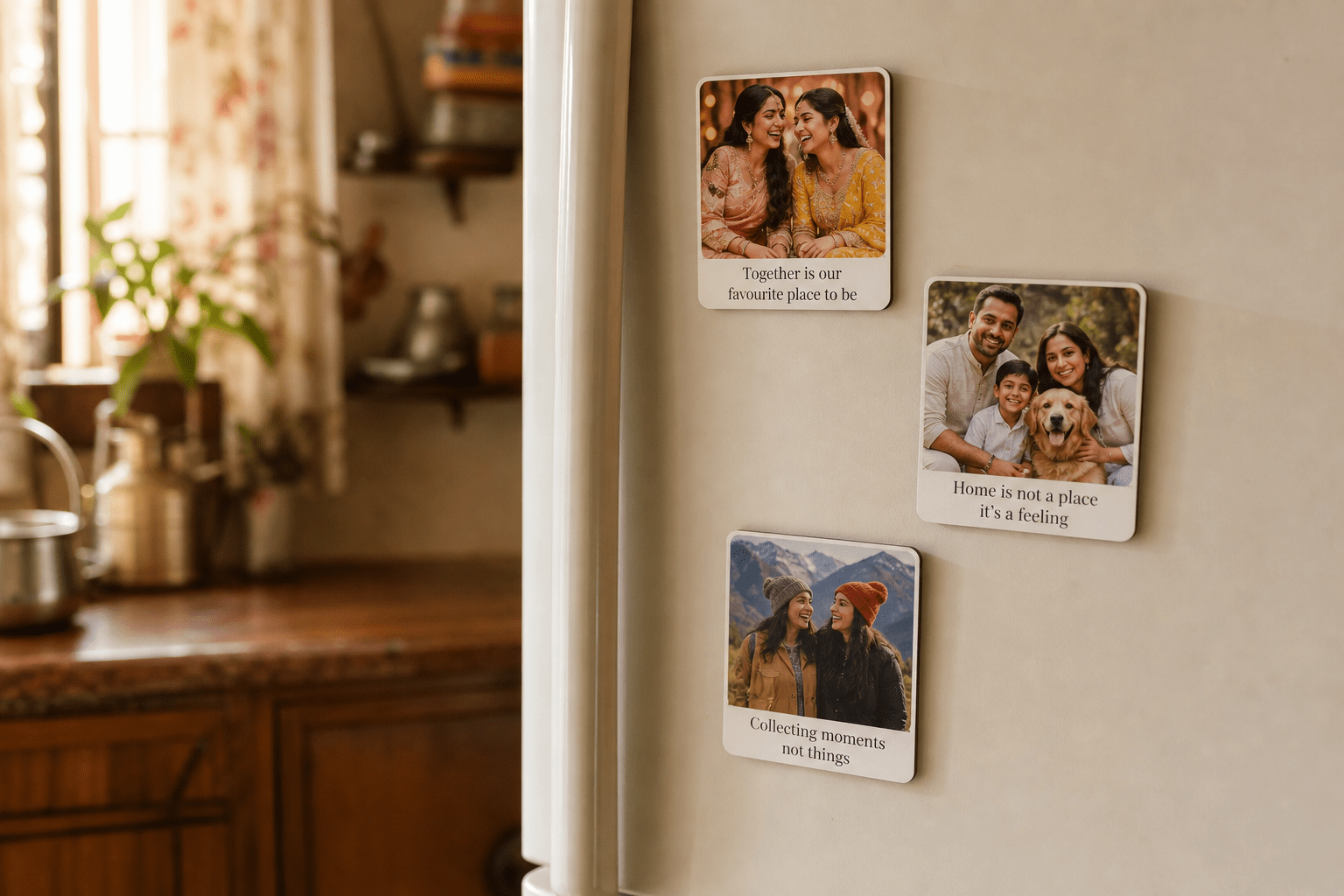
In the end, because I had run out of time and was catching a train in four hours, I ordered something small and quick — a personalised fridge magnet with a photograph from the two of us. A photo I had taken at her mehendi the previous evening, both of us laughing at something her aunt had said, dupatta slightly crooked, completely unposed and slightly blurry at the edges. I had it printed with both our names and one line — some friendships become family.
It arrived the next day, I packed it with a small card, and gave it to her at the reception feeling mildly guilty that it was not the large and considered gift I had planned.
Three years later, that magnet is on her fridge in Pune. She has sent me photographs of it twice — once when she moved into their new flat and was setting up the kitchen, and once when her mother-in-law visited and asked about it.
The silk sarees are in a cupboard. The decorative items are in a storage room. The magnet is on the fridge.
What I Started to Understand
After Shreya’s wedding I started paying more attention to what actually lasted in people’s homes after gifts were given.
Not the large things. Almost never the large things. The things that lasted were small and specific and personal — the things that had someone’s actual face in them, or a memory attached to them, or a detail so particular to that person that nobody else could have given it.
A friend of mine has a small framed photograph on her desk at work — her and her grandmother, taken on a trip they took together years before the grandmother passed. Nothing expensive. Just a photograph in the right place at the right time.
My brother has a keychain his daughter made him at school — badly painted, slightly lopsided, her name spelled incorrectly on the back. It has been on his keyring for four years and will probably never leave it.
What these things have in common is not their price or their size. It is that they are undeniably, specifically about someone. They could not have been given to anyone else. And that is what makes them stay.
How I Found What I Was Looking For
Once I understood this, I started looking for gifts that could be personal without being complicated. Things that could hold a photograph, a name, a memory — and be small enough to live somewhere visible in a person’s daily life rather than packed away in a cupboard.
I found a collection of custom fridge magnets that did exactly this — personalised with your own photograph, names, and a short message if you wanted one. Printed on proper acrylic or wood, sharp colours, strong magnetic back. And before printing, they send a full preview so you can check every detail and approve it before it is made.
The range was wider than I expected. Couple magnets, family magnets, magnets for friends, for siblings, for grandparents. Magnets with city names for people who love travelling. Even one for long-distance couples that shows both their cities on a small map with a heart connecting them. Starting from around ₹335, delivered across India within a few days.
I have ordered from this collection four times in the past year. Once for Shreya’s house-warming when she moved to the new flat — a family photograph of her, her husband and their new puppy. Once for my mother’s birthday — a photograph from a trip we took together to Uttarakhand, just the two of us, that she had never printed anywhere. Once as a return gift for my own small birthday gathering — eight magnets, each with a different photograph of that friend and me, packed in small kraft paper bags.
Every single one of them is still up somewhere. I know this because people mention them.
The Return Gift That Actually Got Kept
The birthday magnets are worth mentioning separately because they taught me something I did not expect.
Return gifts are one of the most thankless gifting challenges in an Indian household. You want to give something that feels considered but is practical to order in multiples, fits every person, and does not end up being thrown away or regifted within a week. Chocolates are fine. Diyas are fine. Plants are fine if you know your guests’ living situations. But none of them are personal.
Eight friends came to my birthday dinner. For each of them I ordered a small personalised fridge magnet — a different photograph of that friend and me together, chosen from my phone, with their name and mine and the year we became friends written below it.
The cost per magnet was under ₹400. The time it took to choose eight photographs and fill in eight names was about forty minutes. What arrived were eight completely different, completely personal gifts that could not have been given to anyone else.
One friend texted me that night from home to say she had put it on her fridge immediately. Another one sent me a photo a week later — it was on her office desk, propped against a small plant because she does not have a metal surface there.
None of them ended up in a drawer. I know this with reasonable confidence because three of them mentioned it the next time I saw them, unprompted.
What Small Gifts Actually Do
I am not arguing against large gifts. Sometimes the occasion calls for something substantial. Sometimes you know exactly what someone needs and it happens to be large and expensive and that is the right thing to give.
But I think we consistently underestimate what small, personal, considered gifts do — and we consistently overestimate what large, generic, well-priced gifts do.
A large gift says: I spent money on you. A small personal gift says: I was paying attention to you.
Both are forms of love. But one of them tends to end up in a cupboard and one of them ends up on a fridge door where it gets seen every single morning.
The fridge is one of the most looked-at surfaces in any Indian home. Every family passes it multiple times a day — for water, for leftovers, for chai ingredients, for children running in from school. Whatever is on that fridge gets seen constantly, without intention, in the most ordinary moments of daily life.
A personalised fridge magnet with the right photograph lives in that space. Not on a shelf that gets dusted occasionally. Not in a drawer that gets opened twice a year. On the fridge. Every day. In the background of the most ordinary and therefore most real moments of someone’s life.
That is not a small thing. That is, I would argue, exactly what a gift is supposed to do.
If You Are Rethinking How You Give
If you have a gifting occasion coming up and you are tired of giving things that end up forgotten — start with a photograph. Find one that is specific to the person, one that has a memory in it that only the two of you share. Then find the smallest, most everyday object you can put it on.
It does not need to be expensive. It does not need to be large. It just needs to be undeniably, specifically about them.
That is the whole thing. That is all a good gift needs to be.
