

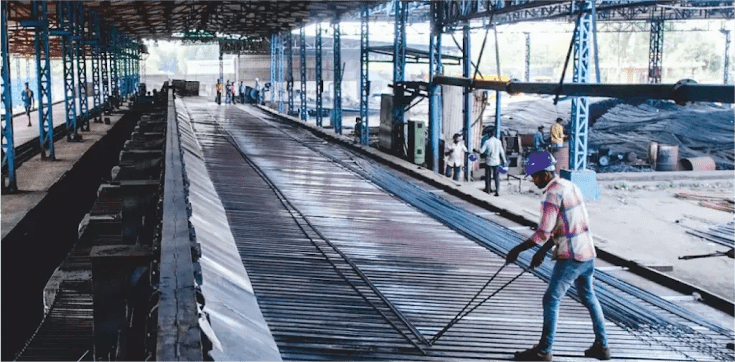
In modern construction, the quality of reinforcement steel plays a crucial role in determining the strength and durability of structures. Thermo-mechanically treated (TMT) bars are widely used due to their superior mechanical properties, and the core of their production lies in a tmt rolling mill. This facility is responsible for transforming raw steel into high-quality TMT bars that meet the demands of residential, commercial, and infrastructure projects.
What is a TMT Rolling Mill?
A tmt rolling mill is a specialized manufacturing unit where steel billets are processed into TMT bars through controlled heating, rolling, and cooling techniques. The rolling mill ensures that the steel achieves the required shape, size, and mechanical properties necessary for construction use.
Key Stages in TMT Bar Manufacturing
1. Heating of Steel Billets
The process begins with heating steel billets in a furnace at high temperatures. This makes the steel malleable and suitable for further shaping.
2. Rolling Process
The heated billets pass through multiple rolling stands, where they are gradually shaped into bars of specific diameters such as 8mm, 10mm, 12mm, and 16mm. The rolling process ensures dimensional accuracy and uniformity.
3. Thermo-Mechanical Treatment
After rolling, the bars undergo rapid cooling through a quenching process. This creates a hard outer layer while maintaining a soft inner core, providing both strength and flexibility.
4. Cooling and Cutting
The bars are then cooled on a cooling bed and cut into standard lengths, making them ready for use in construction.
Importance of a TMT Rolling Mill
Ensures Uniform Quality
A modern tmt rolling mill maintains strict control over temperature and rolling parameters, ensuring that every bar has consistent strength and dimensions.
Improves Mechanical Properties
The combination of rolling and thermo-mechanical treatment enhances tensile strength, ductility, and resistance to stress.
Enhances Bonding with Concrete
Proper rib formation during the rolling process improves the bonding between steel and concrete, which is essential for reinforced structures.
Supports Structural Safety
High-quality TMT bars produced in rolling mills help buildings withstand heavy loads, environmental stress, and seismic activity.
Role in Modern Construction
A well-equipped tmt rolling mill supports the construction industry by supplying reliable reinforcement steel for various applications, including:
- Residential buildings
- Commercial complexes
- Bridges and highways
- Industrial structures
Consistent production of high-quality TMT bars ensures that construction projects maintain safety and durability standards.
Contribution of Advanced Rolling Mills
Modern rolling mills use automated systems, precision engineering, and advanced cooling technologies to improve efficiency and product quality. These innovations help reduce defects, maintain uniform strength, and support large-scale production.
Conclusion
The tmt rolling mill is the backbone of TMT bar manufacturing. It ensures that raw steel is transformed into high-quality reinforcement bars with the strength, flexibility, and durability required for modern construction. By maintaining strict quality control and using advanced manufacturing processes, rolling mills play a vital role in delivering safe and long-lasting structures.
