

Introduction
Every growing company eventually faces the same question build an internal team or bring in outside experts? The debate around In-house CRM versus outsourcing often feels less like a strategy meeting and more like a philosophical discussion about control, cost, and courage. Customer relationship systems promise clarity, efficiency, and measurable growth sometimes all before lunch. Yet the path to building that system matters just as much as the platform itself. Choosing wisely requires more than budget math—it demands a realistic look at talent, scalability, and long-term vision.
What Does an In-House CRM Team Really Mean?
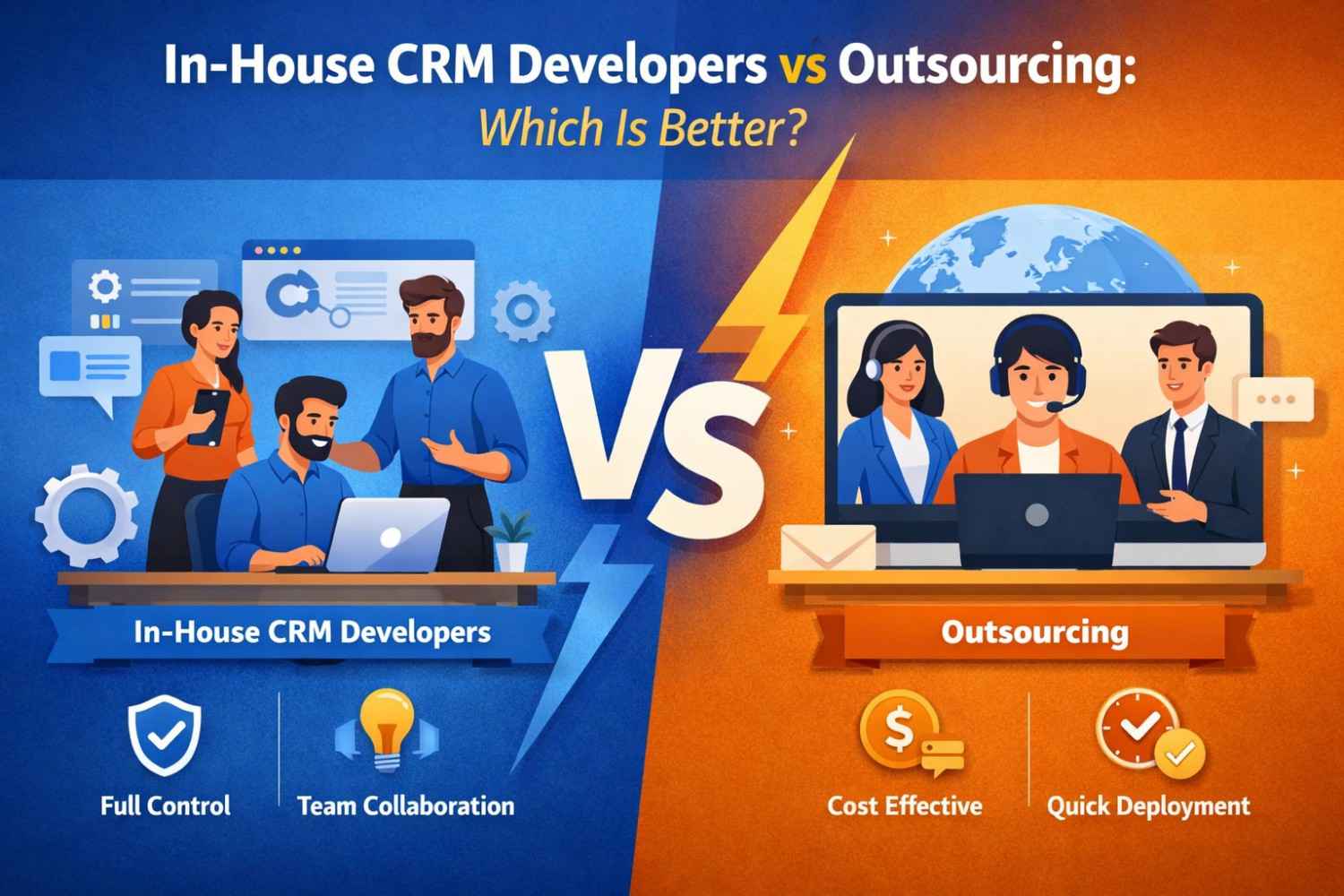
An internal CRM team sounds reassuring. Developers sit a few desks away, meetings happen instantly, and product discussions feel organic. An In-house CRM model provides deeper cultural alignment and tighter collaboration across departments. Institutional knowledge grows naturally, and ownership remains firmly within company walls. However, recruitment, onboarding, training, and retention can quietly inflate budgets. Skilled CRM engineers are not always easy to find—or keep. Internal teams also require ongoing management oversight, which can stretch leadership bandwidth. Control feels empowering, yet responsibility becomes equally demanding.
Outsourcing CRM Development: A Strategic Shortcut or Smart Move?
Outsourcing shifts the equation from employment to partnership. Instead of building a team from scratch, organizations can hire crm developers who already possess specialized experience. Agencies often bring cross-industry insights, refined workflows, and proven deployment frameworks. Time-to-market typically shortens, which matters in competitive industries. On the other hand, communication gaps and time-zone differences can create friction. Clear documentation and strong contracts become essential safeguards. Outsourcing is not surrendering control—it is reallocating it. When managed strategically, external expertise can accelerate innovation without sacrificing quality.
Cost Comparison: Budget Reality vs Business Ambition
Financial considerations frequently drive this debate. An in-house model involves salaries, benefits, office infrastructure, and long-term commitments. Outsourcing usually operates on project-based or retainer pricing structures. At first glance, outsourcing may appear more economical, but extended partnerships can balance out the savings. Conversely, internal teams require consistent payroll investment regardless of project load. Hidden costs exist on both sides—software licenses, training, turnover, or scope expansion. Ultimately, the true calculation is not simply expense; it is return on investment and sustainable growth alignment.
Control, Flexibility, and Customization
Control is often cited as the strongest argument for internal teams. Direct oversight ensures rapid adjustments, continuous iteration, and full transparency. Yet external partners specializing in custom crm software development often deliver advanced customization faster due to dedicated experience. Flexibility can exist in both models, though it manifests differently. Internal teams adapt based on internal priorities, while agencies scale resources dynamically. The critical question becomes strategic alignment: which structure better supports evolving customer journeys, integrations, and automation demands? The answer depends less on preference and more on preparedness.
Scalability and Speed to Market
Scaling an internal team takes time—job postings, interviews, onboarding cycles, and ramp-up periods. Outsourced teams typically deploy immediately, bringing structured processes and ready-made expertise. For fast-growing companies, this speed can be decisive. A mid-sized firm once delayed product integration for months while recruiting developers; meanwhile, competitors launched updates effortlessly. The lesson felt obvious in hindsight. Agility matters. When rapid implementation determines market advantage, outsourcing often provides momentum. Internal teams, however, may deliver steadier long-term continuity once fully established and resourced.
Risk Management and Data Security
CRM systems house sensitive customer information, making security a non-negotiable factor. Internal teams provide direct oversight of infrastructure and compliance policies. Data remains under direct supervision, which reassures many executives. Outsourcing, however, does not automatically equate to vulnerability. Reputable vendors implement advanced security protocols and adhere to strict regulatory standards. Service-level agreements and compliance certifications help mitigate risks. Vendor lock-in remains a valid concern, so contractual clarity is essential. Effective governance—not merely location—ultimately determines the strength of data protection strategies.
Talent Availability and Expertise
The demand for CRM specialists continues to outpace supply in many regions. Recruiting experienced developers can require months of search and negotiation. Outsourced partners often maintain multidisciplinary teams skilled in integrations, automation, analytics, and user experience design. That breadth of expertise may exceed what a small internal team can provide. Training internal hires builds loyalty but requires patience. Outsourcing offers immediate access to advanced knowledge, while internal teams develop contextual understanding over time. The trade-off lies between instant capability and cultivated familiarity.
Hybrid Approach: The Middle Ground
A blended strategy often delivers practical balance. Internal leaders oversee architecture and strategic direction, while external experts execute specialized modules or integrations. This hybrid approach preserves institutional knowledge without sacrificing technical depth. Communication flows internally, yet execution benefits from outside efficiency. Many organizations discover that neither extreme fully satisfies operational needs. Instead, collaborative frameworks create resilience and adaptability. By defining ownership boundaries clearly, companies avoid confusion while benefiting from shared accountability. Hybrid models require coordination—but they frequently yield stability and scalability.
Personal Observation
Decision-making around CRM development can resemble a budgeting chess match. One leadership team once spent weeks comparing spreadsheets, debating control versus cost, and revising projections repeatedly (sometimes dramatically). After exhaustive analysis, the realization emerged: clarity of goals mattered more than staffing structure. Without a defined CRM roadmap, neither internal nor outsourced teams could deliver measurable success. Strategy preceded staffing. That insight reshaped the conversation entirely. Rather than asking who should build it, the focus shifted to why it needed to exist. The answer changed everything.
How to Decide: A Practical Framework
Start by evaluating long-term business objectives. Consider projected growth, integration complexity, and required scalability. Assess internal technical maturity and leadership bandwidth. Examine budget flexibility—not just for today, but for the next five years. Identify risk tolerance levels and compliance requirements. Map out customer journey priorities before evaluating staffing options. A structured decision framework reduces emotional bias and highlights operational realities. When business strategy leads the evaluation process, the appropriate model—internal, outsourced, or hybrid—often becomes surprisingly clear.
FAQs
Is an In-House CRM team more secure than outsourcing?
Security depends on governance and implementation quality. Internal teams offer direct oversight, but reputable outsourcing partners follow strict compliance standards and often implement advanced security frameworks.
When should a business outsource CRM development?
Outsourcing works well during rapid growth phases, tight deadlines, or when specialized expertise is unavailable internally.
What industries benefit most from outsourcing CRM projects?
Startups, SaaS providers, healthcare firms, and fast-scaling enterprises often gain speed advantages from outsourcing models.
How do long-term costs compare?
Internal teams involve fixed recurring costs, while outsourcing operates through flexible contracts. Over time, cost differences depend on project scope and duration.
Can a company transition from outsourcing to internal development later?
Yes. Many organizations begin with outsourcing and gradually build internal capabilities once strategy and infrastructure mature.
Conclusion
Choosing between internal development and outsourcing is rarely a binary decision. The better model depends on growth stage, resources, risk tolerance, and long-term objectives. Some companies thrive with tight internal control, while others accelerate through specialized partnerships. What matters most is alignment—between technology investment and business strategy. CRM systems influence sales, marketing, and customer experience profoundly. Selecting the right development structure ensures those systems become growth engines rather than operational burdens. Thoughtful planning, realistic budgeting, and strategic clarity ultimately define success.
