

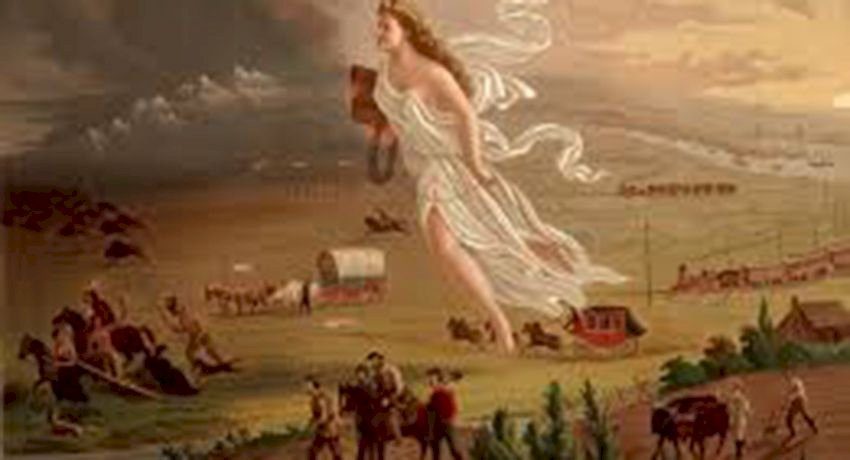
The famous Manifest Destiny painting most often discussed is John Gast’s 1872 work, American Progress. This image has become one of the most iconic visual representations of the belief that the United States was destined to expand across the North American continent. The painting is not just a piece of art but a political and cultural statement. It captures how many Americans in the 1800s understood westward expansion—not simply as migration or settlement, but as a divine mission, a natural right, and an inevitable historical movement. The painting expresses the optimism, pride, and confidence of the era, while also revealing the darker realities that were often ignored or justified through ideology.
At the heart of the painting is the central figure of a glowing woman floating westward through the sky. She is often interpreted as an allegorical figure named Columbia, a symbolic representation of the United States, similar to how Britannia symbolizes Britain. Columbia appears angelic, larger than life, and surrounded by light. Her presence suggests that expansion is not only political but also sacred and morally righteous. By placing her above the landscape, the artist implies that the nation’s growth is guided by higher forces, almost as if God himself has approved the movement westward. This reflects the religious undertones of Manifest Destiny, which argued that Americans had a divine responsibility to spread civilization, democracy, and Christianity.
Columbia is moving from the bright eastern side of the painting toward the darker western frontier. This contrast is deeply symbolic. The East is shown as developed, settled, and full of signs of progress, while the West appears wild, shadowy, and untamed. The message here is clear: the West is portrayed as a space waiting to be transformed. This artistic framing supports the belief that American settlement would bring light, order, and improvement. The painting suggests that expansion is not conquest but advancement, and that civilization naturally replaces wilderness. This idea was central to Manifest Destiny ideology, which viewed American culture as superior and destined to spread.
One of the most striking details is that Columbia carries a schoolbook or instrument of knowledge in her hands. This symbolizes education, enlightenment, and learning. It suggests that as Americans move west, they are bringing knowledge and culture with them. In the 19th century, many supporters of expansion believed they were spreading progress and opportunity. Schools, churches, and democratic institutions were seen as markers of civilization. The painting reinforces the idea that westward expansion was not only about land but about the extension of American values and ways of life.
Another important symbol is the telegraph wire that Columbia is stringing across the continent. This represents modern technology and communication, linking the East and West. The telegraph was a major innovation in the mid-1800s, and its inclusion shows that Manifest Destiny was connected to industrial growth and modernization. Expansion was not only geographic but economic and technological. The message is that American progress was unstoppable, powered by invention and industry. The painting celebrates the transformation of the continent into a connected, modern nation.
Beneath Columbia, the landscape is filled with images of westward movement. Settlers in wagons, farmers plowing fields, and trains speeding across the land symbolize migration and development. The railroad in particular represents industrial power and national unity. It was one of the most important forces behind expansion, making it easier for settlers to travel west and transport goods. In the painting, the train becomes a symbol of progress cutting through nature, showing how technology reshapes the land. The artist presents these developments as positive and heroic, reinforcing the belief that expansion was beneficial and necessary.
However, the painting also reveals the cost of this so-called progress. As Columbia moves westward, Native Americans and wild animals are shown fleeing into the darkness. This is one of the most telling and troubling aspects of the image. Indigenous peoples are portrayed not as rightful inhabitants but as part of the wilderness being pushed aside. Their displacement is shown as inevitable, almost natural, rather than violent or unjust. This reflects the racist and colonial assumptions behind Manifest Destiny, which often denied Native Americans sovereignty and humanity. The painting communicates the idea that Indigenous cultures would disappear before American civilization, a belief used to justify forced removal and genocide.
The animals fleeing—buffalo, bears, and other wildlife—also symbolize the transformation of the natural environment. Expansion meant not only settlement but ecological destruction. Vast herds of buffalo were nearly exterminated, forests were cleared, and landscapes were reshaped by farming and industry. The painting does not mourn this loss but presents it as part of the march of progress. In this way, the artwork reflects the 19th-century belief that nature existed to be conquered and used for human advancement.
The painting’s dramatic use of light and darkness is central to its message. The East is bathed in golden sunlight, representing civilization, safety, and order. The West is shown as mysterious and dark, representing danger, chaos, and primitiveness. Columbia herself brings light, literally illuminating the frontier as she moves forward. This creates the impression that American expansion is the spreading of enlightenment into darkness. This imagery mirrors the language used by Manifest Destiny supporters, who spoke of bringing civilization to “empty” or “uncultured” lands, ignoring the rich societies already present there.
Manifest Destiny as an idea emerged strongly in the 1840s, when journalist John L. O’Sullivan declared it was America’s “manifest destiny” to overspread the continent. The belief combined nationalism, religious conviction, and economic ambition. Americans saw themselves as chosen to expand freedom and democracy. Yet this belief was deeply contradictory, because expansion often meant war, slavery, and oppression. The painting reflects only the triumphant narrative, not the suffering caused by expansion. It presents the United States as heroic and destined for greatness.
The painting also connects Manifest Destiny to capitalism and economic growth. Westward expansion opened new lands for farming, mining, and settlement. It promised wealth and opportunity for white Americans, especially settlers and businessmen. The railroad companies, land speculators, and industries benefited enormously. The painting’s emphasis on trains, farms, and development reflects the economic motivations behind the ideology. Expansion was not purely spiritual; it was tied to resources, markets, and power.
Another major historical context behind the painting is the aftermath of the Civil War. Painted in 1872, American Progress appeared during a period of reconstruction and renewed national growth. The country was healing from division, and westward expansion offered a new vision of unity and purpose. The painting served as propaganda for national progress, suggesting that the future lay in continued development and conquest of the frontier. It reassured Americans that despite conflict, the nation was still moving forward toward greatness.
The painting also reflects gender symbolism. Columbia is a female figure, gentle and angelic, representing moral guidance rather than brute force. This is significant because the actual expansion of the West was often violent, involving wars, forced removals, and military campaigns. By using a peaceful female symbol, the painting softens the reality of conquest. It makes expansion seem benevolent and graceful rather than aggressive. This artistic choice helps justify imperialism by presenting it as nurturing rather than destructive.
The message of the Manifest Destiny painting is therefore complex. On the surface, it celebrates progress, technology, education, and national growth. It portrays America as a beacon of light spreading civilization across the continent. It expresses pride in development and confidence in the future. For many Americans at the time, it confirmed their belief that expansion was both inevitable and righteous.
At the same time, the painting reveals the darker ideological assumptions of Manifest Destiny. It shows Native Americans being pushed aside, nature being conquered, and the West being treated as empty land meant for American control. The painting is a reminder of how art can be used to support political power and cultural dominance. It reflects the mindset of colonialism, where one group’s progress is shown as more important than another’s survival.
Today, historians view American Progress as both a symbol of American ambition and a critique of the myths that justified expansion. It helps modern audiences understand how Americans in the 19th century imagined themselves and their role in history. The painting is valuable not because it tells the full truth, but because it reveals the beliefs and values of its time. It shows how the idea of destiny was used to legitimize conquest, and how progress was defined in ways that excluded Indigenous peoples and other marginalized groups.
In conclusion, the Manifest Destiny painting communicates the belief that American westward expansion was divinely guided, morally justified, and historically inevitable. Through powerful symbols—Columbia, light, technology, settlers, and fleeing Native peoples—the painting tells a story of progress and transformation. But beneath its glowing optimism lies a deeper reality of displacement, violence, and environmental destruction. The artwork remains one of the clearest visual representations of Manifest Destiny, capturing both the pride and the tragedy embedded in America’s expansionist past.
