

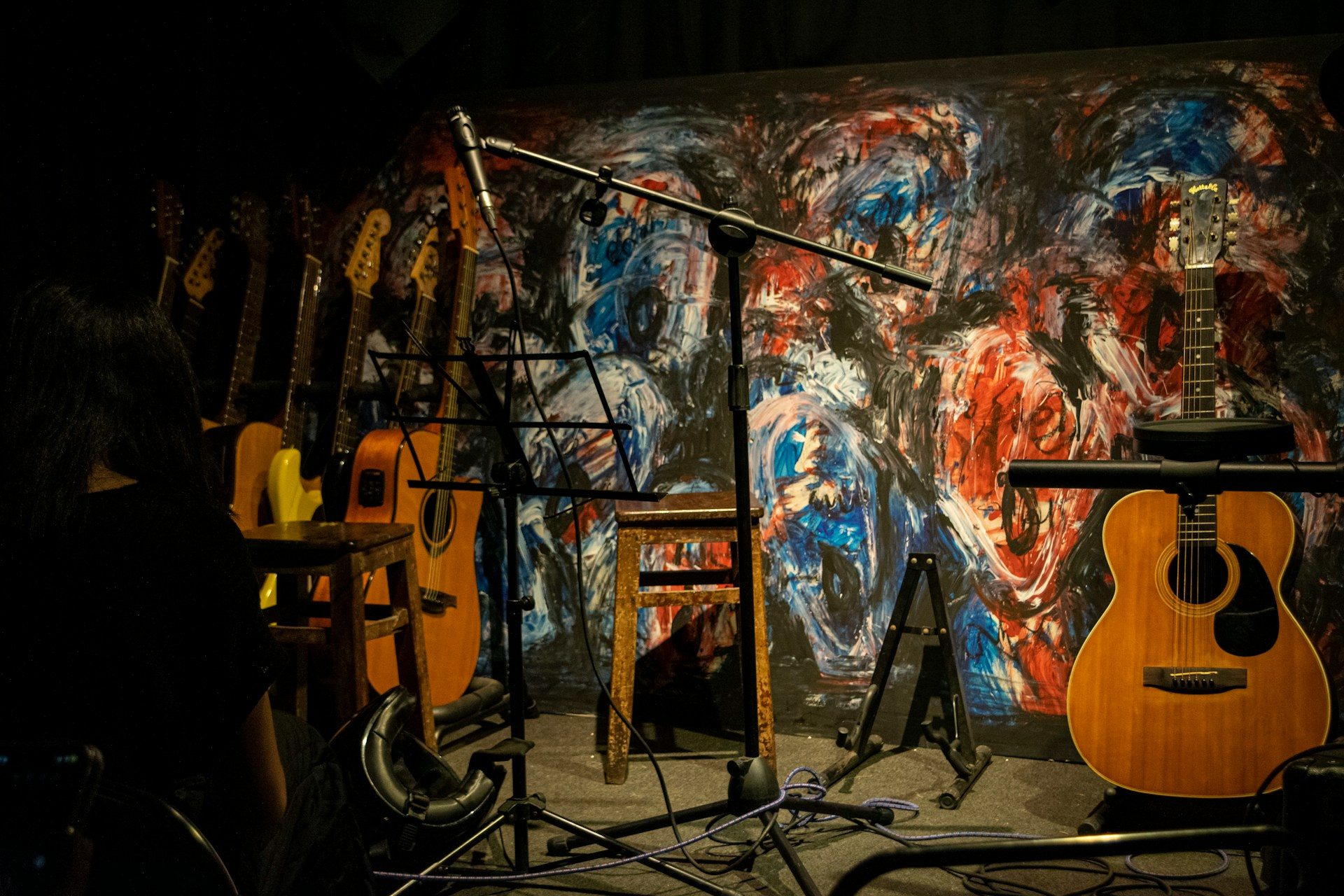
Guitar steampunk artwork is a distinctive fusion of music culture, visual art, and the retro-futuristic aesthetic known as steampunk. At its core, it reimagines the guitar—one of the most iconic instruments in modern music—through the lens of an alternate history where Victorian-era technology, steam power, and ornate mechanical design dominate the world. Instead of sleek, factory-finished instruments, steampunk guitars appear handcrafted, time-worn, and mechanically intricate. They often look as if they were built in a 19th-century inventor’s workshop, combining brass gears, exposed cogs, copper pipes, pressure gauges, leather straps, clockwork mechanisms, and engraved metal plates with traditional wooden guitar bodies. This artistic style transforms the guitar from a purely musical tool into a sculptural object that tells a story, blurring the boundary between instrument and artwork.
The concept of steampunk itself emerged from speculative fiction and science fiction literature, inspired by writers such as Jules Verne and H. G. Wells, who imagined futuristic technologies powered by steam and mechanical ingenuity rather than electricity or digital systems. Guitar steampunk artwork draws heavily from this imaginative tradition. In this context, the guitar is not just an instrument for producing sound but a symbolic artifact from an imagined past-future world. It suggests a timeline in which rock music, blues, or experimental soundscapes developed alongside steam engines, airships, and clockwork automatons. This narrative quality is one of the most defining characteristics of steampunk guitar art: every scratch, bolt, and gear feels intentional, as though it carries the history of a fictional civilization.
Visually, steampunk guitar artwork is famous for its dense layering of textures and materials. Wood grains are often left visible or deliberately distressed to give an aged appearance. Metals such as brass, bronze, iron, and copper dominate, chosen not only for their color but also for their association with Victorian engineering. These metals may be polished to a warm glow or deliberately oxidized to create a patina that suggests decades of use. Decorative elements like filigree, rivets, watch parts, keys, chains, and mechanical wings are frequently attached to the guitar’s body or headstock. Pickguards may be replaced with engraved metal plates, while knobs and switches are redesigned to resemble valves, levers, or clock dials. The result is an instrument that feels both heavy with history and alive with mechanical energy.
Beyond surface decoration, many steampunk guitar artworks incorporate functional or semi-functional mechanical elements. Some artists design moving gears that turn when the guitar is played, or pressure gauges that respond to vibration or sound. Others include hidden compartments, spring-loaded parts, or LED lighting disguised as glowing vacuum tubes. These features reinforce the illusion that the guitar is powered by steam or clockwork rather than electricity. Even when these components are purely decorative, they contribute to the sense of theatricality and invention that defines steampunk. The guitar becomes a prop in a larger performance, enhancing the musician’s stage presence and the audience’s immersion in a fantastical world.
Guitar steampunk artwork is also famous for its craftsmanship. Unlike mass-produced instruments, steampunk guitars are often custom-built or heavily modified by individual artists and luthiers. This hands-on approach aligns with the steampunk philosophy of valuing artisanal skill, creativity, and mechanical understanding over industrial uniformity. Each instrument is typically one of a kind, reflecting the personal vision of its creator. Artists may spend hundreds of hours carving wood, machining metal parts, aging surfaces, and assembling complex decorative structures. Because of this labor-intensive process, steampunk guitars are often considered collectible art pieces rather than everyday performance instruments, although many are fully playable and professionally set up.
The fame of steampunk guitar artwork also comes from its strong connection to performance art and stage aesthetics. Musicians who adopt steampunk guitars often incorporate them into elaborate costumes and narratives. Bands and solo performers in genres such as industrial rock, gothic rock, dark cabaret, experimental metal, and alternative blues have embraced steampunk visuals to stand out in a crowded music scene. On stage, a steampunk guitar acts as a visual focal point, instantly signaling the artist’s identity and artistic philosophy. The instrument becomes part of the storytelling, reinforcing themes of rebellion, invention, nostalgia, and imagined futures. Audiences remember not just the sound of the music, but the striking image of a performer wielding a mechanical, steam-powered guitar.
Another reason steampunk guitar artwork is famous is its presence in popular culture, conventions, and exhibitions. Steampunk festivals, comic conventions, cosplay events, and maker fairs often feature these guitars as showpieces. They attract attention from both music lovers and visual art enthusiasts, bridging communities that might otherwise remain separate. In galleries, steampunk guitars are displayed as sculptural works, inviting viewers to examine their details up close. Online, images of these instruments circulate widely on social media platforms, art websites, and video channels, where their intricate designs and imaginative concepts captivate global audiences. This digital visibility has helped steampunk guitar art gain recognition far beyond niche subcultures.
Symbolically, steampunk guitar artwork is famous for what it represents: a critique of modern technology and a romanticization of the past. In an age dominated by digital devices, software, and invisible processes, steampunk celebrates visible mechanics and tangible materials. A steampunk guitar proudly displays its “machinery,” even when that machinery is symbolic. This openness contrasts with the sleek, sealed designs of modern electronics. For many artists and fans, this aesthetic expresses a desire to reconnect with craftsmanship, individuality, and the human touch. The guitar, already associated with personal expression and emotion, becomes an even more powerful symbol when combined with steampunk’s philosophy of mindful making and imaginative engineering.
The historical resonance of the guitar itself also contributes to the appeal of steampunk interpretations. The guitar has evolved over centuries, from early stringed instruments to classical, acoustic, and electric forms. Steampunk guitar artwork playfully rewrites this history, suggesting alternative evolutionary paths. Instead of magnetic pickups and plastic components, these guitars might feature “steam pickups,” brass resonators, or mechanical amplifiers. This speculative approach invites viewers to think differently about technological progress and cultural history. It raises questions about how music, art, and society might have developed under different technological conditions.
In terms of sound, steampunk guitars are not famous for a single, standardized tone. Some are designed primarily as visual art and may not be optimized for performance. Others, however, are fully functional instruments capable of producing rich, distinctive sounds. Builders may combine traditional electric or acoustic guitar electronics with unusual materials that subtly affect resonance and sustain. The visual heaviness of a steampunk guitar often leads audiences to expect a powerful, gritty sound, which aligns well with genres like rock, metal, blues, and industrial music. Even when the sound itself is conventional, the visual context changes how it is perceived, adding layers of meaning and drama to the performance.
Steampunk guitar artwork is also famous for encouraging experimentation and cross-disciplinary creativity. Artists who create these guitars often draw skills from multiple fields, including woodworking, metalworking, mechanical engineering, sculpture, costume design, and electronics. This blending of disciplines reflects the steampunk ethos of the “maker,” someone who learns by doing and combines old and new techniques. As a result, steampunk guitars inspire others to experiment with instrument modification and artistic customization. They challenge the idea that instruments must look a certain way, opening the door to more personalized and expressive designs.
The narrative dimension of steampunk guitar artwork cannot be overstated. Many creators design their instruments with a backstory in mind. A guitar might be presented as a relic from an airship captain, a scientist’s experimental sound machine, or a revolutionary musician from an alternate Victorian era. These stories add depth and emotional resonance, transforming the guitar into a character in its own right. This storytelling aspect aligns closely with steampunk literature and cosplay, where characters and objects are richly imagined and contextualized. For fans, owning or seeing a steampunk guitar is like encountering a tangible piece of fiction brought to life.
Fame also comes from the rarity and exclusivity of steampunk guitar artwork. Because these instruments are often custom-made and expensive, they carry a sense of prestige. Collectors, museums, and high-profile musicians may commission unique pieces, further elevating their status. When a well-known performer appears with a steampunk guitar, it draws media attention and reinforces the association between the aesthetic and artistic originality. Over time, these high-visibility moments contribute to the broader recognition of steampunk guitars as icons of alternative art and music culture.
Educationally and philosophically, steampunk guitar artwork is famous for sparking curiosity. Viewers often find themselves asking how the instrument was made, which parts are functional, and what inspired the design. This curiosity can lead to deeper engagement with history, engineering, and art. Steampunk guitars serve as conversation starters, encouraging discussions about the relationship between technology and creativity, the value of handmade objects, and the role of imagination in shaping cultural identity. In this way, they function not only as artworks but also as educational tools and sources of inspiration.
In summary, guitar steampunk artwork is a unique and influential artistic form that transforms the guitar into a symbol of retro-futuristic imagination, craftsmanship, and storytelling. It is famous for its elaborate visual design, combining aged wood, ornate metals, and mechanical motifs inspired by Victorian-era technology and speculative fiction. It stands out for its emphasis on handmade quality, individuality, and cross-disciplinary creativity. On stage and in galleries, steampunk guitars captivate audiences by merging music, performance, and sculpture into a single expressive object. More than just decorative instruments, they represent a philosophy that values imagination over efficiency, narrative over uniformity, and human creativity over anonymous mass production. Through this blend of art, history, and fantasy, guitar steampunk artwork has earned its place as a striking and memorable expression of modern alternative culture.
