

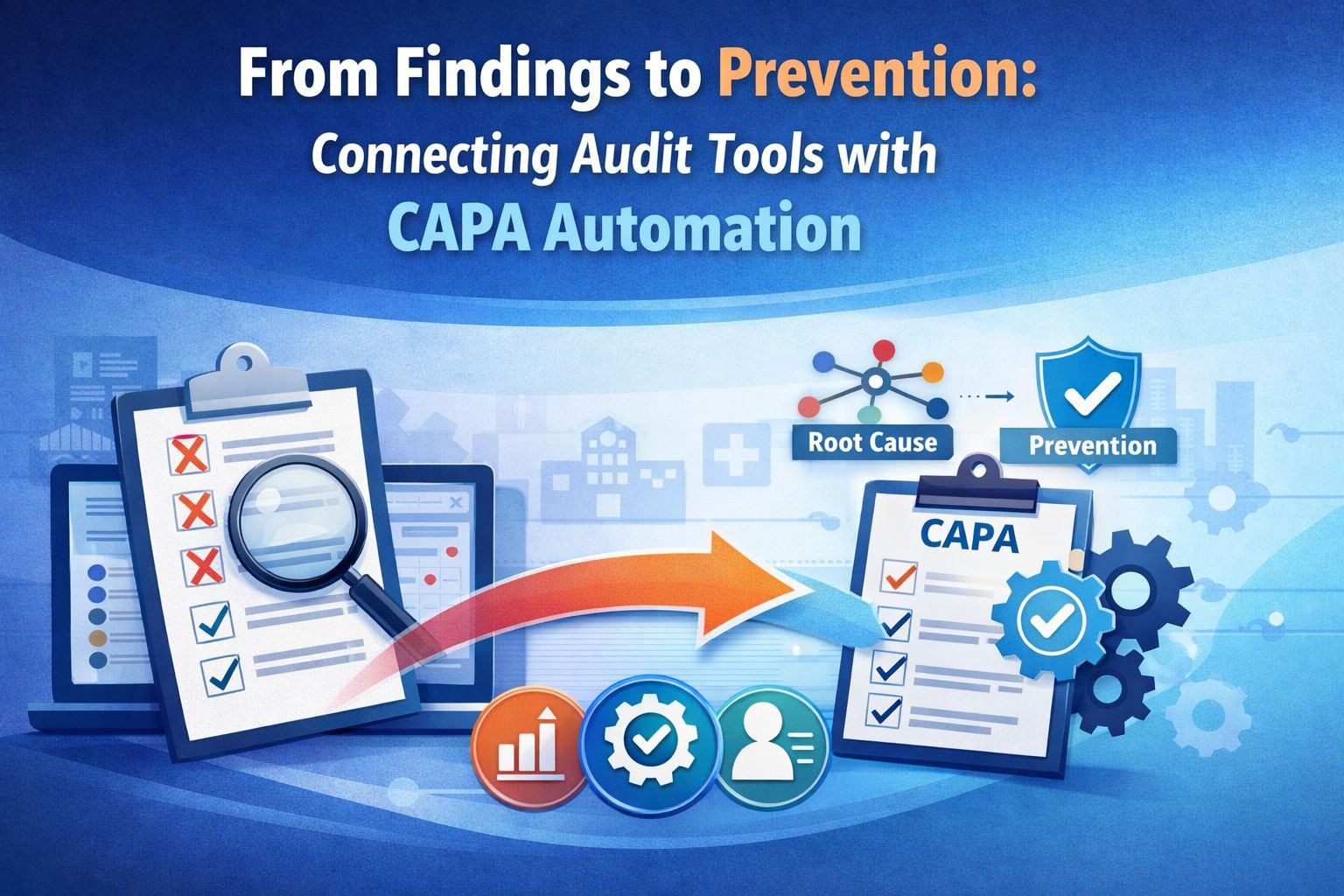
Audit findings are not the real problem. They are symptoms.
Behind every audit observation lies a process gap, a systemic weakness, or a missed opportunity for prevention. Yet in many organizations, audits still end where they should begin—with a list of findings, a flurry of corrective actions, and little confidence that the same issues will not reappear in the next inspection.
The shift from reactive correction to proactive prevention depends on how well audit activities are connected to corrective and preventive action workflows. When audit tools operate in isolation, findings remain disconnected from long-term improvement. When they are tightly integrated with CAPA automation, audits become one of the most powerful drivers of quality maturity.
Why audit findings keep repeating
Most regulated organizations conduct audits regularly, whether internal, supplier, or regulatory. Yet repeat observations remain one of the most common challenges flagged by auditors.
This usually happens because:
-
Audit findings are documented but not analyzed deeply
-
Corrective actions address symptoms rather than root causes
-
CAPAs are tracked manually with limited oversight
-
Audit outcomes are not linked to broader risk and quality trends
When audits and CAPA processes live in separate systems or spreadsheets, there is no closed loop. The organization fixes the immediate issue but fails to strengthen the underlying process.
Rethinking the role of audit tools
Traditionally, audit tools have focused on scheduling audits, managing checklists, and capturing observations. While these capabilities are essential, they are not sufficient on their own.
Modern audit tools must serve a larger purpose:
-
Identify systemic risks, not just nonconformances
-
Trigger standardized workflows based on severity and impact
-
Feed insights into preventive quality planning
When audits are treated as data sources rather than compliance events, their value increases exponentially.
The missing link: CAPA automation
Corrective and preventive actions are where audits turn into improvement. Without automation, CAPAs often become slow, inconsistent, and difficult to scale across sites.
Automated CAPA workflows help organizations:
-
Enforce consistent root cause analysis methods
-
Assign clear ownership and timelines
-
Monitor effectiveness through defined checkpoints
-
Escalate overdue or ineffective actions automatically
When CAPA automation is directly connected to audit findings, every observation becomes an opportunity for prevention rather than a one-time fix.
How integration changes audit outcomes
Connecting audit management software with CAPA automation transforms how organizations respond to findings. Instead of manually transferring data between systems, integration creates a seamless flow from detection to resolution.
Key benefits include:
-
Audit findings automatically generating CAPA records based on predefined rules
-
Risk-based prioritization that aligns effort with impact
-
Complete traceability from finding to corrective action to verification
This level of integration reduces delays, improves accountability, and ensures that no finding is overlooked or forgotten.
Driving prevention through root cause intelligence
Prevention begins with understanding why issues occur, not just where they appear. Integrated systems make it easier to analyze trends across audits, sites, and processes.
Organizations can:
-
Identify recurring findings linked to the same root causes
-
Detect process weaknesses before they trigger regulatory action
-
Use historical audit and CAPA data to inform risk assessments
This intelligence-driven approach shifts the organization from reacting to individual findings to strengthening systems proactively.
Implications for regulated industries
The connection between audits and CAPAs is especially critical in highly regulated environments where patient safety, product quality, and regulatory trust are at stake.
In a pharmaceutical QMS, audits often uncover gaps related to data integrity, deviation handling, or validation processes. Without automated CAPA linkage, these issues may be addressed inconsistently across manufacturing sites.
Similarly, in a medical device QMS, audit findings related to design controls, supplier quality, or complaint handling must feed directly into corrective and preventive workflows to meet regulatory expectations and avoid repeat observations.
In both cases, auditors expect to see evidence that:
-
Findings are evaluated systematically
-
Actions address root causes
-
Preventive controls are implemented and monitored
Integrated audit and CAPA systems make this evidence readily available.
Moving from compliance to continuous improvement
When audit tools and CAPA automation work together, audits stop being standalone compliance exercises. They become part of a continuous improvement cycle.
This cycle includes:
-
Audits identifying gaps and risks
-
CAPAs correcting and preventing issues
-
Management reviews evaluating effectiveness
-
Process updates reducing future findings
Over time, this approach reduces audit fatigue, improves inspection outcomes, and builds organizational confidence.
Visibility and leadership accountability
Another critical advantage of integration is visibility. Leadership teams often struggle to understand the true state of audit readiness and corrective action effectiveness.
Connected systems provide:
-
Real-time dashboards showing open findings and CAPA status
-
Trend analysis highlighting high-risk areas
-
Clear accountability across functions and sites
This transparency enables proactive decision-making rather than last-minute escalation before audits.
Preparing for the future of audits
Regulatory expectations continue to evolve, with greater emphasis on risk-based thinking, data integrity, and system effectiveness. Auditors increasingly assess how well organizations prevent issues, not just how they document them.
Organizations that rely on disconnected tools will find it harder to meet these expectations. Those that connect audit execution with automated CAPA workflows will be better positioned to demonstrate control, learning, and prevention.
From findings to prevention
The real value of audits lies not in the findings themselves, but in what organizations do next. When audit tools are integrated with CAPA automation, findings become catalysts for lasting improvement rather than recurring problems.
By closing the loop between detection and prevention, organizations can reduce repeat observations, strengthen quality systems, and move beyond compliance toward operational excellence.
Platforms like ComplianceQuest support this integrated approach by connecting audits, CAPAs, risk, and quality processes within a single system. By enabling seamless workflows and real-time visibility, ComplianceQuest helps organizations turn audit findings into preventive action and sustained compliance.
