

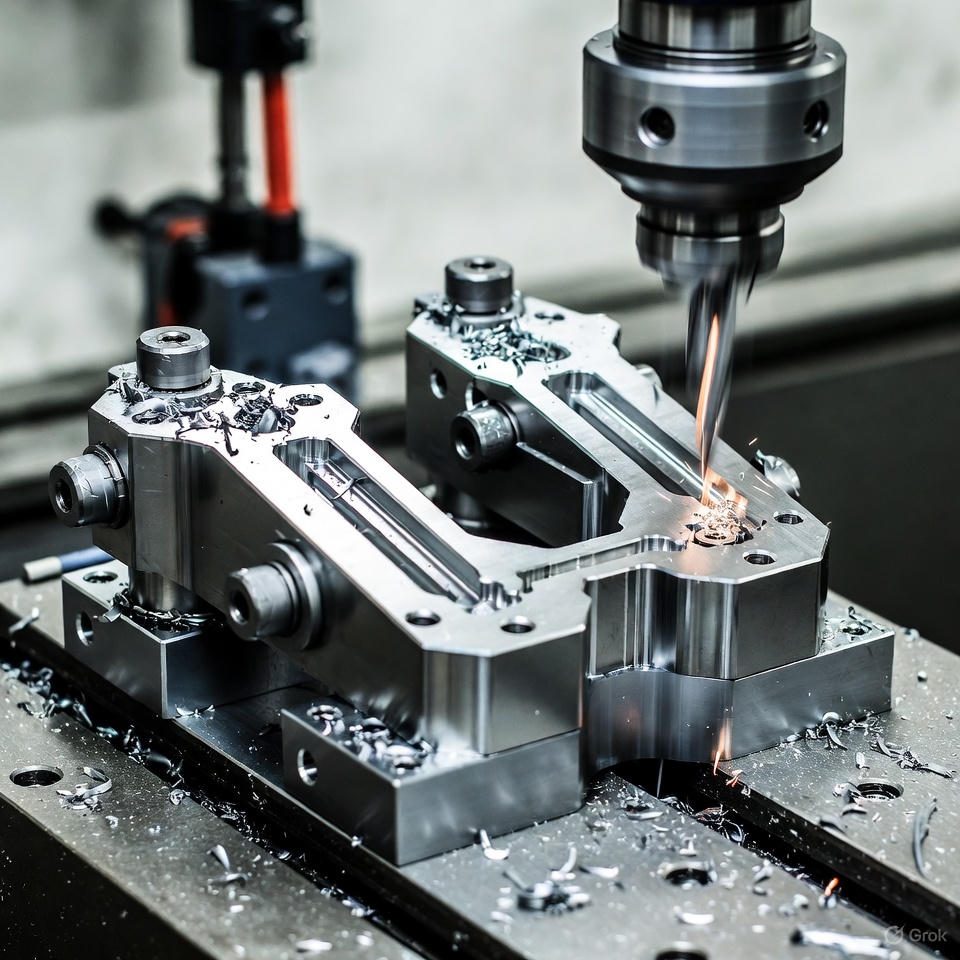
Modern CNC manufacturing demands precision, stability, and repeatability to meet the rising expectations of global industries. As component designs become more complex and tolerance requirements grow tighter, manufacturers must control every aspect of the machining process. One of the most critical foundations of this control is jigs and fixtures which ensure that each workpiece is accurately positioned, securely held, and consistently aligned throughout production. Without dependable tooling, even advanced CNC machines cannot deliver consistent and repeatable results.
In competitive manufacturing environments, CNC machining is expected to produce identical parts across prototypes, small batches, and large-scale production. This level of consistency cannot be achieved through machine accuracy alone. Tooling solutions must be integrated into the production workflow from the earliest planning stages. Well-designed tooling reduces variation, improves process stability, and supports manufacturers in meeting strict quality and delivery requirements without sacrificing efficiency.
The Role of Jigs and Fixtures in CNC Manufacturing Accuracy
CNC machines operate based on programmed tool paths, but the effectiveness of those paths depends entirely on how the workpiece is positioned. Jigs and fixtures establish fixed reference points that define the relationship between the cutting tool, the machine, and the part. When these reference points remain stable, machining results stay predictable across multiple cycles.
Accurate tooling minimizes the need for repeated manual alignment and reduces dependence on operator judgment. This controlled setup allows manufacturers to maintain uniform dimensions, consistent surface finishes, and reliable feature placement. Such control is essential for industries where part interchangeability and dimensional accuracy directly affect performance and safety.
Understanding the Fundamentals of Jigs and Fixtures
Jigs and fixtures act as the interface between CNC machines and raw materials. Jigs are generally used to guide cutting tools during operations such as drilling, tapping, or reaming. Fixtures, on the other hand, focus on holding and locating the workpiece in a fixed position during machining. Together, they create a controlled environment that supports accurate and repeatable production.
Effective tooling design balances rigidity, accuracy, and usability. Tooling must withstand cutting forces without deflection while remaining easy to load and unload. Poorly designed tools can slow production, increase setup time, and introduce dimensional errors. Thoughtful engineering ensures that tooling enhances productivity while preserving machining precision.
Workholding Tools and Machining Stability
Workholding tools play a critical role in maintaining stability during CNC operations. Cutting processes generate forces that can cause vibration or movement if the part is not secured properly. Controlled clamping applies enough force to hold the workpiece steady without causing distortion or stress.
Key advantages of reliable workholding tools include:
-
Reduced vibration and chatter during machining
-
Improved dimensional accuracy and repeatability
-
Better surface finish and extended cutting tool life
Stable workholding is especially important when machining hard materials or complex geometries where even minor movement can result in defects or costly rework.
CNC Fixture Design for Consistent Production Results
CNC fixture design focuses on accurate locating and rigid support throughout the machining cycle. Fixtures use defined datum points to ensure that every workpiece is positioned in the same orientation during each setup. This consistency allows tool paths to remain unchanged, supporting tight tolerance requirements and reducing variation between parts.
Fixtures must also be practical for production use. Designs that allow quick loading and secure clamping help reduce cycle times while maintaining rigidity during machining. By balancing precision and efficiency, well-designed fixtures support both quality and productivity in CNC operations.
Machining Support Tooling for Delicate and Complex Parts
Certain components require additional support due to their shape, size, or material properties. Thin-walled parts, long components, and lightweight structures are prone to deflection under cutting forces. Machining support tooling reinforces these areas, preventing deformation and maintaining dimensional accuracy.
Support tooling improves cutting stability by reducing vibration and chatter. This stability leads to smoother surface finishes, more predictable machining outcomes, and lower scrap rates. Over time, consistent support contributes to improved tool performance and greater confidence in production quality.
Precision Locating Devices and Repeatability Control
Precision locating devices ensure that every workpiece is positioned exactly the same way during each machining cycle. Locating pins, bushings, and reference surfaces define the part’s orientation relative to the machine. This eliminates cumulative errors that can occur with manual positioning.
Benefits of precision locating devices include:
-
Faster and more consistent setups
-
Improved part interchangeability
-
Reduced variation across machines and operators
These advantages are especially valuable in high-volume production environments where maintaining consistency is critical to meeting delivery schedules and quality standards.
Industry Applications of CNC Tooling Systems
Many industries depend on CNC machining for components that require strict dimensional control and repeatability. Aerospace, automotive, medical, and industrial equipment manufacturing all rely on structured tooling systems to meet demanding specifications. In these sectors, even small deviations can lead to performance issues or regulatory non-compliance.
Standard tooling solutions are not always sufficient for complex parts or unique materials. Custom tooling allows manufacturers to address specific challenges while maintaining accuracy and efficiency. Tailored solutions ensure that machining processes remain stable without limiting flexibility or innovation.
Integrating Tooling into CNC Process Planning
Tooling should be considered an essential part of CNC process planning rather than an afterthought. Early integration allows tooling design to align with part geometry, material selection, and machining strategy. This approach reduces the risk of production delays and minimizes costly modifications later.
When tooling is designed with adaptability in mind, it supports continuous improvement. Fixtures and supports can often be modified to accommodate design updates, allowing manufacturers to respond quickly to changing requirements while protecting their investment.
Efficiency, Cost Control, and Long-Term Value
Well-designed tooling systems directly support cost control by reducing setup errors, rework, and downtime. Stable machining conditions allow CNC machines to operate closer to optimal parameters, improving productivity and extending tool life. Over time, these efficiencies lower production costs and improve profitability.
By investing in reliable tooling solutions, manufacturers can scale production without compromising quality. Consistent processes lead to predictable output, helping manufacturers meet customer expectations in competitive markets.
Conclusion
An understanding of manufacturing engineering principles helps explain why tooling stability and repeatability are essential to CNC success, as outlined in resources such as Manufacturing engineering on Wikipedia. Precision machining relies not only on advanced machines but also on controlled positioning and secure support throughout the process.
At the core of this stability are jigs and fixtures, which provide accurate locating, reliable workholding, and repeatable results across production runs. When combined with sound process planning and engineering fundamentals such as those discussed in CNC machining theory on Wikipedia effective tooling enables manufacturers to achieve consistent quality, improved efficiency, and long-term production reliability.
