

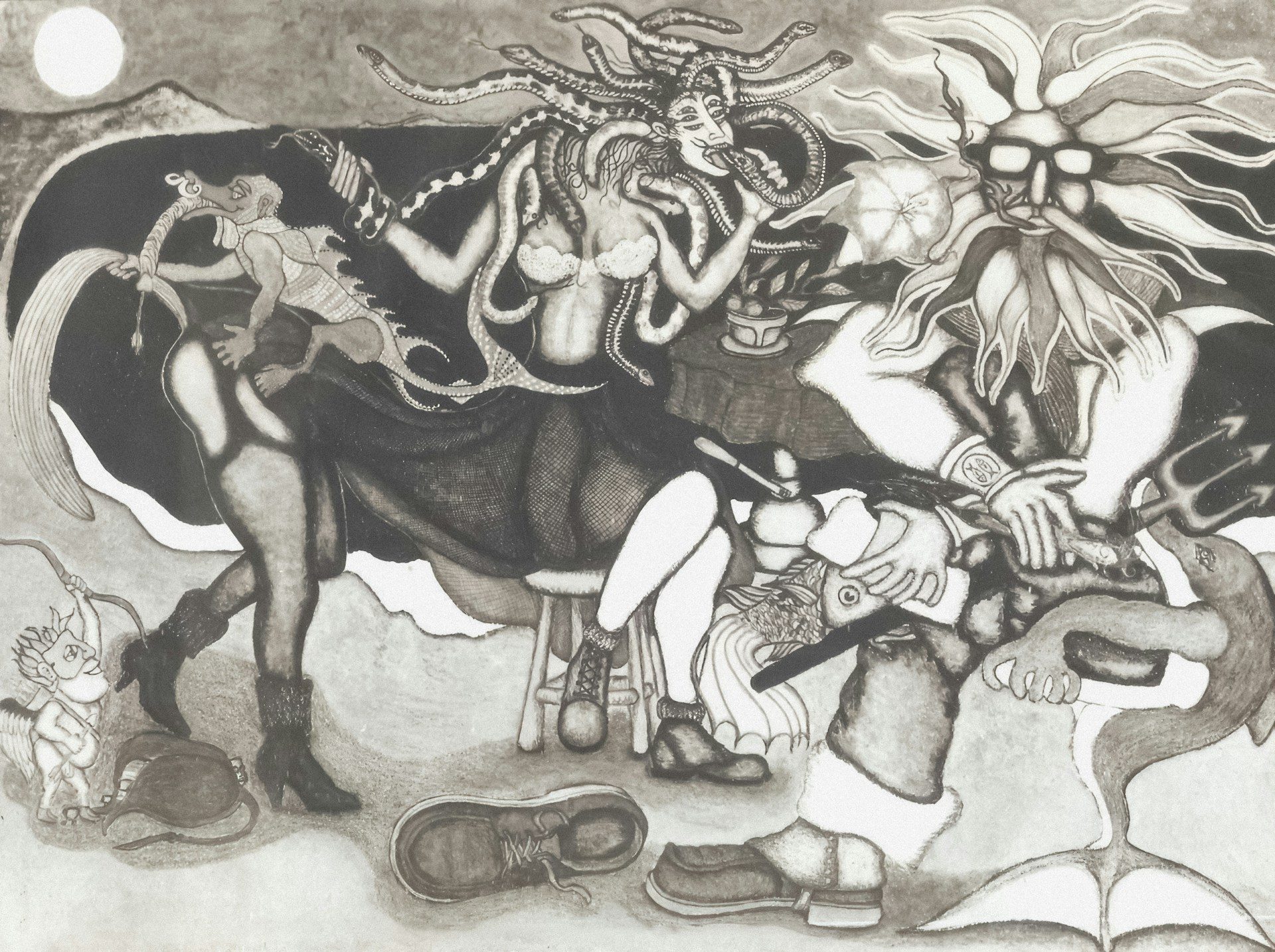
Feminist art drawing is both a practice and a political stance that emerged from the broader feminist movement, challenging the historical marginalization of women and gender-diverse people in art. It uses drawing—traditionally seen as preparatory, intimate, or “minor”—as a powerful site for critique, self-representation, and cultural transformation. By interrogating who is represented, how bodies are depicted, and whose stories are valued, feminist art drawing has reshaped art culture’s assumptions about authorship, aesthetics, and power. This essay examines the origins, principles, strategies, and cultural significance of feminist art drawing, tracing its development from the late twentieth century to the present and explaining why it remains vital to contemporary art culture.
Feminist art drawing arose in response to a long history in which women were excluded from academies, denied access to life drawing classes, and positioned primarily as muses or subjects rather than creators. For centuries, drawing—the foundation of artistic training—was regulated by institutions that restricted women’s participation. As a result, women’s artistic labor was often relegated to the domestic sphere or categorized as craft. Feminist artists recognized that reclaiming drawing was not merely about medium preference; it was about reclaiming authorship, bodily autonomy, and intellectual authority. Drawing’s immediacy and accessibility allowed artists to document lived experience, resist monumental hierarchies, and assert presence in spaces that had historically erased them.
The feminist movement of the 1960s and 1970s catalyzed a radical rethinking of art’s social role. As activists challenged legal and cultural inequalities, artists questioned the canon and its gatekeepers—museums, critics, and markets that privileged male genius. Influenced by second-wave feminism, many artists turned to drawing as a tool for consciousness-raising. The act of drawing became a way to visualize the personal as political: menstruation, childbirth, domestic labor, se xuality, and trauma entered the frame not as taboo subjects but as central realities deserving visibility. This shift did not simply add women to existing narratives; it transformed the criteria by which art was judged.
One of the defining features of feminist art drawing is its insistence on self-representation. Historically, women’s bodies were drawn through the male gaze—idealized, objectified, and controlled. Feminist artists countered this by drawing their own bodies and experiences, often in ways that resisted conventional beauty standards. Self-portraiture became an arena for agency, allowing artists to confront stereotypes and expose the power dynamics embedded in looking. Through direct, sometimes confrontational imagery, feminist drawings disrupted passive consumption and demanded ethical engagement from viewers.
The influence of feminist theory is evident in how artists approached the body as a site of knowledge. Drawing enabled a tactile, process-oriented exploration of embodiment—lines could be tentative, fragmented, or layered to reflect lived complexity. This approach aligned with feminist critiques of Cartesian dualism, which separated mind from body and associated rationality with masculinity. By foregrounding embodied experience, feminist art drawing asserted that knowledge is situated and relational. The body, marked by gender, race, class, and se xuality, became a source of insight rather than an obstacle to universality.
Early feminist art initiatives also emphasized collaboration and pedagogy. Collectives and workshops challenged the myth of the solitary genius by fostering shared learning environments. Drawing sessions became spaces for dialogue, where participants exchanged skills and stories. This communal ethos contrasted with competitive art markets and underscored feminism’s commitment to solidarity. By valuing process over product, feminist art drawing questioned commodification and proposed alternative measures of artistic worth.
Iconic figures played a crucial role in shaping feminist art drawing’s visibility and discourse. Judy Chicago foregrounded women’s histories and bodily realities, using drawing and preparatory studies to support large-scale feminist projects. Miriam Schapiro bridged drawing with pattern and craft, challenging the hierarchy that devalued decorative traditions associated with women. Louise Bourgeois used drawing as an intimate diary, translating memory, se xuality, and psychological tension into expressive line. These artists demonstrated that drawing could be both deeply personal and culturally transformative.
The feminist slogan “the personal is political” found a natural home in drawing. Sketchbooks, notebooks, and serial drawings functioned as archives of daily life, recording emotions often excluded from public discourse. Feminist art drawing validated vulnerability and care as subjects worthy of attention. This validation was not sentimental; it was strategic. By making private experiences visible, artists exposed structural inequalities—unequal labor, reproductive rights, violence—that shaped individual lives. Drawing’s capacity for repetition and accumulation reinforced this critique, showing how systemic patterns manifest over time.
Intersectionality significantly expanded feminist art drawing’s scope. Coined by Kimberlé Crenshaw, intersectionality emphasized how gender intersects with race, class, se xuality, and disability. Feminist artists of color challenged white, middle-class feminism by drawing from their own histories and communities. Faith Ringgold integrated drawing with narrative to confront racism and se xism simultaneously. Betye Saar employed drawing as a conceptual foundation for works that reclaimed Black female identity from derogatory imagery. These practices demonstrated that feminist art drawing is not monolithic; it is plural, contested, and responsive to diverse realities.
Global perspectives further complicated feminist art drawing. Artists working outside Euro-American contexts adapted feminist strategies to local histories of colonialism, religion, and tradition. Drawing became a flexible medium for negotiating censorship and resource constraints, enabling subtle forms of resistance. In many regions, feminist drawings addressed issues such as honor violence, migration, and labor exploitation, connecting gender justice to broader struggles. This global turn challenged Western art institutions to reconsider whose feminism they represented and how cultural translation operates.
Queer and trans perspectives also reshaped feminist art drawing by questioning binary notions of gender. Artists explored fluidity, transition, and nonnormative desire through experimental mark-making and narrative sequencing. Drawing’s openness to ambiguity made it an ideal medium for expressing identities in flux. By refusing fixed categories, these works aligned feminist art with broader movements for se xual and gender diversity, emphasizing coalition rather than exclusion.
Materiality is central to feminist art drawing’s meaning. Choices of paper, charcoal, ink, thread, or found materials often carry symbolic weight. Fragile surfaces can suggest precarity; bold strokes can signal defiance. Some artists intentionally use “non-art” materials to critique elitism and connect art to everyday life. The visibility of erasure, correction, and layering foregrounds labor and time—elements historically obscured in polished masterpieces. This emphasis on process aligns with feminist ethics of transparency and care.
Feminist art drawing has profoundly influenced art education. Curricula that once centered canonical male draughtsmen now incorporate feminist histories and methodologies. Life drawing classes are reimagined to address consent, representation, and power relations between artist and model. Students are encouraged to analyze who looks, who is looked at, and under what conditions. By integrating theory with practice, feminist pedagogy transforms drawing from a neutral skill into a critical tool for social inquiry.
Museums and galleries have gradually responded to feminist critiques, though unevenly. Exhibitions dedicated to feminist art drawing have expanded the canon and prompted reassessments of collection practices. Curators increasingly contextualize drawings within social movements rather than isolating them as aesthetic objects. However, challenges remain: market forces still favor certain styles and demographics, and feminist works risk being tokenized. The ongoing task is not merely inclusion but structural change—rethinking how value is assigned and whose narratives are sustained.
In contemporary culture, feminist art drawing intersects with digital media and activism. Artists circulate drawings online to address urgent issues such as reproductive rights, gender-based violence, and workplace inequality. The speed and reach of digital platforms amplify drawing’s immediacy, allowing artists to respond in real time. At the same time, the intimacy of hand-drawn marks counters the abstraction of data-driven discourse, reminding viewers of human stakes behind political debates.
Critics sometimes question whether feminist art drawing remains relevant in an era of expanded representation. Yet ongoing disparities—in pay, visibility, and safety—underscore its necessity. Feminist drawing continues to adapt, addressing new forms of precarity and surveillance. Its strength lies in its capacity for reflection and resistance: a line can register hesitation, anger, hope, and solidarity in ways that defy simplification.
The importance of feminist art drawing in art culture ultimately lies in its transformative impact. It has expanded subject matter, diversified voices, and redefined excellence beyond technical virtuosity to include ethical engagement. By challenging the neutrality of aesthetics, feminist drawing reveals how art participates in social power. It insists that culture is not a passive mirror but an active force capable of shaping values and possibilities.
Moreover, feminist art drawing fosters empathy and critical awareness. Encountering drawings that articulate lived experiences invites viewers to reconsider assumptions and recognize interdependence. This encounter can be uncomfortable, even confrontational, but it is precisely this discomfort that generates dialogue and change. In a polarized world, such reflective spaces are invaluable.
In conclusion, feminist art drawing is not a niche genre but a dynamic field that has reshaped art culture’s foundations. From reclaiming the body and redefining authorship to advancing intersectional and global perspectives, it has challenged exclusionary histories and proposed more inclusive futures. Drawing’s immediacy, accessibility, and intimacy make it uniquely suited to feminist aims, allowing artists to translate personal experience into collective critique. As social conditions evolve, feminist art drawing will continue to adapt, reminding us that lines on paper can carry profound political and cultural weight.
