

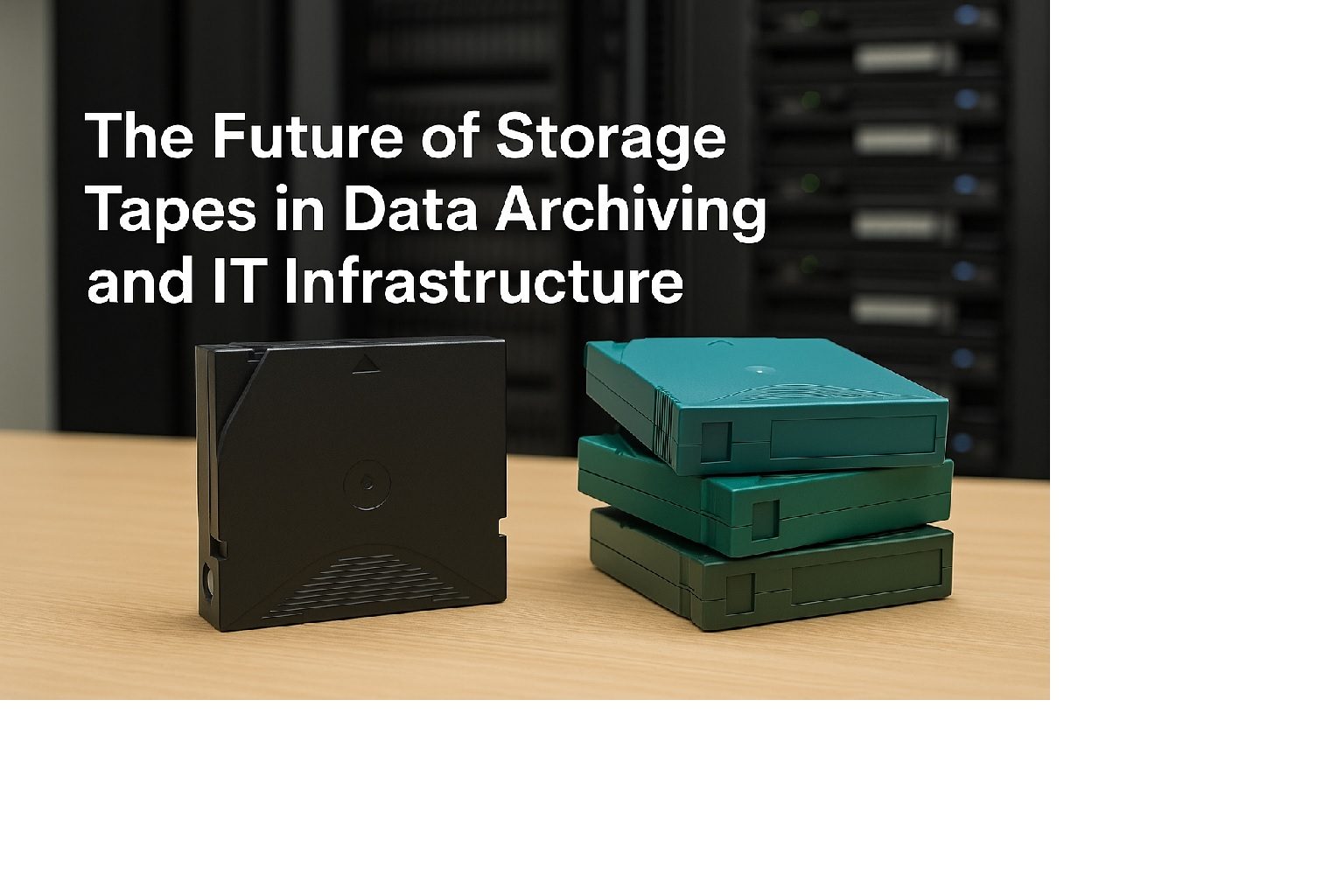
In today’s rapidly evolving digital landscape, data storage technologies are constantly being evaluated for their efficiency, reliability, and longevity. Despite the dominance of Network Storage Devices, SSDs, and cloud platforms, storage tapes remain a critical component in data archiving and IT infrastructure. As organizations face an exponential rise in data volumes, the relevance of storage tapes is not only intact but growing in new, strategic directions.
Why Storage Tapes Still Matter in Modern IT Infrastructure
While some view tape storage as outdated, the reality is that storage tapes offer unmatched longevity, cost-efficiency, and security. Modern Linear Tape-Open (LTO) technology has evolved to meet the requirements of enterprise-scale operations, providing a compelling solution for cold storage, long-term data retention, and compliance archiving.
Key Benefits of Storage Tapes:
- Lower cost per terabyte compared to HDDs, SSDs, or even some Network Storage Devices
- Long archival life — up to 30 years with proper conditions
- Energy efficiency — no power consumption when not in use
- Robust offline security — immune to cyberattacks like ransomware
- High storage capacities with LTO-9 tapes offering up to 45TB compressed
These advantages make storage tapes a vital asset for enterprises managing massive data archives, particularly in sectors like finance, healthcare, media, research, and government.
The Evolution of Tape Technology: LTO Innovations
Tape storage is not static; it has undergone technological evolution that aligns it with the needs of modern infrastructure.
LTO-9 and Beyond
The Linear Tape-Open (LTO) format continues to be the industry standard. With LTO-9, we see:
- Native capacity of 18TB and compressed capacity up to 45TB
- Data transfer speeds of up to 1,000 MB/s compressed
- Enhanced data encryption (AES-256) and WORM (Write Once Read Many) features
- Backward compatibility to read/write with previous generations
Looking ahead, LTO-10 and LTO-11 are expected to deliver even greater scalability, with future-proofing in mind for petabyte- and exabyte-level storage needs.
Tape Storage vs. Network Storage Devices and Cloud
Both Network Storage Devices (NAS), cloud storage, and tape storage have unique strengths, but when it comes to cost-effective, long-term data archiving, storage tapes stand out for several reasons.
|
Feature |
Cloud Storage |
NAS Devices / Network Storage Devices |
Storage Tape |
|
Initial Cost |
High (subscription-based) |
Moderate to High (hardware + setup) |
Low (initial investment) |
|
Longevity |
Limited to provider policies |
5–10 years average lifespan |
20–30 years+ |
|
Security |
Online — risk of breaches |
Online with limited offline options |
Offline — immune to ransomware |
|
Scalability |
High |
Limited to hardware capability |
Virtually unlimited with libraries |
|
Energy Usage |
High |
Moderate |
Very low (idle = zero) |
While Network Storage Devices are excellent for real-time access and collaboration, they cannot compete with the energy efficiency and cost per GB of long-term tape-based archiving.
Tape Libraries and Integration with Hard Drive Enclosures
Modern data centers increasingly integrate automated tape libraries to manage massive tape archives efficiently. But more interestingly, many organizations are now pairing tapes with Hard Drive Enclosures for a hybrid archival strategy.
How Hard Drive Enclosures Fit In:
- Enclosures offer quick external access to archived hard drives
- Tapes serve as deep storage while drives in enclosures act as a middle tier
- Ideal for media workflows where some archived content is retrieved frequently
Hard Drive Enclosures allow the use of older SATA drives for portable backups or intermediate archives, before archiving the finalized data to tape. This reduces wear on NAS and provides flexibility.
Sustainability and Cost-Effectiveness of Storage Tapes
As energy efficiency becomes a central concern for IT departments, storage tapes lead the way in green computing practices.
- Tapes consume zero electricity when not actively in use
- Require minimal cooling, unlike large racks of Network Storage Devices
- Are often recyclable and easier to decommission securely
Tapes provide a lower total cost of ownership for businesses dealing with multi-petabyte data archives, especially when integrated with offline hard drive solutions like Hard Drive Enclosures.
Use Cases That Depend on Tape and Network Storage Devices Together
Modern enterprises benefit from combining both Network Storage Devices and tape libraries in a tiered approach. Here’s how key industries are leveraging this combination:
Common Use Cases:
- Media & Entertainment:
Live video footage is stored in NAS; final versions are archived to tape. - Scientific Research:
Experimental data is held in Hard Drive Enclosures and then transferred to tape. - Healthcare:
Imaging systems push data to NAS, with periodic backups to LTO tape. - Legal and Government:
Compliance data is stored long-term on tape to meet regulatory timelines.
Combining tape, NAS, and Hard Drive Enclosures allows organizations to build an adaptive storage strategy that balances performance, cost, and compliance.
Future Trends: Tape in AI and Intelligent Infrastructure
As artificial intelligence and machine learning continue to reshape infrastructure, intelligent storage tiers are emerging. Tape technology is being enhanced with features such as:
- AI-driven retrieval prediction for faster access
- Integration with LTFS (Linear Tape File System) for smoother file browsing
- Metadata tagging at the tape level for better management
These innovations allow tapes to function alongside Network Storage Devices and external enclosures, providing unified control over diverse storage tiers.
Conclusion
Despite the rise of SSDs, NAS systems, and Hard Drive Enclosures, storage tapes continue to play a vital role in the future of data archiving and IT infrastructure. Tapes offer a unique combination of low cost, high capacity, and long-term durability that is unmatched in the industry. By integrating tapes with modern Network Storage Devices and external drive solutions, businesses can achieve resilient, energy-efficient, and scalable data storage strategies that are built to last.
