

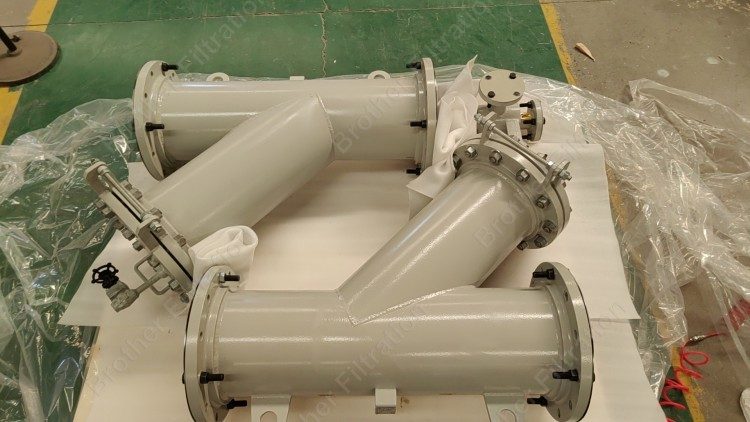
Strainers play a crucial role in industrial and commercial piping systems by removing debris, protecting equipment, and ensuring efficient operations. However, choosing the right type of strainer can be challenging. Two of the most commonly used strainers are basket strainers and Y strainers. While both serve the purpose of filtration, their design, functionality, and applications differ significantly.
In this guide, we’ll explore the key differences, advantages, and factors to consider when choosing between a basket strainer and a Y strainer.
What is a basket strainer?
A basket strainer is a filtration device designed to remove large and small particles from liquid or gas flow. It features a perforated or mesh-lined basket that captures debris while allowing clean fluid to pass through. Basket strainers are typically installed in pipelines where a large volume of contaminants needs to be removed efficiently.
Advantages of a Basket Strainer:
-
High Dirt-Holding Capacity—Basket strainers can handle a significant amount of debris before requiring cleaning.
-
Efficient Filtration—The large surface area provides superior filtration efficiency compared to Y strainers.
-
Low Pressure Drop—The design allows for minimal resistance, ensuring smooth fluid flow.
-
Easy Maintenance—The removable basket simplifies cleaning and replacement.
-
Ideal for high-flow applications—best suited for large pipelines with continuous operation.
Common Applications:
-
Water treatment plants
-
Chemical processing
-
Oil and gas industry
-
HVAC systems
-
Food and beverage production
What is a Y strainer?
A Y strainer is a compact filtration device shaped like a “Y.” It features a mesh screen that captures debris and is commonly used in applications where space is limited. Unlike basket strainers, Y strainers are often used for intermittent filtration in low-flow systems.
Advantages of a Y Strainer:
-
Compact and Lightweight—Ideal for applications with space constraints.
-
Versatile Installation—Can be installed both horizontally and vertically.
-
Cost-Effective—Generally more affordable than basket strainers.
-
Durable Construction—Made from robust materials to withstand high pressure.
-
Ideal for Steam and Gas Applications—Best suited for high-pressure systems requiring occasional filtration.
Common Applications:
-
Steam and gas pipelines
-
Cooling and heating systems
-
Small-scale water filtration
-
Power plants
-
Petrochemical processing
Key Differences Between Basket Strainer and Y Strainers
| Feature | Basket Strainer | Y Strainer |
|---|---|---|
| Design | Large, basket-shaped | Compact, Y-shaped |
| Flow Capacity | High | Moderate to low |
| Filtration Area | Large | Small |
| Maintenance | Easy, removable basket | Requires dismantling for cleaning |
| Pressure Drop | Low | Higher than basket strainer |
| Best for | High-flow, continuous filtration | Occasional, low-flow filtration |
How to Choose the Right Strainer for Your Application
When selecting between a basket strainer and a Y strainer, consider the following factors:
1. Flow Rate and Volume
-
If your system has a high flow rate, a basket strainer is the better choice due to its larger filtration capacity.
-
For low- to moderate-flow systems, a Y strainer can efficiently handle filtration needs.
2. Type of Fluid Being Filtered
-
Liquids: Basket strainers are ideal for water, oil, and other liquid-based systems.
-
Steam or Gas: Y strainers are better suited for gas and steam applications.
3. Filtration Requirements
-
If you need fine filtration and a larger dirt-holding capacity, opt for a basket strainer.
-
If occasional filtration is sufficient, a Y strainer will work well.
4. Space Availability
-
Basket strainers require more space and are typically used in large industrial settings.
-
Y strainers are compact and can be installed in tight spaces.
5. Maintenance and Cleaning Frequency
-
Basket strainers are easier to clean due to their removable basket design.
-
Y strainers require more effort as the mesh screen needs to be removed and cleaned manually.
6. Budget Considerations
-
If cost is a major factor, Y strainers are generally more affordable.
-
Basket strainers may have a higher initial cost but provide long-term savings due to their efficiency.
Conclusion
Choosing between a basket strainer and a Y strainer depends on your specific industrial requirements. If you need continuous, high-capacity filtration with easy maintenance, a basket strainer is the best option. However, if you have space constraints, a lower flow rate, or steam-based applications, a Y strainer is the more suitable choice.
By evaluating flow requirements, filtration needs, space availability, and maintenance preferences, you can select the right strainer that enhances system efficiency, prolongs equipment lifespan, and reduces operational costs.
