

The global Automotive Differential Market is witnessing steady growth as the automotive industry continues to evolve with increasing vehicle production, rising demand for high-performance vehicles, and advancements in drivetrain technologies. Automotive differentials are critical drivetrain components that distribute engine torque to the wheels while allowing them to rotate at different speeds during cornering, improving vehicle stability, handling, and traction. Growing adoption of all-wheel-drive (AWD) and four-wheel-drive (4WD) systems, along with the expansion of electric and hybrid vehicles, is significantly driving market growth.
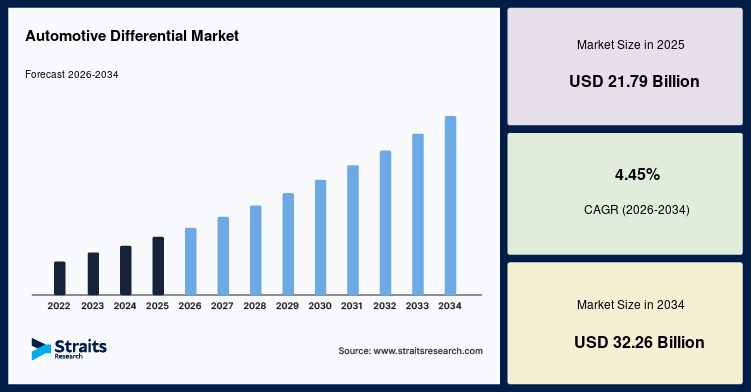
According to industry analysis, the global Automotive Differential Market size was valued at USD 21.79 billion in 2025 and is projected to grow from USD 22.76 billion in 2026 to USD 32.26 billion by 2034, exhibiting a CAGR of 4.45% during the forecast period (2026–2034).
Read Full Report: https://straitsresearch.com/report/automotive-differential-market
The increasing production of passenger and commercial vehicles, growing demand for fuel-efficient drivetrain systems, technological advancements in limited-slip and electronic differentials, and rising investments in electric mobility are among the key factors driving market growth. Automotive manufacturers are developing lightweight, electronically controlled differential systems that improve vehicle performance, safety, and energy efficiency.
Increasing Vehicle Production Fuels Market Growth
One of the primary drivers of the Automotive Differential Market is the continued growth in global vehicle production. Rising consumer demand for passenger cars, commercial vehicles, and utility vehicles has increased the need for reliable drivetrain components that ensure smooth power distribution and enhanced driving performance.
As automotive manufacturing expands across both developed and emerging economies, demand for advanced differential systems continues to rise. Original equipment manufacturers (OEMs) are integrating improved differential technologies to enhance vehicle durability, stability, and fuel efficiency.
The growing automotive production landscape is expected to support long-term market expansion.
Rising Demand for All-Wheel-Drive and Four-Wheel-Drive Vehicles
Consumers are increasingly purchasing all-wheel-drive (AWD) and four-wheel-drive (4WD) vehicles due to their superior traction, improved handling, and enhanced performance across challenging road conditions. These drivetrain configurations require advanced differential systems to effectively distribute power between wheels and axles.
Sport utility vehicles (SUVs), pickup trucks, off-road vehicles, and premium passenger cars are among the major vehicle categories driving demand for sophisticated differential technologies. Electronic locking differentials and torque vectoring systems further improve vehicle control and driving safety.
The growing popularity of AWD and 4WD vehicles is expected to remain a significant growth driver for the market.
Advancements in Electronic Differential Technologies
Technological innovation is transforming the automotive differential industry through the development of electronically controlled differential systems. Electronic limited-slip differentials (eLSDs), torque vectoring differentials, and intelligent control systems improve traction, cornering performance, and vehicle stability by continuously adjusting torque distribution.
These advanced systems are particularly valuable for performance vehicles, luxury automobiles, and electric vehicles, where precision control enhances driving dynamics and energy efficiency. Integration with advanced driver assistance systems (ADAS) further improves overall vehicle safety.
Continuous advancements in electronic drivetrain technologies are expected to strengthen market competitiveness throughout the forecast period.
Growing Adoption of Electric and Hybrid Vehicles
The rapid expansion of electric vehicles (EVs) and hybrid vehicles is creating new opportunities for the Automotive Differential Market. Electric drivetrains require specialized differential solutions that optimize torque delivery while improving vehicle efficiency and driving performance.
Manufacturers are developing lightweight differential assemblies that reduce overall vehicle weight and increase battery efficiency. Advanced electronic differential systems also support regenerative braking and intelligent power management in electric vehicles.
As global EV adoption continues to accelerate, demand for next-generation differential technologies is expected to grow steadily.
Demand for Fuel-Efficient and Lightweight Components
Automotive manufacturers are increasingly focusing on lightweight vehicle design to improve fuel economy and reduce emissions. Lightweight differential housings, advanced alloys, and precision-engineered gears help reduce drivetrain weight without compromising durability or performance.
Improved manufacturing techniques and innovative materials contribute to lower energy losses within drivetrain systems, supporting both conventional and electric vehicle efficiency goals.
The growing emphasis on fuel efficiency and emissions reduction is expected to drive continued innovation in differential technologies.
Expansion of Advanced Driver Assistance Systems
Modern vehicles increasingly incorporate advanced driver assistance systems (ADAS) that work alongside intelligent drivetrain components to improve safety and driving performance. Electronic differential systems integrate with traction control, stability control, anti-lock braking systems (ABS), and adaptive cruise control to optimize vehicle dynamics under varying road conditions.
This integration enhances cornering stability, minimizes wheel slip, and improves overall driving confidence in both passenger and commercial vehicles.
The increasing adoption of connected and intelligent vehicle technologies is expected to create additional opportunities for market growth.
North America Maintains Market Leadership
North America currently holds a significant share of the global Automotive Differential Market due to strong automotive manufacturing capabilities, high demand for SUVs and pickup trucks, and widespread adoption of AWD and 4WD vehicles. The United States remains the largest contributor to regional market growth, supported by technological innovation, growing electric vehicle production, and increasing investments in advanced drivetrain systems.
The region’s strong automotive ecosystem continues to support market development.
Europe Benefits from Automotive Innovation
Europe represents a major market for automotive differentials, driven by the presence of leading automotive manufacturers, increasing production of premium vehicles, and continuous investments in vehicle performance technologies. Countries such as Germany, France, Italy, the United Kingdom, and Sweden are advancing drivetrain innovation through research in electric mobility, lightweight engineering, and intelligent vehicle systems.
The region’s focus on fuel efficiency, emissions reduction, and high-performance vehicles continues to encourage adoption of advanced differential technologies.
Asia-Pacific Emerges as the Fastest-Growing Region
Asia-Pacific is expected to witness the highest growth rate during the forecast period. Rapid expansion of automotive manufacturing, rising vehicle ownership, increasing disposable incomes, and strong investments in electric mobility are driving regional demand for automotive differential systems.
Countries such as China, India, Japan, South Korea, and Thailand are investing heavily in automotive production, electric vehicle manufacturing, and advanced mobility technologies. Government support for clean transportation, expanding automotive supply chains, and increasing exports are further accelerating market growth.
As automotive production continues to expand across the region, Asia-Pacific is expected to become the primary growth engine for the global Automotive Differential Market.
Competitive Landscape Focuses on Lightweight Engineering and Electronic Differentials
The Automotive Differential Market remains highly competitive, with leading manufacturers focusing on lightweight materials, electronic differential systems, torque vectoring technologies, and drivetrain efficiency improvements. Companies are investing heavily in research and development to enhance product durability, reduce mechanical losses, and improve compatibility with electric and hybrid vehicles.
Strategic partnerships, acquisitions, product launches, and collaborations with automotive OEMs are helping companies strengthen their market positions and expand global operations. Manufacturers are also developing intelligent differential systems that integrate seamlessly with connected vehicle platforms and advanced safety technologies.
These initiatives are expected to drive continuous innovation and strengthen competition across the industry.
Future Outlook for the Automotive Differential Market
The future of the Automotive Differential Market remains promising as automotive manufacturers continue investing in vehicle electrification, intelligent mobility, and advanced drivetrain technologies. Increasing vehicle production, rising demand for AWD and 4WD systems, growing electric vehicle adoption, continuous advancements in electronic differentials, and stronger emphasis on fuel efficiency are expected to support steady market growth through 2034.
Innovations in lightweight drivetrain components, AI-assisted vehicle control systems, torque vectoring technologies, smart mobility solutions, and electric propulsion systems will continue to reshape the automotive industry. As consumers seek safer, more efficient, and higher-performing vehicles, advanced automotive differential systems will remain an essential component of modern vehicle design.
Frequently Asked Questions
What is the current size of the Automotive Differential Market?
The market was valued at USD 21.79 billion in 2025.
What is the projected market size by 2034?
The market is expected to reach USD 32.26 billion by 2034.
What is the CAGR of the Automotive Differential Market?
The market is projected to grow at a CAGR of 4.45% during 2026–2034.
What factors are driving market growth?
Key drivers include increasing vehicle production, rising demand for AWD and 4WD vehicles, advancements in electronic differential technologies, growing adoption of electric and hybrid vehicles, demand for lightweight and fuel-efficient components, and expanding implementation of advanced driver assistance systems.
Which region holds a significant market share?
North America currently maintains a significant share of the global Automotive Differential Market.
Which region is expected to grow the fastest?
Asia-Pacific is expected to witness the highest growth rate during the forecast period due to expanding automotive manufacturing, increasing vehicle ownership, rising investments in electric mobility, growing automotive exports, and continuous technological advancements in drivetrain systems.
