

Antisense and RNAi Therapeutics Market Analysis 2034
The global Antisense and RNAi Therapeutics Market is witnessing rapid growth, driven by increasing prevalence of genetic disorders, rising investments in precision medicine, expanding applications of gene-silencing technologies, and continuous advancements in biotechnology and genomic research. The growing success of RNA-based therapies in treating rare diseases and chronic conditions is accelerating market adoption worldwide.
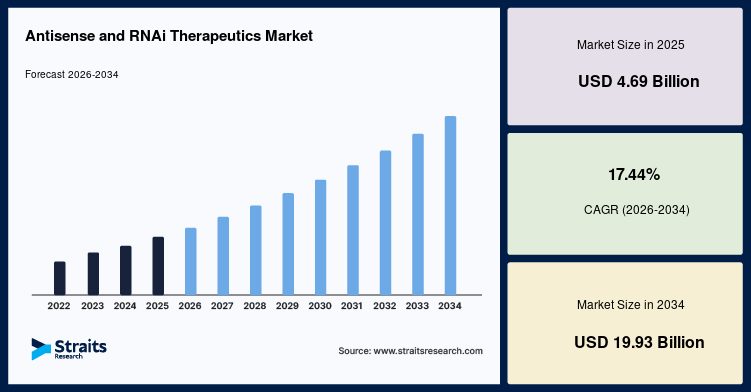
The global antisense and rnai therapeutics market size was valued at USD 4.69 billion in 2025 and is projected to grow from USD 5.51 billion in 2026 to USD 19.93 billion by 2034 at a CAGR of 17.44% during the forecast period 2026-2034.
Antisense and RNA interference (RNAi) therapeutics are advanced nucleic acid-based treatments designed to selectively regulate gene expression. Antisense therapies work by binding to specific messenger RNA (mRNA) molecules to prevent protein production, while RNAi therapeutics utilize small interfering RNA (siRNA) molecules to silence disease-causing genes. These innovative approaches are transforming the treatment landscape for genetic disorders, neurological diseases, cardiovascular conditions, and rare diseases.
Market Drivers
Rising Prevalence of Genetic and Rare Diseases
The increasing incidence of inherited disorders and rare genetic conditions is driving demand for targeted therapies capable of addressing underlying genetic causes.
Growing Investments in Precision Medicine
Pharmaceutical companies and research institutions are investing heavily in personalized medicine approaches, supporting the development of antisense and RNAi-based treatments.
Advancements in Genomic Research
Continuous progress in genomics, molecular biology, and gene sequencing technologies is accelerating the discovery and commercialization of RNA-targeted therapeutics.
Increasing Regulatory Approvals
The successful approval of several antisense and RNAi drugs has strengthened industry confidence and encouraged further research and development activities.
Expanding Applications in Chronic Disease Treatment
Researchers are exploring RNA-based therapies for neurological disorders, cardiovascular diseases, metabolic conditions, infectious diseases, and oncology applications.
Market Challenges
High Development Costs
The research, development, and clinical testing of antisense and RNAi therapeutics require substantial financial investments and extended timelines.
Complex Delivery Mechanisms
Efficient delivery of nucleic acid therapies to target tissues remains a significant challenge for developers.
Stringent Regulatory Requirements
Novel genetic therapies must undergo rigorous clinical evaluation and regulatory review processes to ensure safety and efficacy.
Manufacturing Complexity
Large-scale production of RNA-based therapeutics requires specialized technologies and strict quality control procedures.
Market Segmentation
The antisense and RNAi therapeutics market is segmented based on technology, application, route of administration, end-user, and region.
By Technology
The market includes:
-
Antisense Therapeutics
-
RNA Interference (RNAi) Therapeutics
RNAi therapeutics account for a significant market share due to their high specificity, strong gene-silencing capabilities, and increasing commercial success.
By Application
The market is categorized into:
-
Neurological Disorders
-
Rare Genetic Diseases
-
Cardiovascular Diseases
-
Oncology
-
Infectious Diseases
-
Metabolic Disorders
Rare genetic diseases dominate the market due to the growing number of approved therapies targeting inherited conditions.
By Route of Administration
The market includes:
-
Intravenous
-
Subcutaneous
-
Intrathecal
-
Other Routes
Intravenous administration remains the dominant segment owing to its effectiveness in delivering RNA-based therapies to target tissues.
By End-User
The market is segmented into:
-
Hospitals
-
Specialty Clinics
-
Research Institutes
-
Biotechnology and Pharmaceutical Companies
Biotechnology and pharmaceutical companies account for the largest market share due to extensive investments in drug discovery and clinical development programs.
Regional Insights
North America
North America dominates the antisense and RNAi therapeutics market due to strong biotechnology infrastructure, extensive research funding, favorable regulatory support, and the presence of leading pharmaceutical and biotechnology companies. The United States remains the largest contributor to regional growth.
Europe
Europe represents a significant market supported by increasing investments in genomic medicine, strong healthcare systems, and growing research collaborations in advanced therapeutics.
Asia-Pacific
Asia-Pacific is expected to witness the fastest growth during the forecast period due to expanding biotechnology sectors, increasing healthcare expenditures, growing clinical research activities, and rising adoption of precision medicine across China, Japan, South Korea, and India.
Latin America
Latin America is gradually emerging as a promising market due to improving healthcare infrastructure and growing access to advanced treatment options.
Middle East & Africa
The Middle East & Africa region is experiencing steady growth driven by healthcare modernization initiatives, increasing awareness of rare diseases, and growing investments in biotechnology research.
Key Trends and Growth Opportunities
Expansion of Personalized Medicine
The growing focus on individualized treatment approaches is creating significant opportunities for antisense and RNAi therapeutic development.
Advances in RNA Delivery Technologies
Innovations in lipid nanoparticles, conjugate technologies, and targeted delivery systems are improving therapeutic efficacy and expanding treatment possibilities.
Increasing Strategic Collaborations
Pharmaceutical and biotechnology companies are forming partnerships to accelerate drug discovery, clinical development, and commercialization efforts.
Growth of Gene-Silencing Therapeutics
The success of approved RNA-based therapies is encouraging broader application across multiple disease areas, creating substantial growth opportunities.
Key Players Analysis
The antisense and RNAi therapeutics market is highly competitive, with major biotechnology and pharmaceutical companies focusing on innovation, pipeline expansion, and strategic collaborations.
Key companies operating in the market include:
-
Ionis Pharmaceuticals, Inc.
-
Alnylam Pharmaceuticals, Inc.
-
Arrowhead Pharmaceuticals, Inc.
-
Sarepta Therapeutics, Inc.
-
Wave Life Sciences Ltd.
-
Biogen Inc.
-
Roche Holding AG
-
Novartis AG
-
Silence Therapeutics plc
-
Dicerna Pharmaceuticals, Inc.
These companies are investing in next-generation gene-silencing technologies, advanced delivery platforms, rare disease therapeutics, and strategic partnerships to strengthen their positions in the global antisense and RNAi therapeutics market.
For Detailed Insights, Visit:
https://straitsresearch.com/report/antisense-and-rnai-therapeutics-market
About Us
Straits Research is a leading research and intelligence organization, specializing in research, analytics, and advisory services, along with providing business insights and research reports.
Contact Us
Email: sales@straitsresearch.com
Tel: +1 646 905 0080 (U.S.), +44 203 695 0070 (U.K.)
