

IoT Microcontroller (MCU) Market Overview 2034
The global IoT Microcontroller (MCU) Market is experiencing robust growth, driven by the rapid expansion of Internet of Things (IoT) ecosystems, increasing adoption of smart devices, growing industrial automation, and rising demand for energy-efficient embedded systems. As connected devices become increasingly integrated into daily life and industrial operations, microcontrollers are playing a critical role in enabling intelligent processing, communication, and control functions across IoT applications.
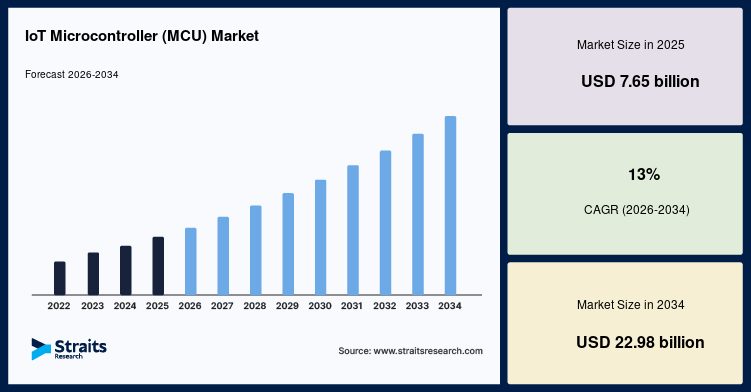
The global iot microcontroller (MCU) market size was valued at USD 7.65 billion in 2025 and is projected to grow from USD 8.64 billion in 2026 to USD 22.98 billion by 2034 at a CAGR of 13% during the forecast period 2026-2034.
IoT microcontrollers are compact integrated circuits designed to manage and control connected devices while supporting wireless communication, data processing, sensor integration, and power management functions. These MCUs serve as the core processing units for smart home devices, wearable electronics, industrial sensors, healthcare equipment, automotive systems, and smart city infrastructure. The increasing deployment of connected technologies and edge computing solutions is expected to drive substantial market growth throughout the forecast period.
Market Drivers
Rapid Growth of IoT Devices
The increasing adoption of connected devices across consumer, industrial, healthcare, and commercial sectors is significantly driving demand for IoT microcontrollers. Smart sensors, connected appliances, and industrial monitoring systems all rely on MCU-based architectures.
Expansion of Smart Home Technologies
The growing popularity of smart home devices such as smart thermostats, lighting systems, security cameras, voice assistants, and connected appliances is boosting the demand for energy-efficient IoT MCUs.
Increasing Industrial Automation
Industries are adopting IoT-enabled automation systems to improve operational efficiency, predictive maintenance, asset tracking, and process monitoring. This trend is accelerating the deployment of advanced microcontrollers in industrial environments.
Rising Adoption of Edge Computing
Edge computing solutions require localized data processing capabilities to reduce latency and improve system responsiveness. IoT MCUs are increasingly being integrated into edge devices to support real-time analytics and decision-making.
Advancements in Wireless Connectivity Technologies
The widespread adoption of Wi-Fi, Bluetooth, Zigbee, Thread, NB-IoT, and LoRa technologies is driving demand for MCUs with integrated wireless communication capabilities.
Market Challenges
Cybersecurity Concerns
As IoT devices become increasingly connected, ensuring secure communication and protecting devices from cyber threats remain major challenges for manufacturers and end-users.
Power Consumption Limitations
Many IoT devices operate on batteries and require ultra-low-power microcontrollers to maximize operational lifespan, creating design and engineering challenges.
Semiconductor Supply Chain Disruptions
Global semiconductor shortages and supply chain uncertainties can impact MCU availability and increase production costs.
Complexity of IoT Ecosystems
Developing interoperable IoT solutions that support multiple communication protocols and platforms requires continuous innovation and standardization efforts.
Market Segmentation
The IoT microcontroller market is segmented based on architecture, connectivity, application, end-user industry, and region.
By Architecture
The market includes:
-
8-Bit MCUs
-
16-Bit MCUs
-
32-Bit MCUs
32-bit MCUs dominate the market due to their superior processing capabilities, enhanced memory capacity, and suitability for advanced IoT applications.
By Connectivity
The market is categorized into:
-
Wi-Fi
-
Bluetooth
-
Zigbee
-
LoRa
-
NB-IoT
-
Others
Wi-Fi-enabled MCUs account for a significant market share due to their widespread use in smart home devices, consumer electronics, and industrial applications.
By Application
The market includes:
-
Smart Home Devices
-
Industrial IoT
-
Healthcare Devices
-
Wearable Electronics
-
Smart Agriculture
-
Smart Cities
-
Automotive IoT
Industrial IoT represents a major application segment owing to increasing adoption of connected manufacturing systems and industrial automation solutions.
By End-User Industry
The market is segmented into:
-
Consumer Electronics
-
Industrial Manufacturing
-
Healthcare
-
Automotive
-
Agriculture
-
Energy and Utilities
-
Retail
Consumer electronics remain the largest end-user segment due to the extensive deployment of connected devices and smart appliances.
Regional Insights
North America
North America dominates the IoT microcontroller market due to strong technological innovation, widespread adoption of connected devices, advanced industrial infrastructure, and significant investments in IoT development. The United States remains the largest contributor to regional growth.
Europe
Europe represents a significant market supported by increasing industrial automation, smart manufacturing initiatives, and strong adoption of IoT solutions across automotive and healthcare sectors.
Asia-Pacific
Asia-Pacific is expected to witness the fastest growth during the forecast period due to rapid industrialization, expanding consumer electronics manufacturing, increasing smart city projects, and rising adoption of connected technologies in countries such as China, India, Japan, South Korea, and Taiwan.
Latin America
Latin America is gradually emerging as a promising market due to increasing digital transformation initiatives, expanding telecommunications infrastructure, and growing adoption of smart devices.
Middle East & Africa
The Middle East & Africa region is experiencing steady growth driven by smart city developments, industrial modernization projects, and increasing investments in connected technologies.
Key Trends and Growth Opportunities
Integration of Artificial Intelligence at the Edge
Manufacturers are increasingly developing MCUs capable of supporting edge AI applications, enabling intelligent data processing directly on IoT devices.
Growth of Ultra-Low-Power Microcontrollers
The demand for battery-powered IoT devices is driving innovation in ultra-low-power MCU architectures designed to maximize energy efficiency.
Expansion of Smart City Infrastructure
Smart transportation systems, connected utilities, environmental monitoring, and public safety applications are creating significant opportunities for IoT MCU providers.
Increasing Adoption of Secure Hardware Architectures
Manufacturers are integrating advanced security features such as hardware encryption, secure boot mechanisms, and authentication technologies into modern IoT microcontrollers.
Key Players Analysis
The IoT microcontroller market is highly competitive, with major semiconductor companies focusing on innovation, wireless integration, security capabilities, and energy-efficient designs.
Key companies operating in the market include:
-
Texas Instruments Incorporated
-
Microchip Technology Incorporated
-
STMicroelectronics N.V.
-
NXP Semiconductors N.V.
-
Renesas Electronics Corporation
-
Infineon Technologies AG
-
Silicon Laboratories Inc.
-
Nordic Semiconductor ASA
-
Espressif Systems (Shanghai) Co., Ltd.
-
Qualcomm Incorporated
These companies are investing in AI-enabled microcontrollers, advanced wireless connectivity solutions, security technologies, and low-power architectures to strengthen their positions in the rapidly growing IoT microcontroller market.
For Detailed Insights, Visit:
https://straitsresearch.com/report/iot-microcontroller-mcu-market
About Us
Straits Research is a leading research and intelligence organization, specializing in research, analytics, and advisory services, along with providing business insights and research reports.
Contact Us
Email: sales@straitsresearch.com
Tel: +1 646 905 0080 (U.S.), +44 203 695 0070 (U.K.)
