

Oil and Gas Pipeline Market Analysis 2034
The global Oil and Gas Pipeline Market is experiencing steady growth, driven by increasing energy demand, expanding oil and gas exploration activities, rising investments in pipeline infrastructure, and growing cross-border energy transportation projects. Pipelines remain the most efficient and cost-effective method for transporting crude oil, natural gas, and refined petroleum products over long distances, making them a critical component of the global energy supply chain.
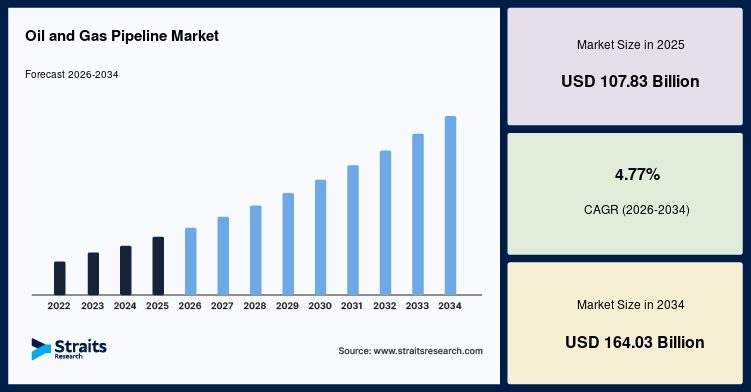
The global oil and gas pipeline market size was valued at USD 107.83 billion in 2025 and is projected to grow from USD 112.97 billion in 2026 to USD 164.03 billion by 2034 at a CAGR of 4.77% during the forecast period 2026-2034.
Oil and gas pipelines are extensive networks of interconnected pipes used to transport hydrocarbons from production fields to refineries, storage facilities, distribution centers, and end-users. As countries continue to strengthen their energy security and expand hydrocarbon production capacities, significant investments are being directed toward pipeline construction, maintenance, monitoring, and modernization. The growing adoption of advanced pipeline monitoring technologies and integrity management systems is further supporting market growth.
Market Drivers
Increasing Global Energy Demand
Rising industrialization, urbanization, and population growth are driving global energy consumption. The growing demand for oil and natural gas is encouraging investments in pipeline infrastructure to ensure reliable and efficient energy transportation.
Expansion of Oil and Gas Exploration Activities
The discovery of new oil and gas reserves, particularly in offshore and unconventional resource regions, is creating demand for new transmission and gathering pipeline networks.
Growing Investments in Pipeline Infrastructure
Governments and energy companies are investing heavily in pipeline expansion projects to improve energy distribution efficiency, reduce transportation costs, and strengthen energy security.
Rising Demand for Natural Gas
Natural gas is increasingly being adopted as a cleaner energy source compared to coal and oil. This trend is driving the construction of extensive natural gas pipeline networks worldwide.
Advancements in Pipeline Monitoring Technologies
The integration of smart sensors, IoT-based monitoring systems, predictive maintenance solutions, and leak detection technologies is improving pipeline safety, efficiency, and operational reliability.
Market Challenges
Environmental and Regulatory Concerns
Pipeline projects often face strict environmental regulations, permitting challenges, and public opposition related to land use, ecological impacts, and greenhouse gas emissions.
High Capital Investment Requirements
Pipeline construction and maintenance involve significant capital expenditures, which can impact project feasibility and return on investment.
Geopolitical Risks
Cross-border pipeline projects are vulnerable to geopolitical tensions, trade disputes, and regulatory uncertainties that may delay project implementation.
Pipeline Integrity and Safety Issues
Aging infrastructure, corrosion, mechanical failures, and accidental damages pose ongoing challenges to pipeline operators and require continuous maintenance investments.
Market Segmentation
The oil and gas pipeline market is segmented based on type, operation, application, and region.
By Type
The market includes:
-
Crude Oil Pipelines
-
Natural Gas Pipelines
-
Refined Product Pipelines
Natural gas pipelines dominate the market due to increasing global natural gas consumption and expanding gas distribution networks.
By Operation
The market is categorized into:
-
Transmission Pipelines
-
Distribution Pipelines
-
Gathering Pipelines
Transmission pipelines account for a significant market share owing to their role in transporting large volumes of hydrocarbons over long distances.
By Application
The market includes:
-
Onshore
-
Offshore
Onshore pipelines hold the largest market share due to extensive terrestrial transportation networks and lower installation costs compared to offshore systems.
Regional Insights
North America
North America dominates the oil and gas pipeline market due to extensive shale oil and gas production, established pipeline infrastructure, and ongoing investments in transmission and distribution networks. The United States remains the largest contributor to regional growth.
Europe
Europe represents a significant market driven by increasing energy security initiatives, natural gas infrastructure development, and cross-border pipeline projects connecting major energy-producing and consuming regions.
Asia-Pacific
Asia-Pacific is expected to witness substantial growth during the forecast period due to rising energy demand, expanding industrial activities, and increasing investments in oil and gas transportation infrastructure across China, India, and Southeast Asia.
Latin America
Latin America is experiencing steady growth supported by expanding oil and gas exploration activities, infrastructure modernization projects, and increasing regional energy demand.
Middle East & Africa
The Middle East & Africa region holds a significant market share due to vast hydrocarbon reserves, large-scale export infrastructure, and continuous investments in pipeline development projects.
Key Trends and Growth Opportunities
Adoption of Smart Pipeline Technologies
Pipeline operators are increasingly implementing digital monitoring systems, artificial intelligence, and predictive analytics to improve operational efficiency and reduce maintenance costs.
Expansion of Cross-Border Energy Projects
Growing international energy trade is creating opportunities for large-scale cross-border pipeline infrastructure developments.
Increasing Focus on Pipeline Safety
Companies are investing in advanced leak detection systems, corrosion monitoring technologies, and automated inspection tools to enhance pipeline integrity.
Integration of Renewable Energy Infrastructure
Some pipeline operators are exploring opportunities to transport hydrogen and other alternative fuels using existing pipeline networks, creating new growth avenues for the industry.
Key Players Analysis
The oil and gas pipeline market is highly competitive, with major engineering, construction, and energy companies focusing on infrastructure expansion, technological innovation, and strategic partnerships.
Key companies operating in the market include:
-
Enbridge Inc.
-
TC Energy Corporation
-
Kinder Morgan, Inc.
-
Saipem S.p.A.
-
Tenaris S.A.
-
National Oilwell Varco, Inc.
-
Gazprom PJSC
-
China Petroleum Pipeline Engineering Co., Ltd.
-
Bechtel Corporation
-
Worley Limited
These companies are investing in pipeline expansion projects, digital monitoring technologies, infrastructure modernization, and strategic collaborations to strengthen their positions in the global oil and gas pipeline market.
For Detailed Insights, Visit:
https://straitsresearch.com/report/oil-and-gas-pipeline-market
About Us
Straits Research is a leading research and intelligence organization, specializing in research, analytics, and advisory services, along with providing business insights and research reports.
Contact Us
Email: sales@straitsresearch.com
Tel: +1 646 905 0080 (U.S.), +44 203 695 0070 (U.K.)
