

DNA Data Storage Market Outlook 2034
The global DNA Data Storage Market is witnessing remarkable growth due to the exponential increase in digital data generation, growing demand for long-term data archiving solutions, advancements in synthetic biology, and increasing investments in next-generation storage technologies. As traditional storage systems face limitations in capacity, durability, and energy consumption, DNA-based storage is emerging as a revolutionary alternative for future data preservation.
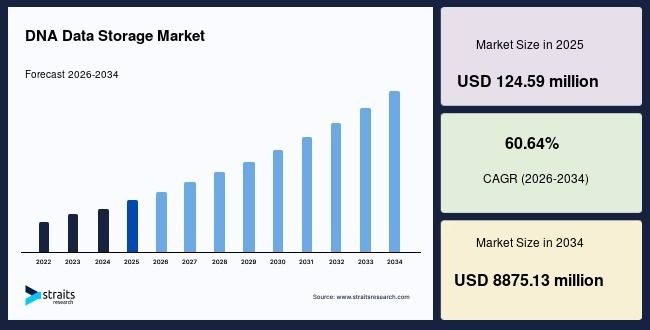
The global dna data storage market size was valued at USD 124.59 million in 2025 and is projected to grow from USD 200.15 million in 2026 to USD 8875.13 million by 2034 at a CAGR of 60.64% during the forecast period 2026-2034.
DNA data storage is an advanced technology that encodes digital information into synthetic DNA sequences. Unlike conventional storage media such as hard drives, magnetic tapes, and optical disks, DNA offers extremely high storage density, long-term durability, and minimal energy requirements for data retention. Researchers and technology companies are actively exploring DNA storage as a viable solution to address the growing global data storage challenge.
Market Drivers
Exponential Growth of Global Data Generation
The rapid expansion of cloud computing, artificial intelligence, Internet of Things (IoT), social media platforms, and digital transformation initiatives is generating unprecedented volumes of data, creating demand for innovative storage solutions.
Superior Storage Density of DNA
DNA can store massive amounts of information within a very small physical space. This extraordinary storage capacity makes DNA an attractive medium for long-term archival applications.
Increasing Demand for Long-Term Data Preservation
Governments, enterprises, healthcare institutions, and research organizations require secure and durable data storage solutions capable of preserving information for decades or even centuries.
Advancements in Synthetic Biology and Genomics
Continuous improvements in DNA synthesis, sequencing technologies, and bioinformatics are reducing costs and enhancing the feasibility of commercial DNA data storage systems.
Rising Investments in Next-Generation Storage Technologies
Technology companies, research institutions, and governments are investing heavily in developing alternative data storage platforms to overcome the limitations of traditional storage infrastructure.
Market Challenges
High Cost of DNA Synthesis and Sequencing
The current costs associated with writing and reading data using DNA remain significantly higher than traditional storage technologies, limiting large-scale commercialization.
Slow Data Retrieval Speeds
Compared to conventional digital storage systems, DNA data retrieval and decoding processes can be relatively time-consuming.
Technical Complexity
DNA data storage requires specialized expertise in molecular biology, biotechnology, and computational sciences, creating implementation challenges.
Limited Commercial Infrastructure
The market is still in its early development stage, with limited large-scale commercial deployment and standardization across the industry.
Market Segmentation
The DNA data storage market is segmented based on technology, storage type, application, end-user, and region.
By Technology
The market is categorized into:
-
DNA Synthesis
-
DNA Sequencing
-
Polymerase Chain Reaction (PCR)
-
Data Encoding and Decoding Software
DNA synthesis dominates the market due to its critical role in converting digital information into DNA sequences.
By Storage Type
The market includes:
-
Archival Storage
-
Cold Storage
-
Long-Term Data Preservation
Archival storage accounts for a significant market share owing to the growing need for durable and high-capacity data retention solutions.
By Application
The market is segmented into:
-
Data Archiving
-
Healthcare and Genomics
-
Government Records
-
Research and Development
-
Media and Entertainment
-
Enterprise Data Management
Data archiving remains the leading application segment due to increasing requirements for long-term digital information preservation.
By End-User
The market includes:
-
Research Institutions
-
Government Organizations
-
Healthcare Providers
-
Information Technology Companies
-
Cloud Service Providers
-
Others
Research institutions currently represent the largest end-user segment due to ongoing experimentation and development of DNA-based storage technologies.
By Region
The market is analyzed across:
-
North America
-
Europe
-
Asia-Pacific
-
Latin America
-
Middle East & Africa
Regional Insights
North America
North America dominates the DNA data storage market due to strong investments in biotechnology research, advanced technological infrastructure, the presence of leading technology companies, and extensive government funding for next-generation storage innovations. The United States remains the primary contributor to regional growth.
Europe
Europe represents a significant market driven by increasing research activities, supportive government initiatives, and collaborations between biotechnology companies and academic institutions.
Asia-Pacific
Asia-Pacific is expected to witness substantial growth during the forecast period. Rising investments in biotechnology, expanding genomic research, growing digitalization, and increasing demand for advanced data storage solutions are driving market expansion across China, Japan, South Korea, and India.
Latin America and Middle East & Africa
These regions are gradually emerging as growth markets due to increasing technology adoption, expanding research capabilities, and growing awareness of innovative data storage technologies.
Technology Trends and Market Opportunities
The DNA data storage market is witnessing advancements in automated DNA synthesis platforms, high-throughput sequencing technologies, AI-driven encoding algorithms, error-correction techniques, and molecular computing systems. Researchers are actively working to reduce storage costs and improve read/write efficiency.
The growing demand for sustainable storage solutions, increasing cloud data volumes, expanding artificial intelligence applications, and rising requirements for secure long-term archives are expected to create significant growth opportunities. Furthermore, ongoing innovations in synthetic biology and computational genomics are likely to accelerate commercialization and support future market expansion.
Key Players Analysis
The DNA data storage market is highly innovative and research-driven, with biotechnology companies, technology firms, and academic institutions collaborating to advance commercial deployment.
Major companies operating in the market include:
-
Microsoft Corporation
-
Illumina, Inc.
-
Twist Bioscience Corporation
-
Catalog Technologies, Inc.
-
Western Digital Corporation
-
IBM Corporation
-
Molecular Assemblies, Inc.
-
GenScript Biotech Corporation
-
DNA Script SAS
-
Oxford Nanopore Technologies plc
These companies are investing in advanced DNA synthesis technologies, sequencing innovations, molecular computing research, and strategic collaborations to accelerate the commercialization of DNA-based data storage systems.
For Detailed Insights, Visit:
https://straitsresearch.com/report/dna-data-storage-market
About Us
Straits Research is a leading market research and intelligence organization specializing in analytics, advisory services, and comprehensive market research reports across multiple industries.
Contact Us
Email: sales@straitsresearch.com
Tel: +1 646 905 0080 (U.S.), +44 203 695 0070 (U.K.)
