

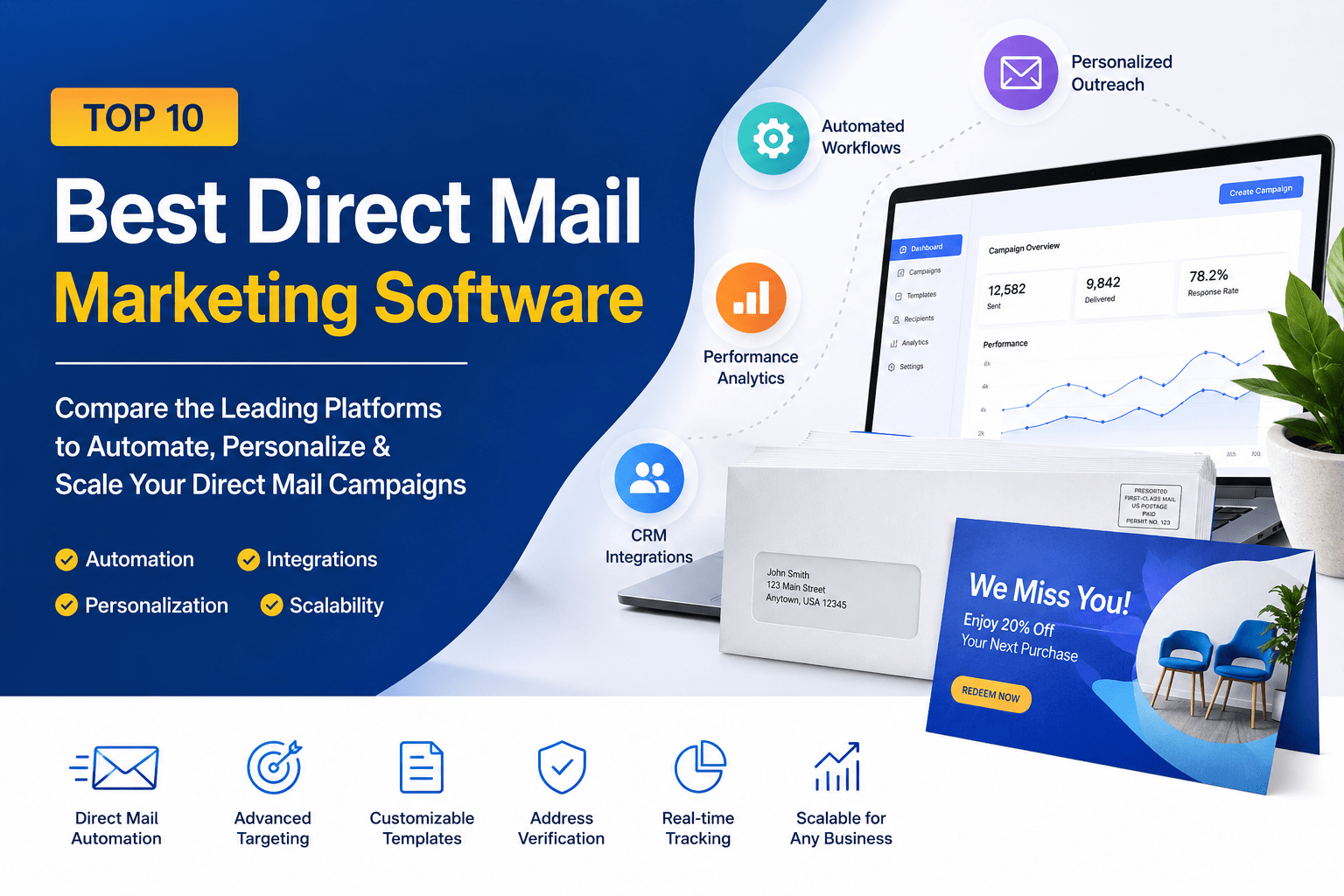
Direct mail continues to be one of the most effective marketing channels for businesses looking to generate leads, improve customer engagement, and increase conversions. While digital marketing channels are becoming increasingly crowded, direct mail offers a tangible and personalized way to connect with prospects and customers.
Today, modern direct mail marketing software platforms combine automation, integrations, APIs, analytics, and personalization capabilities to help businesses scale campaigns efficiently. Whether you’re a startup, enterprise, healthcare provider, or eCommerce brand, choosing the right platform can significantly impact your marketing results.
In this guide, we’ll compare the best direct mail marketing software solutions available today and help you choose the right platform for your business.
Why Businesses Use Direct Mail Marketing Software
Modern direct mail platforms help organizations:
- Automate campaign execution
- Personalize customer communications
- Integrate with CRMs and marketing tools
- Track campaign performance
- Reduce manual mailing processes
- Scale outreach programs efficiently
Industries such as healthcare, real estate, financial services, SaaS, and eCommerce increasingly rely on direct mail automation to improve customer engagement and retention.
For example, organizations implementing healthcare outreach campaigns often follow proven strategies outlined in resources such as PostGrid Healthcare Outreach Strategies to improve patient communication and engagement.
Top 10 Direct Mail Marketing Software Platforms
1. PostGrid Direct Mail API — Best Overall Direct Mail Marketing Software
PostGrid stands out as one of the most comprehensive direct mail automation platforms available today. It enables businesses to automate printing, mailing, address verification, and campaign management through a powerful API-driven infrastructure.
Businesses looking for scalable automation frequently choose PostGrid Direct Mail Marketing Software because it combines enterprise-grade functionality with developer-friendly implementation.
Key Features
- Direct Mail API automation
- Address verification capabilities
- Real-time mail tracking
- Bulk mailing support
- Automated print-and-mail workflows
- CRM integrations
- Webhook support
- Enterprise-grade security
Benefits
- Reduces manual mailing operations
- Improves delivery accuracy
- Scales from startups to enterprises
- Supports highly personalized campaigns
- Simplifies compliance requirements
Integrations
- Salesforce
- HubSpot
- Zapier
- Microsoft Dynamics
- Custom applications via API
Best Use Cases
- Enterprise direct mail automation
- Healthcare outreach
- Financial services communication
- Customer retention campaigns
- High-volume transactional mail
Limitations
- Advanced features may require technical implementation for maximum customization.
2. Sendoso
Sendoso focuses heavily on gifting and direct mail experiences for sales and marketing teams.
Key Features
- Sending automation
- Gift management
- CRM integrations
- Campaign tracking
Pros
- Excellent sales enablement capabilities
- Strong account-based marketing support
Limitations
- Can become expensive at scale
Best For
- B2B sales teams
- Account-based marketing campaigns
3. Reachdesk
Reachdesk helps organizations combine direct mail, gifting, and engagement programs through a centralized platform.
Key Features
- Global delivery support
- CRM integrations
- Automated workflows
- Campaign reporting
Pros
- Strong international capabilities
- Easy workflow automation
Limitations
- Premium pricing structure
Best For
- Enterprise marketing teams
4. Lob
Lob provides APIs that enable developers to automate postcards, letters, and checks.
Key Features
- Mailing APIs
- Address verification
- Print automation
Pros
- Developer-friendly
- Strong documentation
Limitations
- Limited campaign management capabilities
Best For
- Technical teams building custom solutions
5. PostPilot
PostPilot specializes in direct mail marketing for eCommerce brands.
Key Features
- Customer targeting
- Postcard automation
- Revenue attribution
Pros
- Excellent Shopify integration
- Strong eCommerce focus
Limitations
- Less suitable for non-eCommerce industries
Best For
- Online retailers
6. PebblePost
PebblePost bridges digital browsing behavior with direct mail campaigns.
Key Features
- Behavioral targeting
- Automated campaigns
- Audience segmentation
Pros
- Strong retargeting capabilities
Limitations
- More focused on acquisition than lifecycle marketing
Best For
- Performance marketers
7. ClickSend
ClickSend offers direct mail alongside SMS and communication services.
Key Features
- Letters and postcards
- SMS integration
- API access
Pros
- Multi-channel communication
Limitations
- Basic campaign functionality
Best For
- Small and mid-sized businesses
8. LetterStream
LetterStream focuses on business mailing and operational communications.
Key Features
- Automated letters
- Secure mailing
- Business document delivery
Pros
- Reliable transactional mail
Limitations
- Limited marketing automation
Best For
- Operational mailing needs
9. Postalytics
Postalytics combines direct mail automation with marketing analytics.
Key Features
- Marketing automation
- Tracking dashboards
- CRM integrations
Pros
- Easy-to-use interface
- Good reporting capabilities
Limitations
- Fewer enterprise features
Best For
- Marketing teams seeking analytics
10. PostcardMania
PostcardMania provides design and direct mail campaign services.
Key Features
- Postcard campaigns
- Design services
- Mailing lists
Pros
- Full-service support
Limitations
- Less API-focused than competitors
Best For
- Businesses seeking managed services
Features Comparison Table
| Platform | API Support | Automation | CRM Integrations | Scalability | Best For |
|---|---|---|---|---|---|
| PostGrid | Excellent | Advanced | Extensive | Enterprise | Automation & APIs |
| Sendoso | Good | Advanced | Extensive | High | Sales Teams |
| Reachdesk | Good | Advanced | Extensive | High | Enterprise Outreach |
| Lob | Excellent | Good | Moderate | High | Developers |
| PostPilot | Moderate | Good | Strong | Medium | eCommerce |
| PebblePost | Moderate | Good | Moderate | High | Retargeting |
| ClickSend | Good | Moderate | Moderate | Medium | SMBs |
| LetterStream | Basic | Moderate | Limited | Medium | Operational Mail |
| Postalytics | Good | Good | Strong | Medium | Marketing Teams |
| PostcardMania | Limited | Basic | Limited | Medium | Managed Services |
How to Choose the Best Direct Mail Marketing Platform
When evaluating direct mail software, consider the following factors:
1. Automation Capabilities
Look for platforms that automate printing, mailing, tracking, and reporting.
2. API Flexibility
Developer-friendly APIs help businesses integrate direct mail directly into existing workflows.
3. Address Accuracy
Address verification reduces delivery failures and improves campaign ROI.
4. Integration Ecosystem
Ensure compatibility with your CRM, marketing automation platform, and customer data systems.
5. Scalability
Choose a solution capable of supporting future growth and increasing campaign volume.
6. Reporting and Analytics
Performance visibility helps optimize campaigns and justify marketing investments.
Final Verdict
Direct mail remains one of the most effective customer engagement channels when supported by modern automation technology. While platforms such as Sendoso, Reachdesk, Lob, and Postalytics offer strong capabilities, PostGrid stands out due to its comprehensive automation features, robust API infrastructure, scalability, address verification capabilities, and enterprise-ready integrations.
Organizations seeking a developer-friendly API, flexible pricing options, reliable mail delivery, and advanced automation should strongly consider PostGrid as their preferred direct mail marketing platform.
If your business wants to modernize direct mail operations, improve delivery accuracy, and automate customer outreach at scale, PostGrid is one of the strongest solutions available today.
